Dry Eyes in Your 40s: When Hormones May Be One Clue
Dry eye can overlap with the menopause transition, but timing alone can’t tell you what’s causing it.
Hormones could be part of the picture: the eye’s tear-producing and oil-producing tissues are influenced by sex hormones. But dry eye by itself doesn’t establish perimenopause as the cause, and a meta-analysis of observational studies found no significant overall association between menopause and dry eye disease. Contact lenses, screen habits, dry air, health conditions, and medicines are also worth considering. 2 3
Dry, itchy, or unusually watery eyes in your 40s can arrive around the same time as other changes in your life. That timing may make a hormone link seem likely, but it isn’t enough to identify the cause. Dry eye has several possible contributors, and more than one can be involved at once. 1 3
What a hormone link can, and can’t, tell you
Sex hormones influence parts of the eye involved in maintaining the tear film, including tear-producing and oil-producing glands. That makes a hormone connection biologically plausible. But plausibility isn’t the same as proof that perimenopause caused a particular person’s symptoms. 2
A systematic review and meta-analysis of observational studies found no statistically significant overall association between menopause and dry eye disease. That result doesn’t rule out a hormone contribution for an individual; it does mean menopause status alone isn’t a reliable explanation. The review also noted that dry eye is multifactorial, with possible contributors ranging from eye and health conditions to everyday exposures. 3
So if symptoms start in your 40s, treat age and timing as context, not a diagnosis. It may help to notice whether symptoms change alongside other changes you associate with the menopause transition, but don’t use dry eye alone to decide that you’re perimenopausal or that hormones are responsible.
Check the everyday factors, too
A few details can help make sense of the pattern:
- Contact lenses: Note whether symptoms are more noticeable while wearing them or after a long day. Contact lens wear has been identified as a possible dry-eye risk factor in earlier research summarized by a systematic review. 3
- Screens and close work: Long stretches at a computer may be relevant. Taking breaks to rest your eyes is one practical self-care step recommended for dry eyes. 1 3
- Air and surroundings: Heating, air conditioning, wind, dry or dusty conditions, and smoke can contribute to dry-eye symptoms. 1
- Health and medicines: Some conditions, including blepharitis, Sjögren’s syndrome, and lupus, are associated with dry eyes. Medicines have also been studied as possible contributors, but the evidence summarized in the review is not consistent enough to pin symptoms on a particular medicine here. Note any recent medicine changes and discuss them with an eye-care professional or prescriber. Don’t stop a prescribed medicine on your own. 1 3
These possibilities aren’t a checklist for diagnosing yourself. They’re useful context because symptoms can have more than one explanation.
Try simple changes while you watch the pattern
If symptoms are mild, you can try taking screen breaks, keeping your screen just below eye level, and using a humidifier if the air is dry. If you wear contact lenses, giving your eyes a rest by wearing glasses may help. Warm, not hot, compresses around closed eyelids are another self-care option described for dry eyes. 1
Notice whether symptoms ease or persist, and whether they seem linked to lenses, screen time, or a particular environment. If you think a medicine may be involved, bring that up rather than stopping it without advice. These observations can help an eye-care professional consider possible causes; they can’t confirm a hormone explanation on their own.
When to get your eyes checked
Arrange an eye-care assessment if dry eyes continue after trying self-care for a few weeks, or if you notice a change in the shape of your eyelids. Seek prompt care for an eye injury, a very dark-red eye, or a red eye accompanied by a severe headache and nausea. 1
The useful takeaway is simple: a menopause-related hormone change is one possible piece of the picture, not the answer by itself. Looking at timing alongside lenses, screens, surroundings, medicines, and health conditions gives you a more grounded starting point.
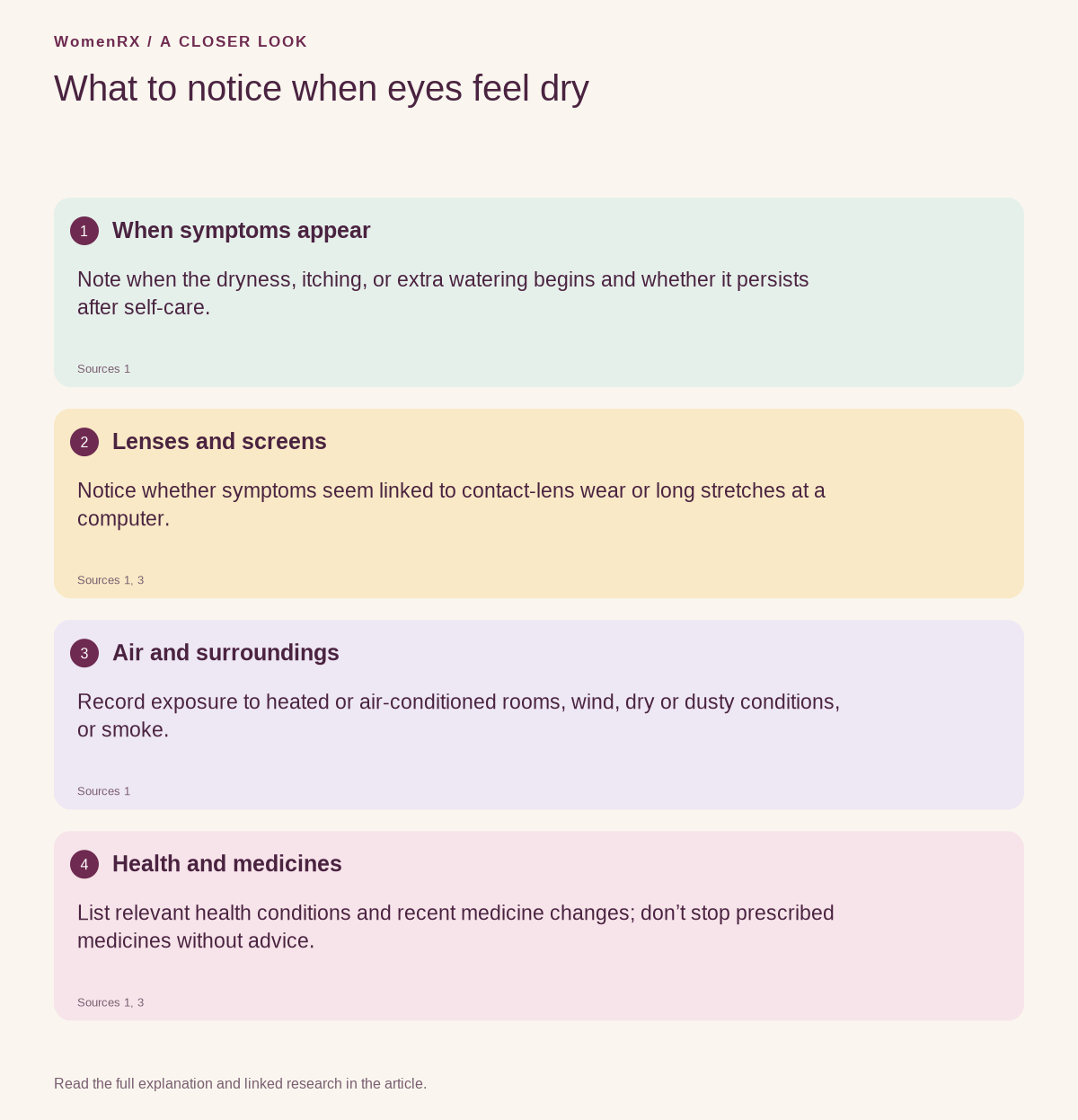
What to notice when eyes feel dry
When symptoms appear: Note when the dryness, itching, or extra watering begins and whether it persists after self-care.1
Lenses and screens: Notice whether symptoms seem linked to contact-lens wear or long stretches at a computer.13
Air and surroundings: Record exposure to heated or air-conditioned rooms, wind, dry or dusty conditions, or smoke.1
Health and medicines: List relevant health conditions and recent medicine changes; don’t stop prescribed medicines without advice.13
Read the figure as text
Record a few patterns to share with an eye-care professional. These observations can help frame a discussion, but they cannot diagnose a hormone cause.- When symptoms appear: Note when the dryness, itching, or extra watering begins and whether it persists after self-care.1
- Lenses and screens: Notice whether symptoms seem linked to contact-lens wear or long stretches at a computer.13
- Air and surroundings: Record exposure to heated or air-conditioned rooms, wind, dry or dusty conditions, or smoke.1
- Health and medicines: List relevant health conditions and recent medicine changes; don’t stop prescribed medicines without advice.13
More questions, answered
Should I stop a medicine if I think it’s causing dry eyes?
No. Don’t stop a prescribed medicine on your own. Make a note of the medicine and when your symptoms began, then discuss the possible connection with your prescriber or an eye-care professional. 1
Sources you can check
- Dry eyes - NHSAccessed 2026-09-25Return to first citation
- Comparative efficacy of Shatavari Ghrita eye drops with Shatavari Ksheerapaka versus Triphala Ghrita eye drops with Shatavari Ksheerapaka in postmenopausal ocular surface disease: a randomized, single-blind trial.Ashwini BN, Sivabalaji K, Bhutada R, Janardhanan RS. · Frontiers in medicine · 2026Return to first citation
- Association between potential factors and dry eye disease: A systematic review and meta-analysis.Yang K, Wu S, Ke L, Zhang H, Wan S, Lu M, Mao J, Gao Y, Yang Y, Xing Y, Yang W. · Medicine · 2024Return to first citation