Dry Eye and Menopause: What Hormones May Explain
Hormones can influence the tear film, but research hasn’t shown that menopause alone causes dry eye or that hormone therapy reliably treats it.
Hormones are one plausible part of the dry-eye picture: they may affect tear-producing glands and the oily layer that slows evaporation. But estrogen’s effects are mixed, and studies in postmenopausal women haven’t established that blood hormone levels explain symptoms. A small treatment trial also didn’t show a consistent benefit over placebo, so menopause may be relevant without being the whole explanation. 1 3 4
The tear film is more than water
Dry eye involves the tear film and the eye’s surface, not simply too few tears. The film includes a watery layer from the lacrimal glands, oil from the meibomian glands in the eyelids, and mucin from cells on the eye’s surface. If these parts don’t work together well, tears can become unstable and the eyes may feel dry or irritated. 2
Sex hormones may influence several parts of this system. Androgens, including testosterone, are thought to support lacrimal and meibomian gland function. Oil from the meibomian glands helps limit tear evaporation. Estrogen receptors are also present in eye-surface tissues, but estrogen’s effects on gland activity and inflammation are less clear. 1
That gives researchers a plausible way hormones might influence dryness. It doesn’t show that a particular hormone change causes an individual woman’s symptoms.
What midlife patterns can tell us
Reviews describe dry eye as more common in women and discuss it in perimenopausal and postmenopausal groups. Those patterns make hormones worth studying, but they don’t isolate menopause as the cause. Dry eye is multifactorial, and changes in the glands and other influences on the eye’s surface can also matter. 1 2
The hormone picture isn’t as simple as “less estrogen means less lubrication.” Androgens may support gland function, while estrogen’s effects on the meibomian glands and tear film remain uncertain. One review describes conflicting findings about estrogen and oil production from these glands. 1
A small cross-sectional study illustrates why blood hormone measurements and symptoms may not line up neatly. It included 46 postmenopausal women with dry eye who weren’t using hormone therapy. Higher blood estrogen was associated with poorer meibomian-gland secretion quality, but hormone levels did not significantly predict reported symptoms. Because researchers observed participants at one point in time, the study shows an association, not whether estrogen caused the gland changes or symptoms. 4
So, hormonal shifts could be one part of dry eye around menopause, but symptoms alone don’t establish a hormone cause. The evidence doesn’t support treating every case in midlife as hormone-driven. 1 2
Hormone therapy isn’t an established dry-eye treatment
Treatment evidence is limited. In a randomized, placebo-controlled pilot study, 40 postmenopausal women with dry eye were assigned to four groups of 10: testosterone, estrogen, a combination, or placebo. After eight weeks, dryness intensity was worse in the estrogen group than in the placebo group. The study found no significant changes versus placebo in other reported symptoms or measured tear and gland outcomes. 3
The combination group had an increase in tear secretion compared with its own starting measurement, but that within-group change doesn’t show that the combination worked better than placebo. With only 10 women per group and an eight-week follow-up, the trial can’t settle the question for all women or all hormone treatments. It does show why hormone therapy shouldn’t be treated as a dependable dry-eye remedy. 3
If dry, irritated eyes begin or worsen around menopause, the timing is useful context, not a diagnosis. Dry eye can involve tear production, evaporation, or more than one part of the tear film, so the hormone connection is only one possibility to consider. 2
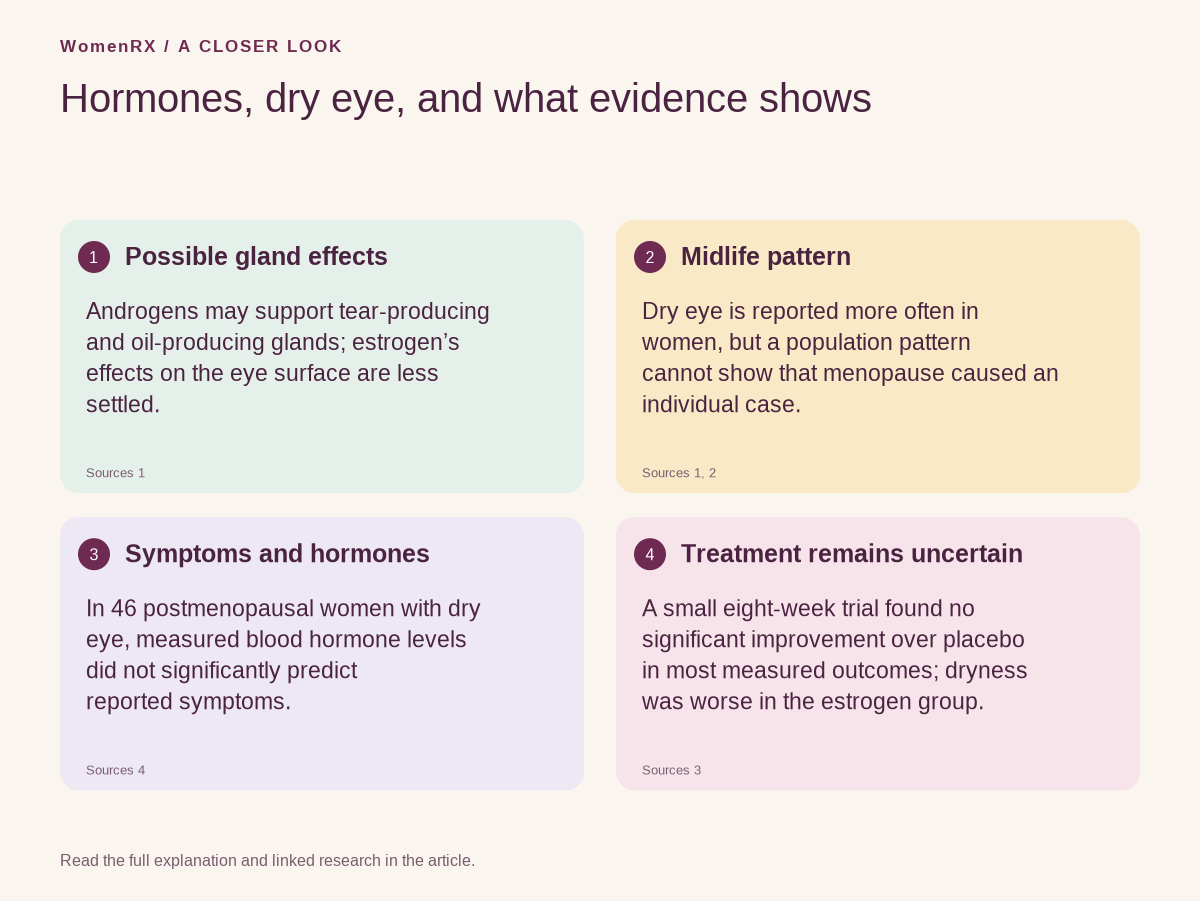
Hormones, dry eye, and what evidence shows
Possible gland effects: Androgens may support tear-producing and oil-producing glands; estrogen’s effects on the eye surface are less settled.1
Midlife pattern: Dry eye is reported more often in women, but a population pattern cannot show that menopause caused an individual case.12
Symptoms and hormones: In 46 postmenopausal women with dry eye, measured blood hormone levels did not significantly predict reported symptoms.4
Treatment remains uncertain: A small eight-week trial found no significant improvement over placebo in most measured outcomes; dryness was worse in the estrogen group.3
Read the figure as text
The evidence moves from plausible effects on the tear film to observed associations, but does not establish menopause as the cause or hormone therapy as a dependable treatment.- Possible gland effects: Androgens may support tear-producing and oil-producing glands; estrogen’s effects on the eye surface are less settled.1
- Midlife pattern: Dry eye is reported more often in women, but a population pattern cannot show that menopause caused an individual case.12
- Symptoms and hormones: In 46 postmenopausal women with dry eye, measured blood hormone levels did not significantly predict reported symptoms.4
- Treatment remains uncertain: A small eight-week trial found no significant improvement over placebo in most measured outcomes; dryness was worse in the estrogen group.3
More questions, answered
Does low estrogen automatically mean you’ll have dry eyes?
No. Estrogen’s effects on the eye surface aren’t settled, and in one study of postmenopausal women with dry eye, measured blood hormone levels did not significantly predict reported symptoms. Hormone levels alone don’t establish what is causing someone’s dry eye. 1 4
Does hormone therapy improve dry eye after menopause?
It hasn’t been shown to do so reliably. In a small eight-week trial, the hormone groups did not show significant improvements over placebo in most measured outcomes, and dryness was worse in the estrogen-only group. 3
Sources you can check
- Sex Differences in the Lacrimal Gland: Implications for Dry Eye Disease.Kaštelan S, Hat K, Tomić Z, Matejić T, Gotovac N. · International journal of molecular sciences · 2025Return to first citation
- Dry Eye Syndrome in Menopause and Perimenopausal Age Group.Peck T, Olsakovsky L, Aggarwal S. · Journal of mid-life health · 2017Return to first citation
- The effects of transdermal testosterone and oestrogen therapy on dry eye in postmenopausal women: a randomised, placebo-controlled, pilot study.Golebiowski B, Badarudin N, Eden J, Gerrand L, Robinson J, Liu J, Hampel U, You J, Stapleton F. · The British journal of ophthalmology · 2017Return to first citation
- Does endogenous serum oestrogen play a role in meibomian gland dysfunction in postmenopausal women with dry eye?Golebiowski B, Badarudin N, Eden J, You J, Hampel U, Stapleton F. · The British journal of ophthalmology · 2017Return to first citation