Recurrent UTIs and Menopause: What Hormones Can Explain
Lower estrogen may make the postmenopausal urinary and vaginal environment more vulnerable to repeat infections, but it’s only one possible contributor.
After menopause, lower estrogen can change the tissues and microbial environment around the vagina and urinary tract. Vaginal estrogen has reduced recurrent infections in clinical trials, so it may be a prevention option for some peri- and postmenopausal women. It doesn’t treat an infection that’s happening now, and hormones don’t explain every recurrence. Testing and individual risk factors still matter. 5 6

The menopause connection is real, but not complete
Estrogen levels fall during and after menopause. That shift can contribute to genitourinary changes such as vaginal dryness and irritation, and research links menopause with changes in the vaginal and urinary microbial environment. Studies have found lower Lactobacillus abundance and, in some research, higher vaginal pH after menopause. These changes offer a plausible way that estrogen loss could affect local defenses, but they don’t establish one single cause for recurrent infections. 3 5 7
That distinction matters: recurrent UTIs are common after menopause, but estrogen deficiency alone doesn’t explain why one woman has repeated infections while another doesn’t. Diabetes, bladder emptying problems, incontinence, catheter exposure, and other health or functional factors may also contribute. Recurrent UTIs also happen before menopause and need to be assessed in the context of your own health. 2 5
Prevention and treatment are different jobs
Vaginal estrogen is a prevention option to discuss if you’re peri- or postmenopausal and have recurrent, confirmed UTIs. A 2026 review of clinical trials reported fewer culture-confirmed recurrences with low-dose vaginal estrogen. A systematic review also found lower UTI rates in studies of vaginal estrogen. The evidence supports it as an option, not a guarantee, and it doesn’t show that one vaginal formulation is best. 6 8
The proposed benefit is local: vaginal estrogen acts in the vaginal area and may improve the local tissue and microbial environment. 5 6 It is not a treatment for bacteria causing an active bladder infection. If you have new symptoms such as burning when you urinate, a clinician can assess whether infection is likely and whether urine testing is needed; UTIs are treated with antibiotics. 2
Vaginal dryness, irritation, burning, urgency, or frequency can also occur with menopause-related genitourinary changes. Because some symptoms overlap, a sensation of burning by itself doesn’t establish that you have an infection. 2 A review of vaginal estrogen found improvement in some urinary symptoms as well as vaginal symptoms, which is another reason symptoms and infection shouldn’t be treated as interchangeable. 3 8
What to weigh with a clinician
If you’re considering vaginal estrogen, make the conversation specific: Are the episodes being confirmed as UTIs, and could menopause-related tissue changes be contributing? Would a local treatment fit your symptoms and health history? What should you do if symptoms return while using it?
Vaginal estrogen can be used in forms inserted into the vagina, including creams, tablets, and rings. It is intended for local menopause-related symptoms, and professional guidance supports low-dose vaginal estrogen for bothersome genitourinary symptoms in women who don’t need systemic hormone therapy. Whether it’s a reasonable UTI-prevention choice for you depends on your circumstances and preferences. 3 4
One evidence limit is worth keeping in view: trials support prevention, but the available review found no trial testing whether to start vaginal estrogen at the same time as antibiotics for an acute UTI. So it’s best understood as a separate prevention discussion, not an add-on that treats an infection in progress. 6
If you keep having symptoms after treatment, or infections keep returning, ask for a review rather than assuming hormones are the whole explanation. Recurrent UTI is commonly defined as at least two symptomatic episodes in six months or three in a year, though confirmation requirements vary across studies. 1 5
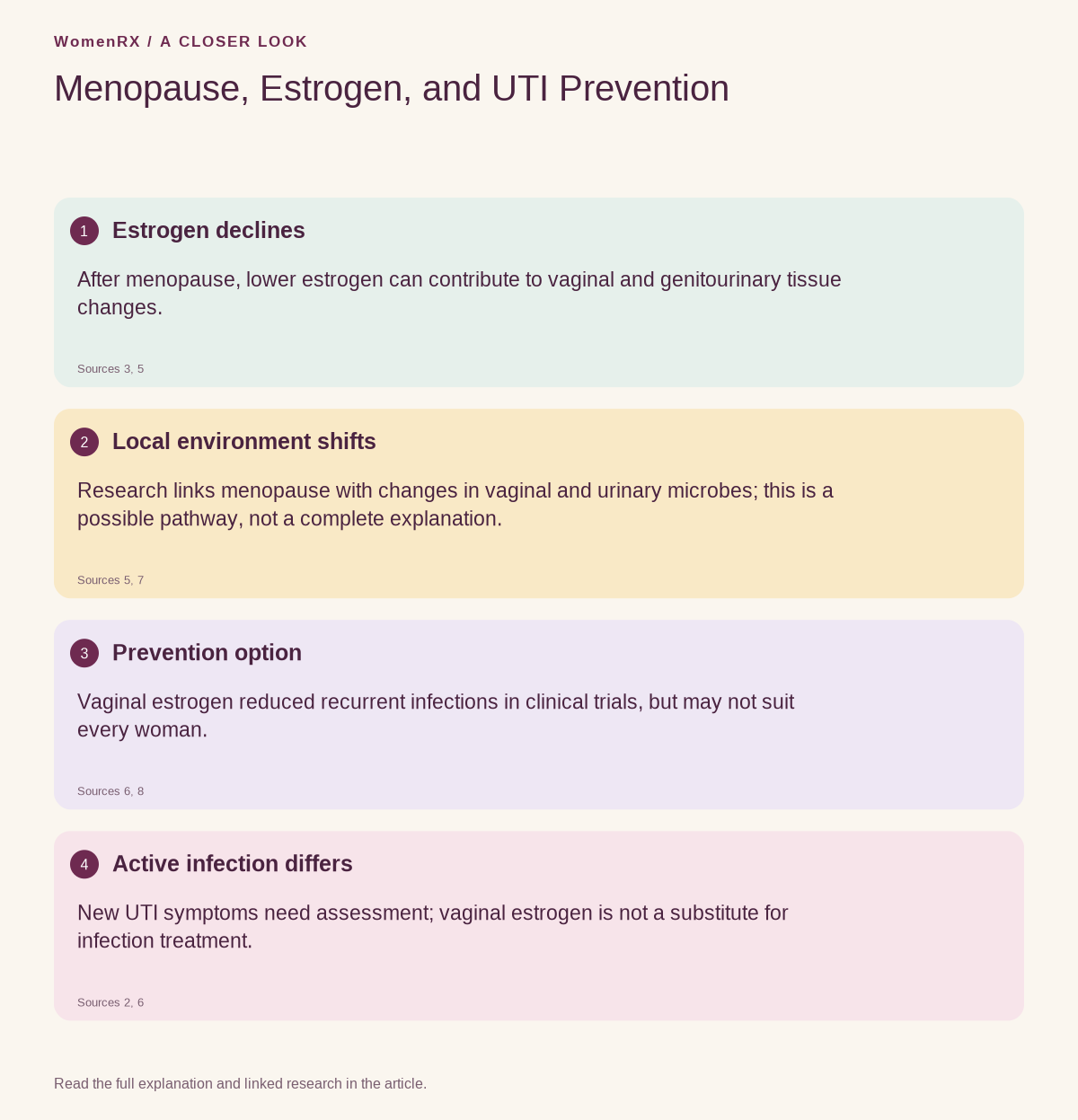
Menopause, Estrogen, and UTI Prevention
Estrogen declines: After menopause, lower estrogen can contribute to vaginal and genitourinary tissue changes.35
Local environment shifts: Research links menopause with changes in vaginal and urinary microbes; this is a possible pathway, not a complete explanation.57
Prevention option: Vaginal estrogen reduced recurrent infections in clinical trials, but may not suit every woman.68
Active infection differs: New UTI symptoms need assessment; vaginal estrogen is not a substitute for infection treatment.26
Read the figure as text
The pathway shows why vaginal estrogen may help prevent some recurrences while keeping prevention separate from treatment of an active infection.- Estrogen declines: After menopause, lower estrogen can contribute to vaginal and genitourinary tissue changes.35
- Local environment shifts: Research links menopause with changes in vaginal and urinary microbes; this is a possible pathway, not a complete explanation.57
- Prevention option: Vaginal estrogen reduced recurrent infections in clinical trials, but may not suit every woman.68
- Active infection differs: New UTI symptoms need assessment; vaginal estrogen is not a substitute for infection treatment.26
More questions, answered
Can vaginal estrogen clear a UTI I have now?
No. Vaginal estrogen is discussed as a way to help prevent future infections in some peri- and postmenopausal women. A suspected active UTI needs its own assessment and treatment plan. 2 6
Does having recurrent UTIs mean I need estrogen?
No. Menopause-related changes may be one contributor, but recurrent infections can have other explanations, including diabetes or problems emptying the bladder. Vaginal estrogen is one prevention option to discuss, not a universal answer. 2 5
Sources you can check
- Urinary tract infections (UTIs) - NHSAccessed 2026-09-25Return to first citation
- Urinary Tract Infections | UTI | UTI Symptoms | MedlinePlusAccessed 2026-09-25Return to first citation
- About vaginal oestrogen - NHSAccessed 2026-09-25Return to first citation
- The 2022 hormone therapy position statement of The North American Menopause Society.“The 2022 Hormone Therapy Position Statement of The North American Menopause Society” Advisory Panel. · Menopause (New York, N.Y.) · 2022Return to first citation
- The Urogenital Microbiome-Metabolic Interface in Postmenopausal Recurrent Urinary Tract Infection: Estrogen Deficiency, Diabetes, Obesity, and Microbial Reservoirs.Alghoul WI, Ashraf R, Rafiuddin S, Kharoufeh AZH, Al-Shammari WBJ, Abedi M, Alabid I, Patni MM, Yousef AJ, Hamdy HA. · Journal of clinical medicine · 2026Return to first citation
- Vaginal Estrogen for Urinary Tract Infection Prevention: A Narrative Review of Evidence, Guidelines, and Regulatory Gaps.Ghasoub R, Mackay W, Shepherd A. · Gynecologic and obstetric investigation · 2026Return to first citation
- Gut, vaginal, and urinary microbiome alterations in women with genitourinary syndrome of menopause: A systematic review.Tsuboi I, Inoue S, Hirayama T, Mitsui Y, Watanabe M, Hirakawa H, Sadahira T. · Maturitas · 2026Return to first citation
- Vaginal estrogen for genitourinary syndrome of menopause: a systematic review.Rahn DD, Carberry C, Sanses TV, Mamik MM, Ward RM, Meriwether KV, Olivera CK, Abed H, Balk EM, Murphy M, Society of Gynecologic Surgeons Systematic Review Group. · Obstetrics and gynecology · 2014Return to first citation