Recurrent UTIs After Menopause: When to Ask About Vaginal Estrogen
For postmenopausal people with repeated, documented UTIs, vaginal estrogen may help prevent another infection, but it won’t treat one that’s happening now.
If you’ve had repeated UTIs after menopause, ask whether low-dose vaginal estrogen could be part of prevention. Research reviews report fewer culture-confirmed recurrences with vaginal estrogen, though it doesn’t prevent every infection and studies haven’t established which formulation works best. It’s a prevention option, not treatment for active UTI symptoms; first make sure repeated symptoms are actually infections. 4
Why menopause can change urinary health
After menopause, lower estrogen can affect the tissues and local environment of the vagina and urinary tract. Studies have found changes such as less Lactobacillus dominance and higher vaginal pH, but these findings vary, and estrogen loss alone doesn’t explain who gets recurrent infections. The exact pathway is still being worked out. 3
This helps explain why vaginal estrogen is considered for prevention: it acts locally and may support urogenital tissue and the vaginal environment. That’s a plausible connection, not a guarantee that restoring one feature of the microbiome will stop infections. 235
What prevention research shows
A 2026 review of five randomized trials reported that low-dose vaginal estrogen reduced culture-confirmed recurrent UTI episodes in peri- and postmenopausal participants. The studies used different forms, including creams, tablets, rings, and gels. They did not directly compare the forms, so the evidence doesn’t show that one is best. 4
The evidence supports discussing vaginal estrogen as one prevention option, not expecting it to work for everyone. In one trial summarized by the review, estriol pessaries prevented fewer recurrences than antibiotic prophylaxis. That comparison doesn’t establish what’s best for you, but it’s a reminder that prevention options can have different benefits and tradeoffs. 4
Vaginal estrogen may also help vaginal dryness or irritation, which can occur alongside urinary symptoms after menopause. Improvement in those symptoms and prevention of a confirmed infection are related but separate goals. 26
First separate a UTI from similar symptoms
Burning, urgency, or frequent urination can happen with a UTI, but some urinary symptoms also occur with genitourinary syndrome of menopause. Those symptoms alone don’t confirm that bacteria are causing an infection. In the prevention trials summarized in the review, the outcomes were culture-confirmed recurrences. Ask whether your past episodes were supported by urine testing or culture, and whether a new episode needs testing. 46
If you have new symptoms now, seek assessment for an active UTI rather than relying on vaginal estrogen. The research reviewed initiation mainly as prevention or after antibiotic treatment, and did not test starting it alongside antibiotics when an acute infection begins. Vaginal estrogen should not be treated as an acute infection treatment. 14
Make the conversation specific to your history
Before the visit, gather what you know about your recent episodes: when they happened, what symptoms you had, whether urine cultures were done, and what treatment was used. This can help distinguish repeated infections from recurring symptoms that need a different explanation.
Useful questions include:
- Were my episodes confirmed UTIs, or could menopause-related tissue changes explain some of the symptoms?
- Would vaginal estrogen be reasonable for prevention in my situation, and what benefit should I realistically expect?
- Which form might suit me, and what are the tradeoffs? Research has not established that one form prevents UTIs better than another. 4
- What parts of my health history or medicines should we review before choosing a vaginal estrogen product?
- If vaginal estrogen isn’t a fit or isn’t enough, what other prevention approach makes sense for my recurrence pattern?
The goal is a plan based on confirmed infections, your symptoms, and your health history, rather than treating every episode of urinary discomfort as the same problem.
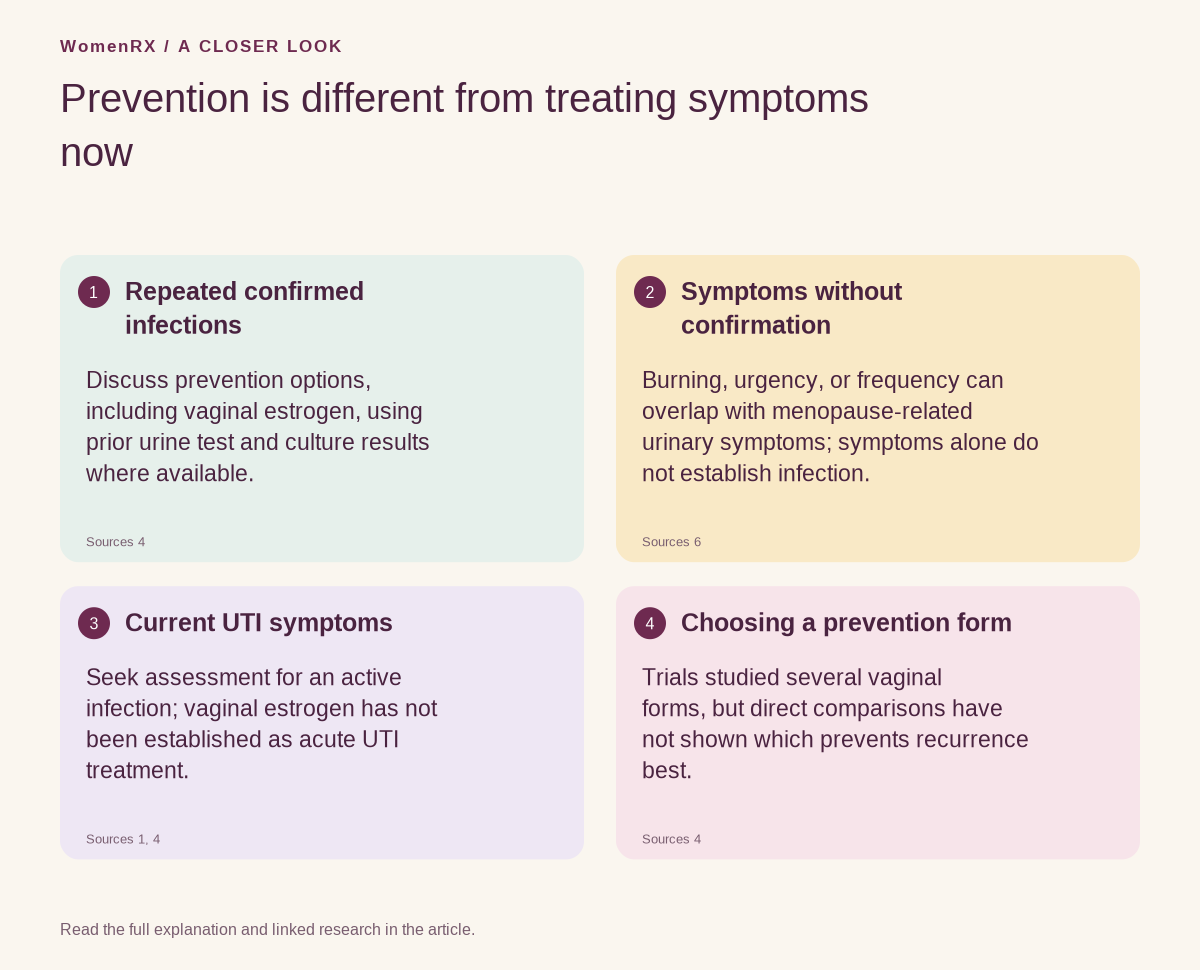
Prevention is different from treating symptoms now
Repeated confirmed infections: Discuss prevention options, including vaginal estrogen, using prior urine test and culture results where available.4
Symptoms without confirmation: Burning, urgency, or frequency can overlap with menopause-related urinary symptoms; symptoms alone do not establish infection.6
Current UTI symptoms: Seek assessment for an active infection; vaginal estrogen has not been established as acute UTI treatment.14
Choosing a prevention form: Trials studied several vaginal forms, but direct comparisons have not shown which prevents recurrence best.4
Read the figure as text
This comparison separates evidence for preventing confirmed recurrences from the assessment needed when urinary symptoms are present.- Repeated confirmed infections: Discuss prevention options, including vaginal estrogen, using prior urine test and culture results where available.4
- Symptoms without confirmation: Burning, urgency, or frequency can overlap with menopause-related urinary symptoms; symptoms alone do not establish infection.6
- Current UTI symptoms: Seek assessment for an active infection; vaginal estrogen has not been established as acute UTI treatment.14
- Choosing a prevention form: Trials studied several vaginal forms, but direct comparisons have not shown which prevents recurrence best.4
More questions, answered
Can vaginal estrogen treat a UTI that has already started?
No. It’s considered for prevention, not as treatment for an active infection. Current urinary symptoms need their own assessment and, if a UTI is confirmed, appropriate treatment. Trials reviewed so far did not test starting vaginal estrogen at the onset of an acute UTI. 14
Does vaginal estrogen prevent every UTI?
No. Research reviews report fewer recurrences, but prevention isn’t guaranteed, and menopause-related estrogen loss is only one factor linked with recurrent UTIs. 34
Sources you can check
- Urinary tract infections (UTIs) - NHSAccessed 2026-09-25Return to first citation
- About vaginal oestrogen - NHSAccessed 2026-09-25Return to first citation
- The Urogenital Microbiome-Metabolic Interface in Postmenopausal Recurrent Urinary Tract Infection: Estrogen Deficiency, Diabetes, Obesity, and Microbial Reservoirs.Alghoul WI, Ashraf R, Rafiuddin S, Kharoufeh AZH, Al-Shammari WBJ, Abedi M, Alabid I, Patni MM, Yousef AJ, Hamdy HA. · Journal of clinical medicine · 2026Return to first citation
- Vaginal Estrogen for Urinary Tract Infection Prevention: A Narrative Review of Evidence, Guidelines, and Regulatory Gaps.Ghasoub R, Mackay W, Shepherd A. · Gynecologic and obstetric investigation · 2026Return to first citation
- Gut, vaginal, and urinary microbiome alterations in women with genitourinary syndrome of menopause: A systematic review.Tsuboi I, Inoue S, Hirayama T, Mitsui Y, Watanabe M, Hirakawa H, Sadahira T. · Maturitas · 2026Return to first citation
- Vaginal estrogen for genitourinary syndrome of menopause: a systematic review.Rahn DD, Carberry C, Sanses TV, Mamik MM, Ward RM, Meriwether KV, Olivera CK, Abed H, Balk EM, Murphy M, Society of Gynecologic Surgeons Systematic Review Group. · Obstetrics and gynecology · 2014Return to first citation