Do Hormonal Changes Affect Recurrent UTIs?
After menopause, lower estrogen may make the urinary and vaginal environment more vulnerable to infection, but it’s one possible factor, not a complete explanation.
Yes, hormonal changes may contribute to recurrent UTIs, particularly after menopause. Lower estrogen can change the vaginal and urinary environment, and clinical trials have found that vaginal estrogen can reduce culture-confirmed recurrences in peri- and postmenopausal women. That evidence is about vaginal estrogen, not systemic hormone therapy, and it doesn’t mean every episode of urinary discomfort is a bacterial infection. 4 5
The hormone connection is plausible, and there’s clinical evidence
Estrogen helps maintain tissues in and around the vagina and urinary tract. After menopause, lower estrogen is associated with changes in the vaginal environment, including less Lactobacillus bacteria and a higher vaginal pH. These shifts may make it easier for potentially harmful bacteria to take hold. But estrogen loss isn’t the only factor: recurrence varies among women, and other health or bladder factors can contribute too. 4 7
There’s also evidence beyond the proposed biology. A review of five randomized trials reported fewer culture-confirmed UTIs with low-dose vaginal estrogen in peri- and postmenopausal women. The trials used different vaginal forms, and the review found no direct comparisons showing that one form works better than another. 5
That’s a reason to discuss vaginal estrogen as one possible prevention option, especially after menopause. It isn’t proof that hormones explain every recurrence, or that estrogen will prevent infections for every woman. This evidence concerns estrogen used vaginally; it shouldn’t be treated as evidence that systemic hormone therapy prevents UTIs. 4 5
Discomfort isn’t always a bacterial UTI
Menopause-related vaginal changes can cause dryness and irritation, and genitourinary syndrome of menopause can also involve urinary symptoms. Those symptoms may resemble an infection, while UTI symptoms can overlap with other conditions. So repeated burning, urgency, or discomfort doesn’t by itself establish that each episode is a bacterial UTI. When symptoms keep returning, whether urine cultures have confirmed infection is a useful part of the conversation. 1 2 6
Recurrent UTI is often defined as at least two symptomatic episodes in six months or three in a year, although studies differ in how they require infection to be confirmed. A pattern of persistent symptoms with no infection found may call for a different explanation than repeated, confirmed bacterial infections. 1 4
What the evidence can, and can’t, tell you
The prevention findings support asking about vaginal estrogen, not assuming it is the right choice for everyone. One trial summarized in a 2026 review found estriol pessaries less effective than antibiotic prevention. That doesn’t show that all vaginal estrogen forms are less effective than antibiotics; the review found no head-to-head trials comparing estrogen formulations. 5
The evidence is also not equally detailed across menopause stages. Reviews include peri- and postmenopausal women, but the available trial summary doesn’t give separate results for each stage. The evidence for altered urogenital conditions and recurrence is especially focused on postmenopausal women, so it’s harder to say how much the same findings apply during perimenopause. 4 5
A useful conversation about prevention
If you’re weighing options, you might ask:
- Have my recurring episodes been confirmed as UTIs, and were cultures done?
- Could vaginal dryness, irritation, or another cause be contributing to symptoms?
- Given my menopause stage and symptoms, is vaginal estrogen a reasonable prevention option for me?
- How does that option compare with other approaches, including antibiotic prevention?
Vaginal estrogen is also used for menopause-related vaginal dryness and irritation. It acts locally, with little of the medicine reaching the rest of the body, and may take time to improve those symptoms. That’s a different goal from treating an active bacterial infection, which may need separate assessment and treatment. 2 3 1
The practical takeaway: hormones can be part of the picture, particularly after menopause, and vaginal estrogen has trial evidence for prevention. But persistent urinary symptoms deserve a closer look rather than being automatically labeled another infection.
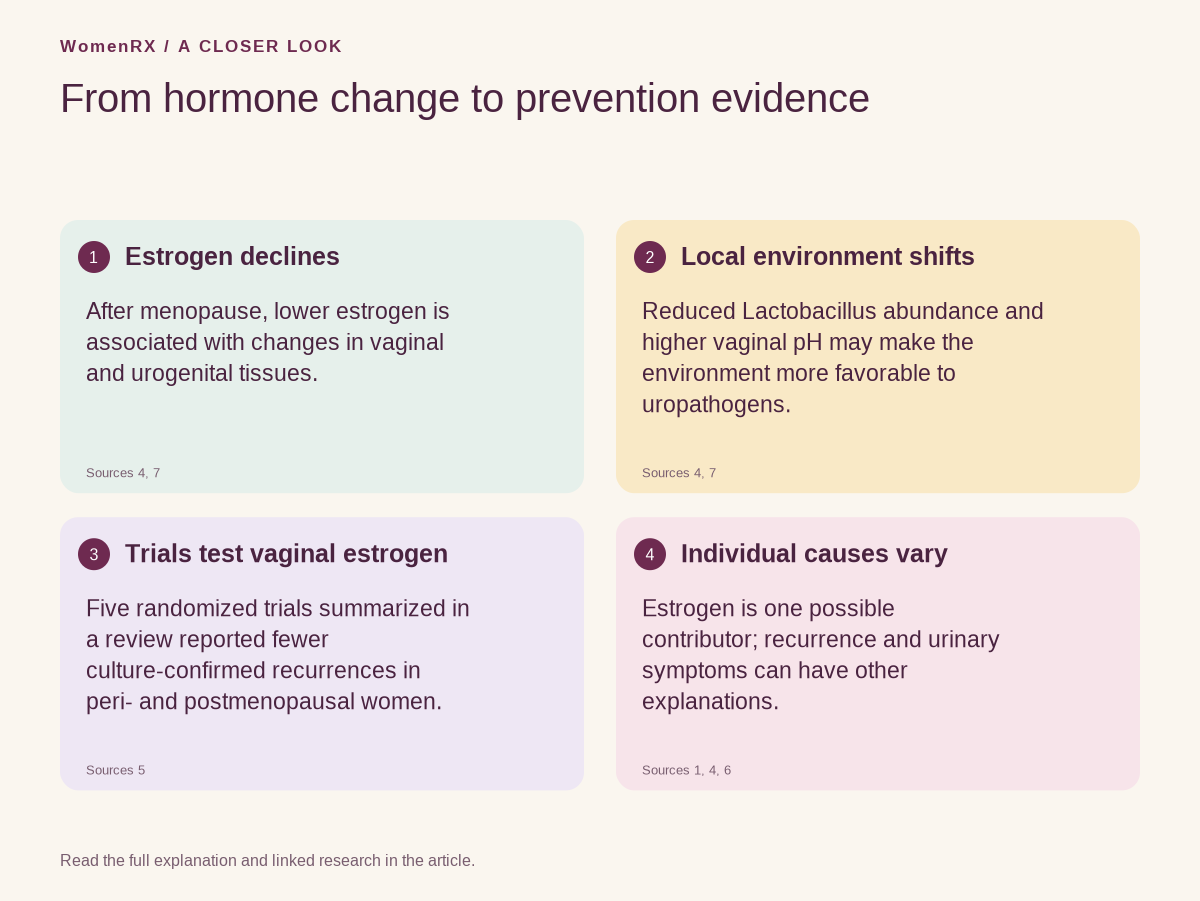
From hormone change to prevention evidence
Estrogen declines: After menopause, lower estrogen is associated with changes in vaginal and urogenital tissues.47
Local environment shifts: Reduced Lactobacillus abundance and higher vaginal pH may make the environment more favorable to uropathogens.47
Trials test vaginal estrogen: Five randomized trials summarized in a review reported fewer culture-confirmed recurrences in peri- and postmenopausal women.5
Individual causes vary: Estrogen is one possible contributor; recurrence and urinary symptoms can have other explanations.146
Read the figure as text
The proposed pathway helps explain why vaginal estrogen is studied, while the trial findings show what can reasonably be concluded.- Estrogen declines: After menopause, lower estrogen is associated with changes in vaginal and urogenital tissues.47
- Local environment shifts: Reduced Lactobacillus abundance and higher vaginal pH may make the environment more favorable to uropathogens.47
- Trials test vaginal estrogen: Five randomized trials summarized in a review reported fewer culture-confirmed recurrences in peri- and postmenopausal women.5
- Individual causes vary: Estrogen is one possible contributor; recurrence and urinary symptoms can have other explanations.146
More questions, answered
Does systemic hormone therapy prevent recurrent UTIs?
The prevention trials summarized here evaluated vaginal estrogen. They don’t establish that systemic hormone therapy prevents recurrent UTIs, so the two shouldn’t be treated as interchangeable evidence. 5
Sources you can check
- Urinary tract infections (UTIs) - NHSAccessed 2026-09-25Return to first citation
- About vaginal oestrogen - NHSAccessed 2026-09-25Return to first citation
- Common questions about vaginal oestrogen - NHSAccessed 2026-09-25Return to first citation
- The Urogenital Microbiome-Metabolic Interface in Postmenopausal Recurrent Urinary Tract Infection: Estrogen Deficiency, Diabetes, Obesity, and Microbial Reservoirs.Alghoul WI, Ashraf R, Rafiuddin S, Kharoufeh AZH, Al-Shammari WBJ, Abedi M, Alabid I, Patni MM, Yousef AJ, Hamdy HA. · Journal of clinical medicine · 2026Return to first citation
- Vaginal Estrogen for Urinary Tract Infection Prevention: A Narrative Review of Evidence, Guidelines, and Regulatory Gaps.Ghasoub R, Mackay W, Shepherd A. · Gynecologic and obstetric investigation · 2026Return to first citation
- Gut, vaginal, and urinary microbiome alterations in women with genitourinary syndrome of menopause: A systematic review.Tsuboi I, Inoue S, Hirayama T, Mitsui Y, Watanabe M, Hirakawa H, Sadahira T. · Maturitas · 2026Return to first citation
- Bioactive Compounds in Natural Remedies and Functional Foods for Managing Recurrent Urinary Tract Infections in Postmenopausal Women.Chamodini K, Samarasingha S, Didulanga K, Jayasekara C. · Journal of menopausal medicine · 2025Return to first citation