Repeated UTIs After Menopause: How to Find the Right Plan
A useful prevention plan starts by confirming that repeated symptoms are bacterial infections, then matching prevention to what may be driving them.
Two UTIs in six months or three in a year is a common threshold for seeking an assessment, but the count alone doesn’t explain why symptoms keep returning. Ask whether episodes should be confirmed with urine testing and review possible contributors, including menopause-related vaginal symptoms and trouble emptying the bladder. Prevention may involve vaginal estrogen, methenamine, or antibiotics, depending on your health and infection pattern. 1 3
After menopause, repeated urinary symptoms deserve a plan that looks beyond the number of episodes. The first step is to check whether each suspected episode is actually a bacterial UTI. Then you and your clinician can consider what might be contributing and compare prevention options. The right choice can vary with your symptoms, medical history, kidney function, and preferences.
Start with what happened during each episode
A commonly used threshold for recurrent UTI is two infections in six months or three in a year. Reaching that threshold is a reason to seek assessment, not proof of a particular cause or a signal that one preventive treatment is right for everyone. 1 3
It can help to bring a brief record of each episode: when symptoms started, what they felt like, whether a urine test or culture was done, what treatment was used, and whether symptoms cleared or returned. Note any pattern you’ve noticed, such as symptoms after sex, or ongoing vaginal dryness or irritation. These details can help clarify whether episodes are separate infections or whether urinary symptoms are persisting for another reason.
Ask whether urine culture is appropriate when symptoms recur. Confirming bacterial infections matters because urinary symptoms with negative cultures can be mistaken for recurrent UTI; repeated symptoms may have noninfectious causes. 3 A urine test isn’t needed in every suspected UTI, so the clinician can decide what testing fits the episode and your history. 1
Look for a pattern, not just a tally
The same recurrence label can describe different situations. Menopause-related low estrogen, symptoms that tend to follow sex, low fluid intake, difficulty emptying the bladder, a persistent source of infection, and urinary symptoms without bacterial infection are among the possible patterns discussed in recurrent UTI care. 3 These possibilities don’t mean you caused the infections; they help make prevention more specific.
For example, if urine cultures confirm infections and symptoms of vaginal dryness or irritation are also present, local vaginal estrogen may be worth discussing. If infections repeatedly follow sex, mention that timing so the prevention conversation can take it into account. If symptoms persist despite treatment or cultures do not confirm infection, ask whether another explanation needs evaluation rather than assuming another antibiotic is the answer. 1 3
Compare prevention options by their tradeoffs
Vaginal estrogen is one option to discuss after menopause, particularly if you also have vaginal dryness or irritation. A review focused on postmenopausal women describes topical estrogen as an option for preventing recurrent UTIs. 4 Separately, the North American Menopause Society recommends low-dose vaginal estrogen for bothersome genitourinary symptoms of menopause that haven’t improved with over-the-counter therapies. That recommendation is for those symptoms, so it shouldn’t be confused with a guarantee that estrogen will prevent every UTI. 2 Your clinician can weigh your symptoms and health history when discussing whether it fits.
Methenamine hippurate may offer an antibiotic-sparing prevention choice for some women. An editorial summarizing the ALTAR randomized non-inferiority trial reports preventive efficacy comparable to daily low-dose antibiotic prophylaxis among women with recurrent UTI. That supports discussing methenamine as an option, but it doesn’t establish that it suits every person or every kind of recurrent infection. 3
Preventive antibiotics can be useful for selected people with frequent, burdensome, culture-confirmed infections. The tradeoff is ongoing antibiotic exposure, including concern about resistance. The decision should account for prior urine results and your individual circumstances, rather than following from the recurrence count alone. 3 If antibiotics are part of a plan, ask how the plan will be reviewed and what should happen if symptoms return.
Make a follow-up plan before you leave
Agree on what to do if symptoms continue after treatment or return soon afterward. Persistent symptoms can mean the infection needs reassessment, or that a different cause needs consideration; ongoing symptoms after UTI treatment are a reason to seek further evaluation. 1 3
A practical plan should cover how future episodes will be assessed, which prevention option you’re trying and why, and when you’ll revisit whether it’s helping. That turns “I keep getting UTIs” into a more useful question: “What evidence do we have that these are infections, and which pattern are we trying to prevent?”
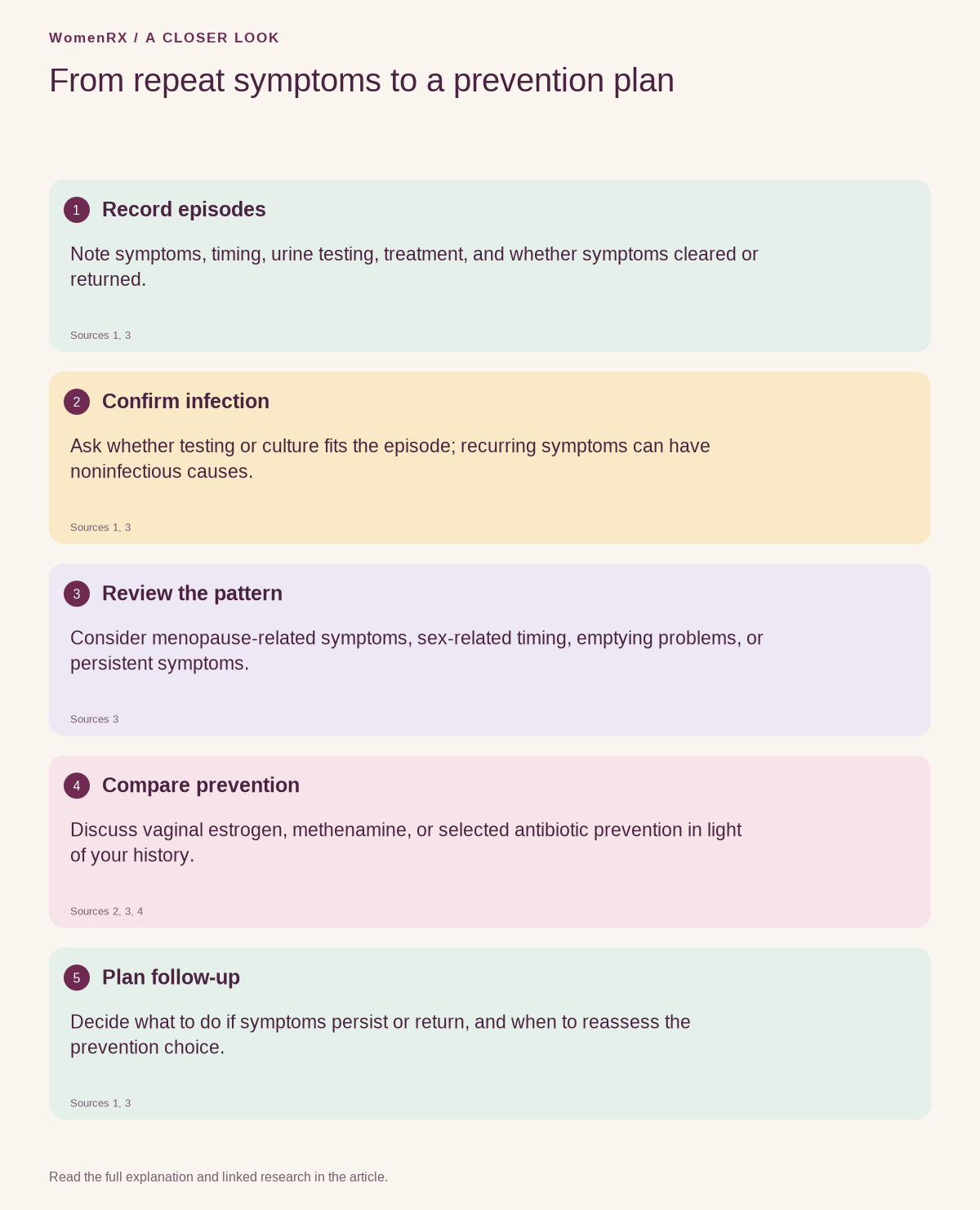
From repeat symptoms to a prevention plan
Record episodes: Note symptoms, timing, urine testing, treatment, and whether symptoms cleared or returned.13
Confirm infection: Ask whether testing or culture fits the episode; recurring symptoms can have noninfectious causes.13
Review the pattern: Consider menopause-related symptoms, sex-related timing, emptying problems, or persistent symptoms.3
Compare prevention: Discuss vaginal estrogen, methenamine, or selected antibiotic prevention in light of your history.234
Plan follow-up: Decide what to do if symptoms persist or return, and when to reassess the prevention choice.13
Read the figure as text
A practical sequence for sorting out repeated urinary symptoms before choosing prevention.- Record episodes: Note symptoms, timing, urine testing, treatment, and whether symptoms cleared or returned.13
- Confirm infection: Ask whether testing or culture fits the episode; recurring symptoms can have noninfectious causes.13
- Review the pattern: Consider menopause-related symptoms, sex-related timing, emptying problems, or persistent symptoms.3
- Compare prevention: Discuss vaginal estrogen, methenamine, or selected antibiotic prevention in light of your history.234
- Plan follow-up: Decide what to do if symptoms persist or return, and when to reassess the prevention choice.13
More questions, answered
Does reaching the recurrent UTI threshold mean I need preventive antibiotics?
No. The recurrence threshold helps identify when assessment is useful; it doesn’t determine the cause or select a treatment. Prevention can include other options, and antibiotics are generally considered for selected people after the infection pattern and personal factors are reviewed. 1 3
Sources you can check
- Urinary tract infections (UTIs) - NHSAccessed 2026-09-25Return to first citation
- The 2022 hormone therapy position statement of The North American Menopause Society.“The 2022 Hormone Therapy Position Statement of The North American Menopause Society” Advisory Panel. · Menopause (New York, N.Y.) · 2022Return to first citation
- Recurrent urinary tract infection is not one disease: moving from antibiotic suppression to phenotype-guided prevention.Ahmad B, Khan K. · Annals of medicine and surgery (2012) · 2026Return to first citation
- The role of estrogen in prevention of recurrent urinary tract infections in postmenopausal women.Wiese E, Amjad A, Bartoli G, Beyzarov M, Gigliotti S, Hanna C, Myers O, Galarza C, Adler J. · JAAPA : official journal of the American Academy of Physician Assistants · 2026Return to first citation