Repeated UTIs After Menopause: What to Check and Discuss
A recurrence count can guide the conversation, but first separate confirmed infections from urinary discomfort that may have another cause.
Two UTIs in six months or three in 12 months is a common threshold for seeking a recurrence review, not proof that every episode was bacterial. If you’re 65 or older and suspect a UTI, seek prompt assessment rather than waiting for another episode. Bring dates, urine-test or culture results, and treatment history; then discuss whether menopause-related symptoms or prevention options such as vaginal estrogen fit your situation. 15
Don’t wait for a recurrence count if you’re 65 or older
If you’re 65 or older and think you may have a UTI, seek prompt clinical assessment rather than waiting for symptoms to happen again or for a recurrence threshold. 1
For a longer-term pattern, two UTIs in six months or three in 12 months is a commonly used threshold for seeking review. It’s a useful signal to look at the pattern, not a rule that proves every bout of burning or discomfort was an infection. 1
Check what each episode showed
Urinary discomfort can resemble symptoms from other conditions, and recurring symptoms can be difficult to diagnose. A urine test may be part of an assessment, though testing isn’t always needed. Keep any test or culture results you have, and ask whether testing could help clarify a future episode. 15
That distinction matters: several confirmed infections call for a different prevention conversation than repeated discomfort without clear evidence of infection. A 2026 editorial argues that recurrent UTI is not one uniform condition; it describes different possible drivers, including postmenopausal changes and noninfectious urinary symptoms. That’s a proposed approach, not a clinical trial demonstrating which prevention will work for an individual. 5
Make a short episode timeline
For each episode, jot down:
- When symptoms started and what you noticed.
- Whether a urine test or culture was done, and the result if you have it.
- What treatment you received, if any, and whether symptoms improved or returned.
- Whether you also noticed vaginal dryness or irritation, leakage, or trouble emptying your bladder.
- Relevant health history, such as diabetes or difficulty emptying your bladder.
You don’t need to decide what caused the symptoms before an appointment. This record helps show which episodes were tested, how they changed over time, and what else may be relevant. In a large retrospective study of women prescribed vaginal estrogen, urinary retention, incontinence, diabetes, older age, and more UTIs before treatment were associated with more UTIs afterward. Those associations don’t show that any one factor caused an individual’s infections, but they’re useful context to share. 6
Where menopause and vaginal estrogen fit
Menopause-related changes can include vaginal dryness and irritation. If you have these symptoms alongside urinary discomfort, mention them; they may be relevant to the discussion, but they don’t by themselves confirm a UTI. 23
Vaginal estrogen is one option to ask about, particularly if menopause-related vaginal symptoms are part of the picture. The North American Menopause Society recommends low-dose vaginal estrogen or other therapies for bothersome genitourinary symptoms that haven’t improved with over-the-counter options, for women without an indication for systemic hormone therapy. That recommendation is about genitourinary symptoms; it doesn’t mean vaginal estrogen is automatically the right UTI-prevention choice for everyone. 3
There is also research specifically on UTI prevention, though the findings apply to the populations and treatments studied. In a 24-week randomized trial of 108 postmenopausal women with genitourinary syndrome of menopause, the group using estriol gel had 32.34 new UTIs per 100 women-years, compared with 43.76 in the moisturizing-gel group. That was a 26% lower incidence rate in the estriol group. The trial tested a specific gel in a specific group, so it can’t establish the same effect for every product or person. 4
A separate retrospective study followed 5,638 women prescribed vaginal estrogen for recurrent UTI prevention. Their average UTI frequency was 3.9 in the year before the prescription and 1.8 in the year after. Because this was a before-and-after study, not a randomized comparison, the decrease doesn’t prove that estrogen caused the full change. 6
Shape the prevention discussion around your pattern
If infections have been confirmed, ask which prevention options match your symptoms and health history. You might ask: “Which episodes were confirmed by testing?” “Could menopause-related vaginal symptoms be contributing?” and “What are the likely benefits and tradeoffs of vaginal estrogen or another approach for me?”
Vaginal estrogen is used locally for menopause-related vaginal symptoms, and hormone-therapy guidance calls for individualizing treatment. The decision is best made in the context of your symptoms, health history, and preferences, rather than treating every recurrence as the same problem. 23
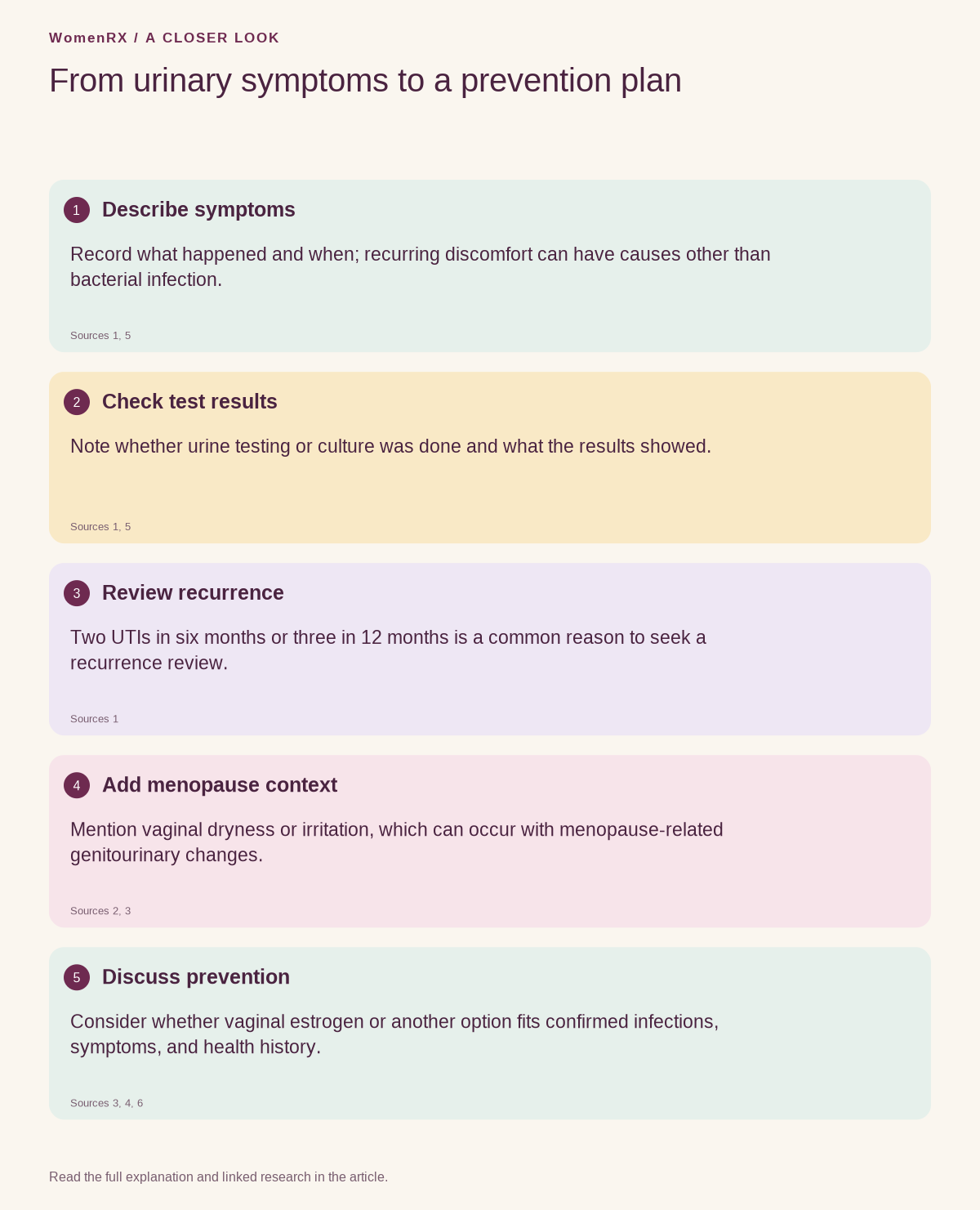
From urinary symptoms to a prevention plan
Describe symptoms: Record what happened and when; recurring discomfort can have causes other than bacterial infection.15
Check test results: Note whether urine testing or culture was done and what the results showed.15
Review recurrence: Two UTIs in six months or three in 12 months is a common reason to seek a recurrence review.1
Add menopause context: Mention vaginal dryness or irritation, which can occur with menopause-related genitourinary changes.23
Discuss prevention: Consider whether vaginal estrogen or another option fits confirmed infections, symptoms, and health history.346
Read the figure as text
Keep symptom assessment, infection confirmation, recurrence history, and prevention decisions separate.- Describe symptoms: Record what happened and when; recurring discomfort can have causes other than bacterial infection.15
- Check test results: Note whether urine testing or culture was done and what the results showed.15
- Review recurrence: Two UTIs in six months or three in 12 months is a common reason to seek a recurrence review.1
- Add menopause context: Mention vaginal dryness or irritation, which can occur with menopause-related genitourinary changes.23
- Discuss prevention: Consider whether vaginal estrogen or another option fits confirmed infections, symptoms, and health history.346
More questions, answered
Does the recurrence threshold mean every episode must be confirmed by a culture?
The threshold describes how often episodes occur; it doesn’t establish what caused them. The guidance says a urine test may be part of an assessment but isn’t always needed. Keep available test or culture results and ask whether testing is useful for your situation. 1
Sources you can check
- Urinary tract infections (UTIs) - NHSAccessed 2026-09-25Return to first citation
- About vaginal oestrogen - NHSAccessed 2026-09-25Return to first citation
- The 2022 hormone therapy position statement of The North American Menopause Society.“The 2022 Hormone Therapy Position Statement of The North American Menopause Society” Advisory Panel. · Menopause (New York, N.Y.) · 2022Return to first citation
- Efficacy and safety of an ultra-low-dose 0.005 % estriol vaginal gel in the prevention of urinary tract infections in postmenopausal women with genitourinary syndrome of menopause: A randomized double-blind placebo-controlled trial.Muiños Fernández N, Martínez Salamanca JI, Pardo González de Quevedo JI, Diz Morales MP, Palomo Alameda L, Duce Tello S, González Béjar M, Rabanal Carrera A, Rosado Martín J, Nogue... · Maturitas · 2024Return to first citation
- Recurrent urinary tract infection is not one disease: moving from antibiotic suppression to phenotype-guided prevention.Ahmad B, Khan K. · Annals of medicine and surgery (2012) · 2026Return to first citation
- Efficacy of vaginal estrogen for recurrent urinary tract infection prevention in hypoestrogenic women.Tan-Kim J, Shah NM, Do D, Menefee SA. · American journal of obstetrics and gynecology · 2023Return to first citation