Recurrent UTIs After Menopause: What to Check First
When urinary symptoms keep returning, confirming infection helps you choose prevention that fits the cause.
Repeated burning or urgency after menopause isn’t always a new UTI. If infections keep returning, urine testing during symptomatic episodes can help distinguish bacterial infection from menopause-related irritation or other causes. Fever, shivering, or pain in your back or side below the ribs needs prompt medical attention. For confirmed recurrent UTIs, vaginal estrogen is a well-supported prevention option; methenamine and preventive antibiotics involve different tradeoffs. 1257
First, find out what’s recurring
A UTI can cause burning when you urinate, but the symptom alone doesn’t identify the cause. After menopause, lower estrogen can also contribute to vaginal dryness and irritation. Urgency and burning may occur in women whose urine cultures show no growth. That doesn’t make the symptoms any less real; it means another course of UTI treatment may miss the problem. 139
If you’ve been calling several episodes “UTIs,” ask what the urine tests showed, particularly when symptoms were present. A urine test can help identify infection, although one isn’t needed for every straightforward episode. Testing becomes especially useful when symptoms keep returning or don’t improve as expected. A negative result isn’t a reason to dismiss persistent symptoms: urinary symptoms can resemble other conditions, and urine tests do not always detect an infection. 12
Recurrent UTI is commonly described as at least two episodes in six months or three in a year. That count is a reason to review the pattern, not proof that every bout of urgency was bacterial. For example, if burning repeatedly comes with vaginal dryness but tests haven’t shown infection, discussing menopause-related genital and urinary changes may be more useful than assuming each episode needs an antibiotic. If cultures have repeatedly confirmed infection, the conversation can turn to prevention. 27
Know when this episode needs attention
Don’t wait for a prevention appointment if you suspect a UTI and develop fever, feel hot or cold and shivery, or have pain in your back or side just below the ribs. Seek prompt medical care: those symptoms can occur with a more serious urinary infection. The NHS also advises prompt assessment for suspected UTI with lower abdominal pain. If symptoms return after treatment or persist despite it, arrange reassessment rather than treating it as another routine recurrence. 12
Why vaginal estrogen enters the discussion
After menopause, reduced estrogen can contribute to genital irritation and is one factor in recurrent UTI risk. Vaginal estrogen acts locally and is available in forms such as a cream, tablet, or ring. It can help vaginal dryness and irritation, but it won’t treat a UTI that has already started or relieve hot flashes. 347
For women after menopause with recurrent UTIs, vaginal estrogen has stronger supporting evidence than many other nonantibiotic options. A review identified randomized trials supporting local estrogen for prevention. In a separate retrospective study of 5,638 women prescribed vaginal estrogen, most of whom were postmenopausal, the average recorded UTI frequency fell from 3.9 in the year before the prescription to 1.8 in the year after. That before-and-after comparison is encouraging, but it cannot show how much of the change was caused by estrogen rather than other differences over time. 67
Local vaginal estrogen differs from systemic hormone therapy: little of the medicine enters the rest of the body. Still, the right choice depends on your symptoms and medical history. It may be particularly worth discussing if confirmed infections occur alongside dryness or irritation. 37
Compare prevention by what it asks of you
Methenamine hippurate is a nonantibiotic prevention option discussed in reviews of recurrent UTI care. It’s an alternative to consider if avoiding ongoing antibiotics is a priority, but this evidence doesn’t establish that it works equally well for every postmenopausal woman. It is for prevention, not treatment of an infection happening now. 58
Preventive antibiotics can reduce recurrence in selected patients. The tradeoff is medication exposure, including antibiotic resistance and, particularly in older people living with frailty, adverse effects such as C. difficile infection. A prevention plan should account for how often infections are confirmed and whether other risks, such as urinary retention or diabetes, need attention. In the vaginal-estrogen study, both retention and diabetes were associated with more UTIs after the prescription; that association doesn’t mean either explains every recurrence. 56
Cranberry products and probiotics are less settled choices, not substitutes for checking a suspected infection. Evidence for cranberry products and probiotics is inconsistent in frail older populations. A review of probiotic trials in adult women found promising results, but the studies varied, and its most precise estimate for one vaginal probiotic included the possibility of no benefit. Cranberry products may help some people prevent recurrence, but they don’t treat an infection that has started. 2510
The useful next question is not simply “Which remedy is natural?” It’s “Were these episodes confirmed infections, and which prevention option fits the pattern and risks?” That distinction makes room to treat both problems when needed: bacterial UTIs when they occur, and menopause-related irritation if it’s contributing to everyday symptoms. 137
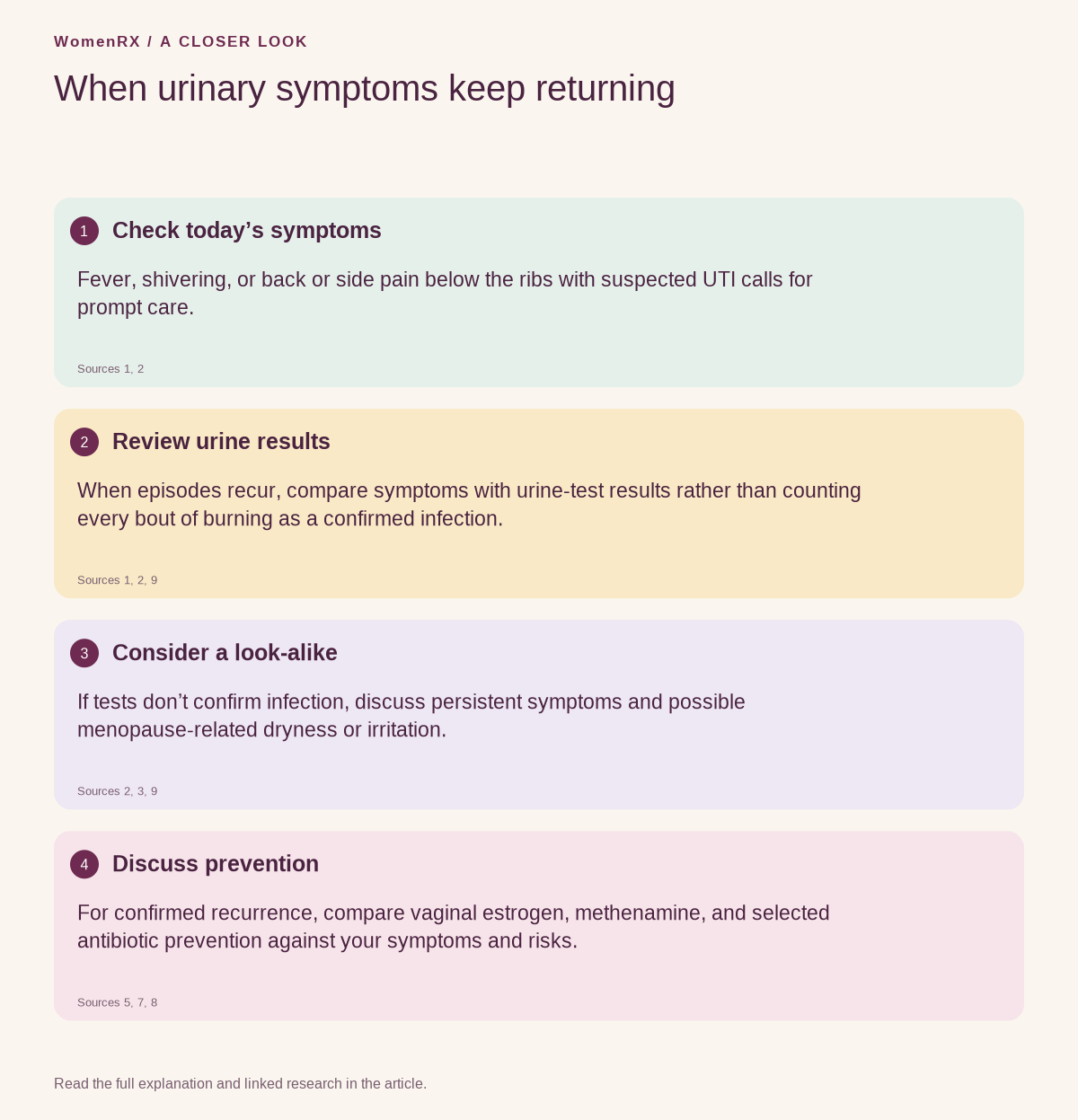
When urinary symptoms keep returning
Check today’s symptoms: Fever, shivering, or back or side pain below the ribs with suspected UTI calls for prompt care.12
Review urine results: When episodes recur, compare symptoms with urine-test results rather than counting every bout of burning as a confirmed infection.129
Consider a look-alike: If tests don’t confirm infection, discuss persistent symptoms and possible menopause-related dryness or irritation.239
Discuss prevention: For confirmed recurrence, compare vaginal estrogen, methenamine, and selected antibiotic prevention against your symptoms and risks.578
Read the figure as text
Use the symptom pattern and test results to decide what conversation comes next.- Check today’s symptoms: Fever, shivering, or back or side pain below the ribs with suspected UTI calls for prompt care.12
- Review urine results: When episodes recur, compare symptoms with urine-test results rather than counting every bout of burning as a confirmed infection.129
- Consider a look-alike: If tests don’t confirm infection, discuss persistent symptoms and possible menopause-related dryness or irritation.239
- Discuss prevention: For confirmed recurrence, compare vaginal estrogen, methenamine, and selected antibiotic prevention against your symptoms and risks.578
More questions, answered
Can I have urinary symptoms after menopause without a positive culture?
Yes. Vaginal dryness and irritation can accompany falling estrogen levels, and a small study of women with recurrent-UTI histories found a symptom cluster that included urgency and burning alongside more no-growth cultures. A negative culture doesn’t automatically explain symptoms, though, and persistent symptoms deserve reassessment. 392
Will vaginal estrogen help an infection I have right now?
It’s discussed as prevention for recurrent UTIs and as treatment for menopause-related vaginal dryness and irritation, not as treatment for an active bacterial UTI. A suspected current infection needs its own assessment. 137
Sources you can check
- Urinary Tract Infections | UTI | UTI Symptoms | MedlinePlusAccessed 2026-09-25Return to first citation
- Urinary tract infections (UTIs) - NHSAccessed 2026-09-25Return to first citation
- About vaginal oestrogen - NHSAccessed 2026-09-25Return to first citation
- Common questions about vaginal oestrogen - NHSAccessed 2026-09-25Return to first citation
- Optimizing Prevention of Recurrent Urinary Tract Infections in Older Patients with Frailty.Hjelholt TJ, Lietzen LW, Kongensgaard R, Bech JK, Azuz S, Hjelholt AJ, Gregersen M. · Drugs & aging · 2025Return to first citation
- Efficacy of vaginal estrogen for recurrent urinary tract infection prevention in hypoestrogenic women.Tan-Kim J, Shah NM, Do D, Menefee SA. · American journal of obstetrics and gynecology · 2023Return to first citation
- Effective Prevention of Recurrent UTIs With Vaginal Estrogen: Pearls for a Urological Approach to Genitourinary Syndrome of Menopause.Buck ES, Lukas VA, Rubin RS. · Urology · 2021Return to first citation
- Treatment and Prevention of Recurrent Lower Urinary Tract Infections in Women: A Rapid Review with Practice Recommendations.Smith AL, Brown J, Wyman JF, Berry A, Newman DK, Stapleton AE. · The Journal of urology · 2018Return to first citation
- Recurrent urinary tract infection: Association of clinical profiles with urobiome composition in women.Burnett LA, Hochstedler BR, Weldon K, Wolfe AJ, Brubaker L. · Neurourology and urodynamics · 2021Return to first citation
- Probiotic prophylaxis in adult women with recurrent uncomplicated urinary tract infections: A systematic review of randomized controlled trials.Yauri-Idelfonso M, Picón-Rafaelo C, Rosales-Goñe P, Pulido-Capurro V, Acevedo-Flores J, Gómez-Gonzales W, Arteaga-Livias K. · Journal of global antimicrobial resistance · 2026Return to first citation