Recurrent UTIs: Confirm the Pattern, Then Choose Prevention
A urine culture during a new episode can help show whether returning symptoms are infections and which prevention options fit.
If you’ve had two UTIs in six months or three in a year, it’s time to review the pattern rather than treat every new symptom on assumption. A urine culture during a symptomatic episode can help confirm infection and guide treatment. Prevention may then involve fluid habits, vaginal estrogen after menopause, methenamine, or an antibiotic plan, depending on your history. Pregnancy needs a separate, prompt assessment. 127
First, find out what’s returning
Burning when you pee can signal a UTI, but symptoms that feel familiar aren’t proof that each episode is another bacterial infection. Recurrent UTI commonly means two episodes within six months or three within a year. If you’ve reached that point, the useful question is not just “How do I stop this?” It’s “Which of these episodes were confirmed infections?” 1
Ask what previous urine tests showed, especially if symptoms returned soon after treatment. A urine culture obtained during a new symptomatic episode can identify bacteria and help guide antibiotic choice. In an outpatient study of women treated for recurrent UTI, about half of visits had no urine culture, illustrating how easily that information can be missed. The study described practice patterns; it didn’t test a prevention method. 7
A test result also needs the story that goes with it. Bacteria found in urine when someone has no urinary symptoms are not the same thing as a symptomatic UTI. Conversely, persistent symptoms after treatment deserve another look even when testing doesn’t show an infection, because other conditions can cause similar symptoms. That distinction matters before committing to long-term prevention aimed at bacteria. 15
Match prevention to your pattern
Start with a habit you can assess honestly. Not drinking enough fluids is listed among UTI risk factors. If you often go long stretches without drinking, discuss whether changing that habit makes sense for you. It’s a reasonable starting point, not a promise that more water will prevent every recurrence. 1
After menopause, ask about vaginal estrogen. This is a prevention discussion for women with lower estrogen levels, not a treatment for an infection already underway. In a retrospective study of 5,638 women prescribed vaginal estrogen for recurrent UTI, most of whom were postmenopausal, the average recorded UTI frequency fell from 3.9 in the year before the prescription to 1.8 in the year after. Because everyone in that analysis received a prescription and there was no untreated comparison group, the change cannot establish how much of the reduction estrogen caused. 8
If you want to discuss prevention without a daily antibiotic, ask about methenamine hippurate. It’s a non-antibiotic option for preventing recurrent UTIs, not a treatment to start when symptoms appear. A paper about women referred to specialty care discusses a trial that found methenamine noninferior to daily antibiotic prevention over 12 months. That’s a useful comparison to raise, but it doesn’t tell you which approach fits your history. Ask how your confirmed episodes and past antibiotic use would shape the choice, and how you’d assess whether prevention is helping. 46
If episodes follow sex, say so. That pattern may lead to a different antibiotic-prevention discussion than infections occurring without a clear trigger. Options described in recurrent-UTI care include prevention tied to intercourse, daily prevention, and a clinician-arranged plan for starting treatment when symptoms appear. These are different plans, not interchangeable instructions: your culture results, prior response to treatment, allergies, and other health factors help determine whether any fits. Antibiotics can cause side effects and contribute to resistance when used unnecessarily. Don’t use leftover antibiotics as a stand-in for a plan. 673
The choice doesn’t have to be permanent. A useful follow-up question is how you and your care team will tell whether the approach is helping and what to do if symptoms return despite it. That keeps the focus on confirmed episodes rather than assuming every day of urinary discomfort is another infection. 57
Pregnancy changes the conversation
If you’re pregnant and think you have a UTI, contact your pregnancy care team promptly instead of applying a prevention plan made for a nonpregnant time. UTIs are among the infections that can be harmful during pregnancy, and treatment choices need to account for both you and the pregnancy. Pregnancy was excluded from the outpatient recurrent-UTI study discussed above, so its antibiotic findings should not be treated as a pregnancy plan. 27
For anyone with recurring symptoms, symptoms that worsen quickly or fail to improve within 48 hours after starting treatment warrant timely reassessment. That’s especially useful when you’ve been told previous episodes were UTIs but this one isn’t following the usual course. 1
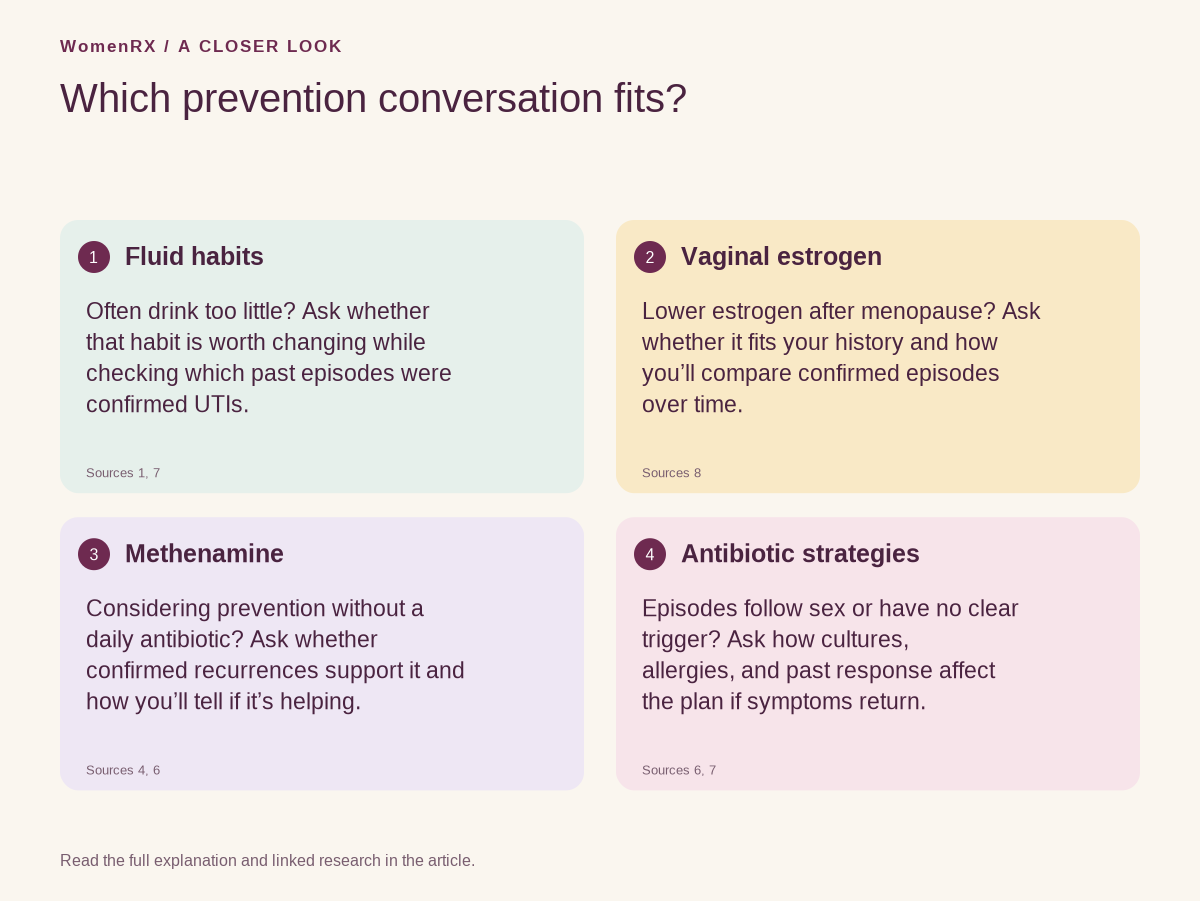
Which prevention conversation fits?
Fluid habits: Often drink too little? Ask whether that habit is worth changing while checking which past episodes were confirmed UTIs.17
Vaginal estrogen: Lower estrogen after menopause? Ask whether it fits your history and how you’ll compare confirmed episodes over time.8
Methenamine: Considering prevention without a daily antibiotic? Ask whether confirmed recurrences support it and how you’ll tell if it’s helping.46
Antibiotic strategies: Episodes follow sex or have no clear trigger? Ask how cultures, allergies, and past response affect the plan if symptoms return.67
Read the figure as text
Each option begins with a different part of your history. Use the paired question to keep the discussion focused on confirmed episodes.- Fluid habits: Often drink too little? Ask whether that habit is worth changing while checking which past episodes were confirmed UTIs.17
- Vaginal estrogen: Lower estrogen after menopause? Ask whether it fits your history and how you’ll compare confirmed episodes over time.8
- Methenamine: Considering prevention without a daily antibiotic? Ask whether confirmed recurrences support it and how you’ll tell if it’s helping.46
- Antibiotic strategies: Episodes follow sex or have no clear trigger? Ask how cultures, allergies, and past response affect the plan if symptoms return.67
More questions, answered
Do I need a urine test every time symptoms return?
A test isn’t always needed for a single suspected UTI, but cultures are particularly useful when infections keep recurring or the right antibiotic is uncertain. Ask how to obtain a sample during a new symptomatic episode so the result can be interpreted alongside your symptoms. 17
Can cranberry products treat a UTI that has already started?
Cranberry drinks and products aren’t shown to ease symptoms or treat an infection that has already begun. Prevention and treatment are separate questions. 1
Sources you can check
- Urinary tract infections (UTIs) - NHSAccessed 2026-09-25Return to first citation
- Infections and Pregnancy | Antibiotics | MedlinePlusAccessed 2026-09-25Return to first citation
- Antibiotics: MedlinePlusAccessed 2026-09-25Return to first citation
- Non-Antibiotic Prophylaxis for Recurrent Urinary Tract Infection: A Narrative Review & Clinical Guide for Primary and Hospital Care.Antoniou V, Somani B. · British journal of hospital medicine (London, England : 2005) · 2026Return to first citation
- Impact of a structured urine culture request form on antimicrobial stewardship in urinary tract infections at a tertiary care hospital in India.Shettar SR, Sumana MN, Shetty MS, Maheshwarappa YD, Reddy R, Srinivasan A, Kalyatanda G, Gowda AG. · Frontiers in antibiotics · 2026Return to first citation
- From Awareness to Action: Women's Self-Care Strategies and Clinical Behaviors in Recurrent Urinary Tract Infections.Miszewska L, Miszewski K, Marczak B, Kucko G, Matuszewski M. · Medicina (Kaunas, Lithuania) · 2026Return to first citation
- Analysis of recurrent urinary tract infection management in women seen in outpatient settings reveals opportunities for antibiotic stewardship interventions.Valentine-King MA, Trautner BW, Zoorob RJ, Germanos G, Hansen M, Salemi JL, Gupta K, Grigoryan L. · Antimicrobial stewardship & healthcare epidemiology : ASHE · 2022Return to first citation
- Efficacy of vaginal estrogen for recurrent urinary tract infection prevention in hypoestrogenic women.Tan-Kim J, Shah NM, Do D, Menefee SA. · American journal of obstetrics and gynecology · 2023Return to first citation