How Clinicians Confirm Recurrent UTIs in Women
A pattern of symptoms matters, but urine cultures help show whether separate episodes are bacterial infections.
Recurrent UTI usually means at least two infections in six months or three in a year, but the count is most useful when episodes fit urinary symptoms and testing. For repeated symptoms, clinicians may use urinalysis and urine culture to check for bacteria and guide treatment. If symptoms persist or tests don’t confirm infection, it’s worth reassessing rather than assuming every flare is another UTI. 5 2 1
First, separate a recurring pattern from recurring symptoms
Clinicians commonly define recurrent UTI as two or more infections within six months, or three or more within a year. That’s a threshold for considering the pattern, not proof that every episode of burning, urgency, or frequency is an infection. 5
A useful distinction is whether symptoms went away between episodes and then returned, or never fully settled. Write down when each episode began, which urinary symptoms you noticed, whether there was a symptom-free stretch, and what urine testing showed. This gives the clinician more than a running count. In a study of women 65 and older treated for recurrent UTI, urinary symptoms were often sparsely documented, including in some encounters with positive cultures. 4
What a urine culture can add
A urinalysis and urine culture can be useful when symptoms keep returning. A culture identifies bacteria growing in the sample; the result can help the clinician decide whether the symptoms fit a bacterial UTI and, if so, whether the treatment choice needs to account for resistance. For recurrent symptoms, a review of women’s care recommends obtaining both tests. 5
The key is interpreting the result alongside symptoms. Bacteria in urine without urinary symptoms is called asymptomatic bacteriuria; a positive culture alone doesn’t establish that symptoms are caused by a UTI. An observational study of women with recurrent UTI likewise defined an episode using both a positive culture and relevant symptoms. 3 5
A culture is helpful, but it isn’t a perfect yes-or-no answer in every situation. Symptoms can continue when tests don’t show infection, and those symptoms can resemble other conditions. If symptoms don’t improve as expected or keep returning despite negative results, ask what else could explain them and whether the diagnosis should be revisited, rather than treating the word “recurrent” as confirmation of a chronic infection. 1
Pregnancy and menopause change the context
Pregnancy deserves separate attention when urine results are interpreted. A review of recurrent UTI care notes that asymptomatic bacteriuria is generally not treated in people without symptoms, with pregnancy as an exception. That means a positive result without typical symptoms should still be discussed in the context of pregnancy, rather than dismissed or self-interpreted. 5
Peri- and postmenopausal status are listed as factors associated with recurrent UTI, but menopause alone doesn’t confirm that a particular spell of urinary discomfort is an infection. The symptom pattern and test results still matter. 5
When more testing comes up
Urine culture is a reasonable part of evaluating recurrent UTI, and ultrasound may also be considered. More invasive testing is not routinely indicated for women, according to a review of the German guideline evidence. The right work-up depends on the situation, so additional tests aren’t automatic just because a recurrence threshold has been reached. 2
For your next discussion, bring the episode timeline and any urine-test results you have. Ask whether each episode was supported by symptoms and culture, whether the latest result changes the explanation or treatment plan, and whether persistent symptoms call for a different evaluation. That keeps the focus on confirming what’s happening now, not only counting past flares.
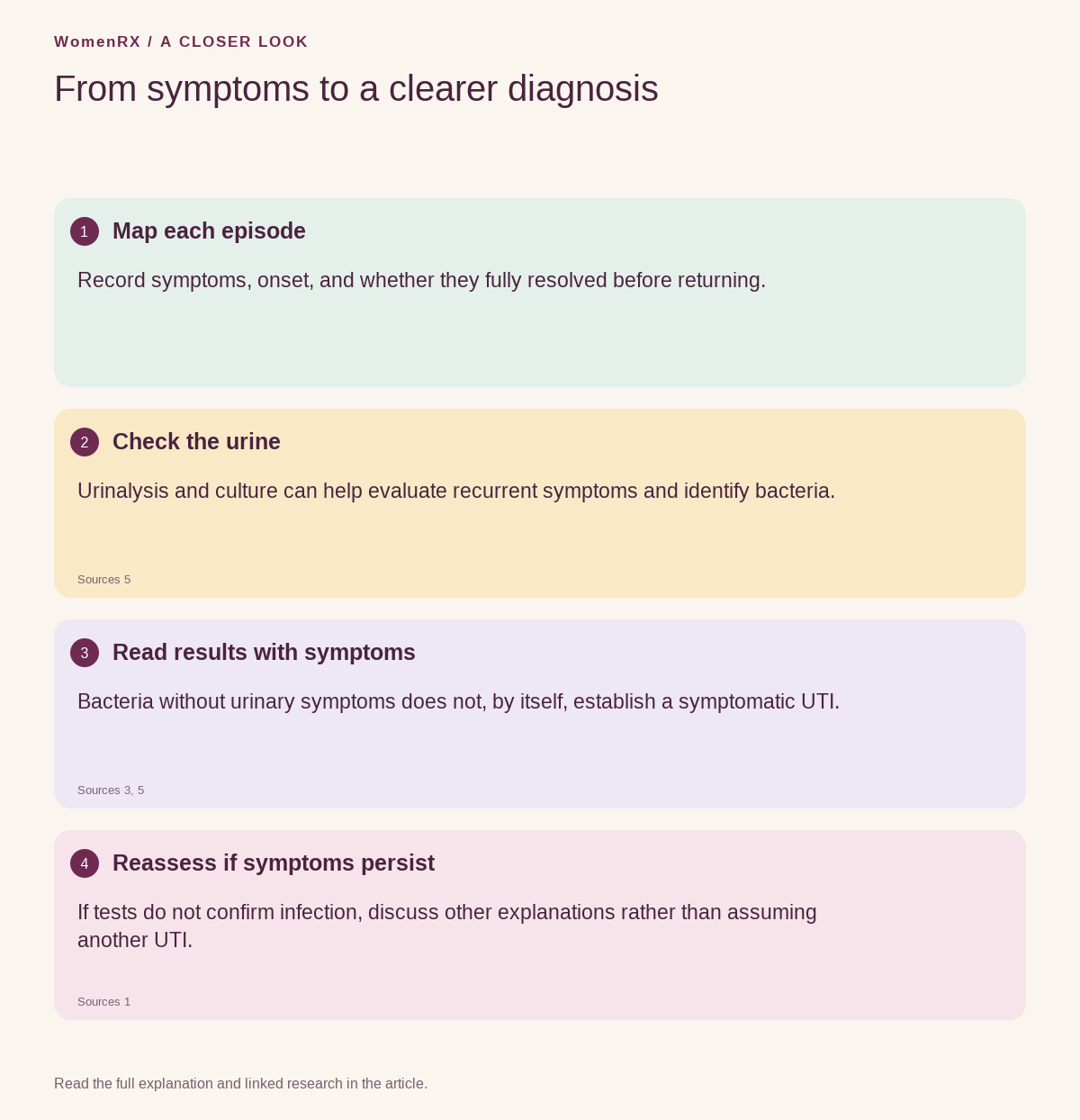
From symptoms to a clearer diagnosis
Map each episode: Record symptoms, onset, and whether they fully resolved before returning.
Check the urine: Urinalysis and culture can help evaluate recurrent symptoms and identify bacteria.5
Read results with symptoms: Bacteria without urinary symptoms does not, by itself, establish a symptomatic UTI.35
Reassess if symptoms persist: If tests do not confirm infection, discuss other explanations rather than assuming another UTI.1
Read the figure as text
Use symptom timing and urine results together to distinguish repeated confirmed infections from symptoms that need another explanation.- Map each episode: Record symptoms, onset, and whether they fully resolved before returning.
- Check the urine: Urinalysis and culture can help evaluate recurrent symptoms and identify bacteria.5
- Read results with symptoms: Bacteria without urinary symptoms does not, by itself, establish a symptomatic UTI.35
- Reassess if symptoms persist: If tests do not confirm infection, discuss other explanations rather than assuming another UTI.1
More questions, answered
Can a positive urine culture mean something other than a UTI?
Yes. Bacteria can be present without urinary symptoms, a condition called asymptomatic bacteriuria. A positive culture needs to be considered alongside symptoms; pregnancy is an important exception to the usual approach to asymptomatic bacteriuria. 5
Does reaching the recurrent-UTI threshold mean I need invasive testing?
Not automatically. A review found urine culture and ultrasound reasonable in evaluation, while further invasive testing is not routinely indicated for women. 2
Sources you can check
- Urinary tract infections (UTIs) - NHSAccessed 2026-09-25Return to first citation
- The Diagnosis, Treatment, and Prevention of Recurrent Urinary Tract Infection.Schmiemann G, Kranz J, Mandraka F, Schubert S, Wagenlehner F, Gágyor I. · Deutsches Arzteblatt international · 2024Return to first citation
- Culture-confirmed Bacterial Species Causing Recurrent Urinary Tract Infection Among Adult Women.Tuddenham S, Brotman RM, Handa VL. · Urogynecology (Philadelphia, Pa.) · 2026Return to first citation
- Symptom Documentation Before Antibiotics for Recurrent Urinary Tract Infections.Kuzma A, Critchlow E, Koelper N, Agrawal S, Dutcher L, Arya L. · Urogynecology (Philadelphia, Pa.) · 2025Return to first citation
- Recurrent UTI in Women: Diagnosis and Management.Zwahlen D, Ball J, Jackson Q. · American family physician · 2026Return to first citation