When Do Repeat UTIs Count as Recurrent?
Recurrent UTIs are usually defined by the number of symptomatic episodes, but a urine culture can help clarify what’s happening when symptoms return.
Two symptomatic UTIs within six months, or three within twelve months, generally meet the definition of recurrent UTI. That count doesn’t prove every episode was a bacterial infection: symptoms can overlap with other conditions. For recurring or lingering symptoms, a clinician may use urine cultures alongside your symptoms and history to help distinguish a new infection from symptoms that persist. 1 3
The count is a starting point, not the whole diagnosis
Recurrent UTI usually means at least two symptomatic episodes in six months or three in twelve months. The definition is commonly used in clinical research, though studies don’t all require the same level of culture confirmation. 1 3
That threshold is a reason to have the pattern assessed, not proof that every bout of burning or urgency was caused by bacteria. Similar symptoms can occur with other conditions, and lingering symptoms after treatment deserve a fresh look rather than automatically being counted as another infection. 1
What a urine culture can add
A urine culture looks for bacteria in a urine sample. In a study of adult women with recurrent UTI, an episode was counted when a culture showed one bacterial species along with relevant symptoms or signs. That illustrates why the test result matters alongside how you feel: a culture result on its own doesn’t tell the whole story. 2
When symptoms keep returning, your clinician may use a culture to help confirm whether an episode is bacterial and to identify the bacteria found. Previous results can also show whether the same species has appeared across episodes. In one retrospective study of 181 adult women, the same species appeared in 239 of 315 pairs of episodes (75.9%). The finding is consistent with, but does not prove, the idea that bacterial reservoirs may contribute to recurrence. 2
Culture isn’t perfect. Standard urine culture can miss some organisms, and results need to be interpreted in context. Researchers are studying other ways of characterizing urinary bacteria, but current evidence does not make those approaches a simple replacement for clinical assessment and standard testing. 3 5
Repeated infection or symptoms that never settled?
A useful distinction is whether you had a period of improvement followed by a new spell of symptoms, or whether the symptoms continued despite treatment. A new, symptomatic, culture-supported episode can strengthen the case for recurrent infection. Symptoms that persist or return quickly after treatment may need reassessment; don’t assume they automatically represent a separate UTI. The symptom pattern, culture results, and treatment history help a clinician decide what to investigate next. 1 2
A simple record can make that conversation more specific. For each episode, note:
- The date symptoms began and whether they fully settled between episodes.
- What you felt, such as burning or urgency, and whether symptoms changed or worsened.
- Whether a urine culture was done, when the sample was collected, and the result if you have it.
- The treatment you received and whether symptoms improved or continued.
Bring the results if you can access them. The timeline helps separate repeated episodes from one ongoing problem, while the culture history gives useful context for interpreting what happened.
When to seek care sooner
You don’t need to wait until you meet the recurrence threshold to ask for help. Contact a clinician if symptoms persist after treatment or keep coming back. If symptoms worsen quickly or aren’t improving within 48 hours after starting treatment, seek prompt medical advice. 1
If you’re pregnant and urinary symptoms keep coming back, seek prompt medical advice rather than waiting for another episode. Repeated UTIs are a reason for prompt assessment, and the routine advice for nonpregnant adults doesn’t apply during pregnancy. Tell the clinician you’re pregnant because pregnancy status matters when interpreting urine findings. 1 4
After menopause, changes in the urinary and vaginal environment can be one factor associated with recurrent UTIs, but they don’t explain every case. Research describes several possible contributing factors and variation between women, so menopause alone doesn’t establish the cause of your symptoms. 3
The practical takeaway
Count symptomatic episodes, but don’t let the count stand in for a diagnosis. A dated symptom record and any urine culture results can help show whether infections were confirmed, whether symptoms fully cleared between episodes, and what needs reassessment.
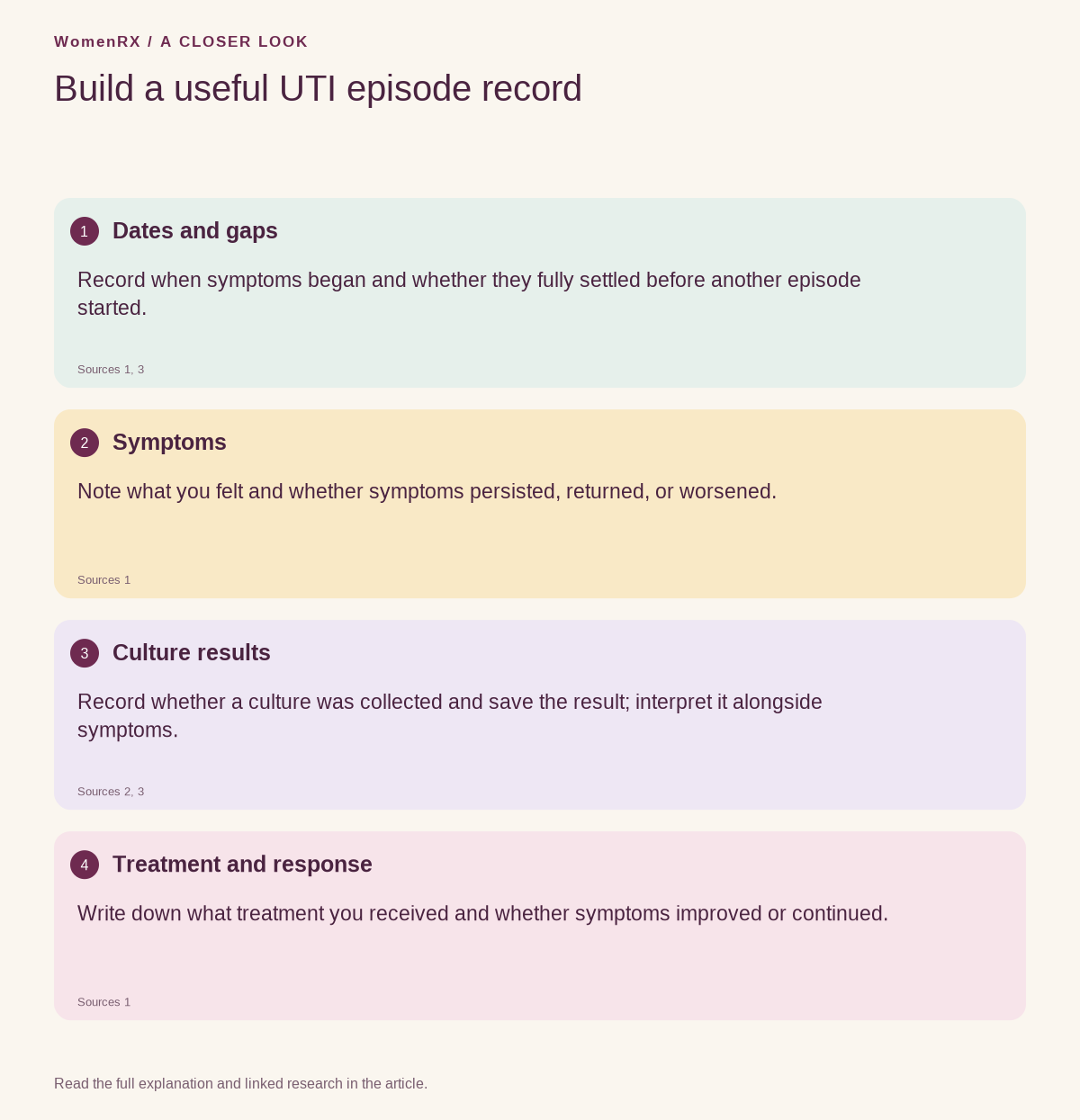
Build a useful UTI episode record
Dates and gaps: Record when symptoms began and whether they fully settled before another episode started.13
Symptoms: Note what you felt and whether symptoms persisted, returned, or worsened.1
Culture results: Record whether a culture was collected and save the result; interpret it alongside symptoms.23
Treatment and response: Write down what treatment you received and whether symptoms improved or continued.1
Read the figure as text
Keep each episode separate and pair symptoms with test results and recovery. This record supports discussion with a clinician; it is not a self-diagnosis tool.- Dates and gaps: Record when symptoms began and whether they fully settled before another episode started.13
- Symptoms: Note what you felt and whether symptoms persisted, returned, or worsened.1
- Culture results: Record whether a culture was collected and save the result; interpret it alongside symptoms.23
- Treatment and response: Write down what treatment you received and whether symptoms improved or continued.1
More questions, answered
Does every suspected UTI need a urine culture?
Not necessarily. Urine testing may be used when a clinician thinks it will help, but it isn’t always needed for an individual suspected UTI. With recurring or persistent symptoms, culture results can add useful context; they still need to be interpreted alongside symptoms and history. 1 3
Does the same bacteria on repeat cultures prove an infection never cleared?
No. Finding the same bacterial species in successive episodes is consistent with possible persistence, but it does not prove that one infection continued or identify the cause in an individual person. 2
Sources you can check
- Urinary tract infections (UTIs) - NHSAccessed 2026-09-25Return to first citation
- Culture-confirmed Bacterial Species Causing Recurrent Urinary Tract Infection Among Adult Women.Tuddenham S, Brotman RM, Handa VL. · Urogynecology (Philadelphia, Pa.) · 2026Return to first citation
- The Urogenital Microbiome-Metabolic Interface in Postmenopausal Recurrent Urinary Tract Infection: Estrogen Deficiency, Diabetes, Obesity, and Microbial Reservoirs.Alghoul WI, Ashraf R, Rafiuddin S, Kharoufeh AZH, Al-Shammari WBJ, Abedi M, Alabid I, Patni MM, Yousef AJ, Hamdy HA. · Journal of clinical medicine · 2026Return to first citation
- Impact of a structured urine culture request form on antimicrobial stewardship in urinary tract infections at a tertiary care hospital in India.Shettar SR, Sumana MN, Shetty MS, Maheshwarappa YD, Reddy R, Srinivasan A, Kalyatanda G, Gowda AG. · Frontiers in antibiotics · 2026Return to first citation
- Characterizing the role of the urobiome in the pathogenesis of recurrent urinary tract infections (rUTIs): a systematic review.Sheiber J, Duque A, Ranjan A, Diokno AC, Swana H. · International urology and nephrology · 2026Return to first citation