Cranberry or D-Mannose for Recurrent UTIs?
Cranberry has some evidence for preventing repeat UTIs in women; D-mannose has a less convincing record, and prevention products shouldn’t replace assessment for symptoms happening now.
Cranberry products may help prevent recurrent UTIs: a 2026 editorial reports fewer UTIs among women with recurrent infections in a review it summarized. D-mannose has less persuasive prevention evidence, including negative trial evidence. This research addresses prevention, not treatment of current symptoms. If symptoms keep returning, or you’re pregnant, get clinician guidance. 1 2 3
Prevention isn’t treatment
A supplement taken to lower the chance of another infection is doing a different job from medicine used to treat an infection that’s happening now. Cranberry products and D-mannose are discussed as prevention options. NHS guidance says there’s no evidence cranberry products help ease symptoms or treat an infection that has started; the evidence described for D-mannose concerns prevention. Don’t rely on a prevention product instead of getting current or recurring symptoms assessed. 1 2 3
“Recurrent UTI” is commonly used for two infections in six months or three in a year. Repeated urinary symptoms don’t automatically prove repeated bacterial infections, though: other conditions can cause symptoms too. Reviewing the pattern and confirming what’s happening can help avoid choosing prevention for the wrong problem. 1 3
How the supplement evidence compares
Cranberry: a possible prevention option, not a sure thing. A 2026 editorial summarizing a 2023 Cochrane review reported fewer UTIs after cranberry interventions among women with recurrent UTIs. It also reported that results didn’t support routine use in every group studied. That makes cranberry more promising than a claim based only on tradition, but it doesn’t establish that every cranberry drink or supplement works equally well. 3
D-mannose: the evidence is weaker. A 2026 editorial describes negative trial evidence for D-mannose. An older review focused on prevention in older people found limited data for D-mannose, and concluded that supplements including D-mannose weren’t strongly supported overall. These findings don’t prove it can never help anyone; they do mean it’s hard to present it as a dependable prevention choice. 2 3
Methenamine hippurate is a different kind of option. It isn’t a supplement. A 2026 editorial reports that, in the ALTAR trial of women with recurrent UTIs, it had preventive efficacy comparable to daily low-dose antibiotic prophylaxis. Whether it’s appropriate is a clinical decision, not a reason to substitute it, or a supplement, for treatment of current symptoms. 3
Practical tradeoffs and when to get guidance
If you’re considering cranberry, check with a clinician or pharmacist if you take warfarin; NHS guidance says to avoid cranberry products with warfarin. Cranberry and D-mannose products can also contain a lot of sugar, so check the product label if that matters to you. 1
If you’re pregnant, ask your clinician before taking cranberry or D-mannose. If you think you have a UTI during pregnancy, seek clinician guidance about the symptoms rather than trying to manage them with a prevention supplement. 1
When infections recur, bring the useful details: how often symptoms happen, whether a urine test or culture confirmed infection, and whether episodes seem linked to a particular circumstance. Those details can help distinguish repeat bacterial infections from other causes and guide a prevention plan. Clinicians may discuss options beyond supplements, including methenamine or antibiotic prevention, depending on the situation. 1 3
The short version: cranberry has a prevention signal in women with recurrent UTIs, but product effects aren’t interchangeable; D-mannose has less convincing support. Prevention products aren’t a substitute for assessment of active symptoms.
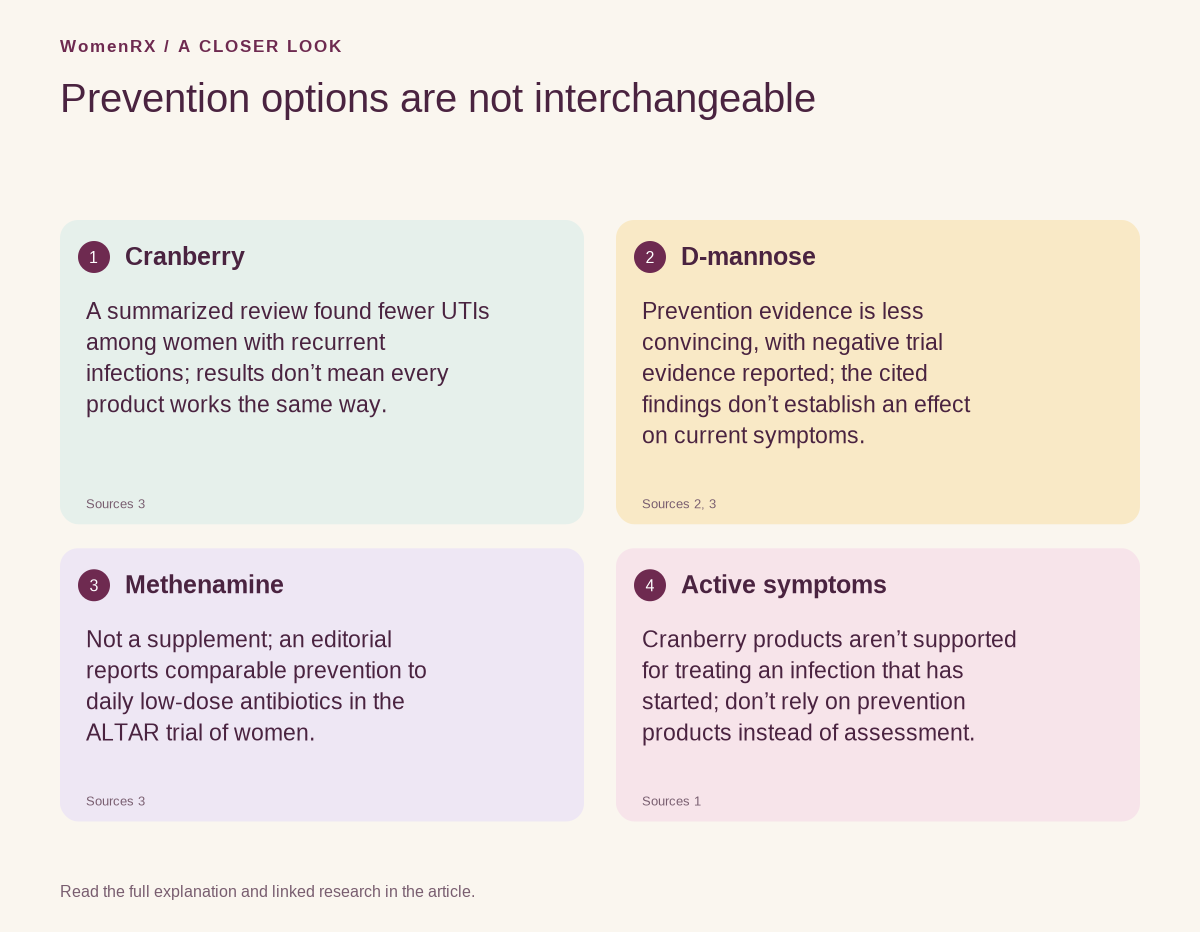
Prevention options are not interchangeable
Cranberry: A summarized review found fewer UTIs among women with recurrent infections; results don’t mean every product works the same way.3
D-mannose: Prevention evidence is less convincing, with negative trial evidence reported; the cited findings don’t establish an effect on current symptoms.23
Methenamine: Not a supplement; an editorial reports comparable prevention to daily low-dose antibiotics in the ALTAR trial of women.3
Active symptoms: Cranberry products aren’t supported for treating an infection that has started; don’t rely on prevention products instead of assessment.1
Read the figure as text
Compare the prevention evidence for cranberry and D-mannose with the separate role of methenamine, and distinguish prevention research from guidance about current symptoms.- Cranberry: A summarized review found fewer UTIs among women with recurrent infections; results don’t mean every product works the same way.3
- D-mannose: Prevention evidence is less convincing, with negative trial evidence reported; the cited findings don’t establish an effect on current symptoms.23
- Methenamine: Not a supplement; an editorial reports comparable prevention to daily low-dose antibiotics in the ALTAR trial of women.3
- Active symptoms: Cranberry products aren’t supported for treating an infection that has started; don’t rely on prevention products instead of assessment.1
More questions, answered
Can I take cranberry if I use warfarin?
NHS guidance advises avoiding cranberry products if you take warfarin. Ask your pharmacist or clinician about a suitable alternative. 1
Should I try a supplement during pregnancy?
Ask your clinician before taking cranberry or D-mannose during pregnancy. If you have symptoms that may be a UTI, seek clinician guidance rather than using a prevention supplement in place of assessment. 1
Sources you can check
- Urinary tract infections (UTIs) - NHSAccessed 2026-09-25Return to first citation
- Literature Review of Ascorbic Acid, Cranberry, and D-mannose for Urinary Tract Infection Prophylaxis in Older People.Song G, Koro M, Leung V, Loh G. · The Senior care pharmacist · 2023Return to first citation
- Recurrent urinary tract infection is not one disease: moving from antibiotic suppression to phenotype-guided prevention.Ahmad B, Khan K. · Annals of medicine and surgery (2012) · 2026Return to first citation