Can Supplements Prevent Repeat UTIs Around Menopause?
Cranberry may help prevent some repeat UTIs, while D-mannose results are uncertain and probiotics need more specific evidence.
Cranberry products may help prevent some repeat UTIs, but they won’t treat one that’s already started. A review of randomized trials found no statistically significant prevention benefit from D-mannose, and probiotic products can’t be treated as interchangeable. If infections keep returning around menopause, confirming what’s happening matters before choosing between supplements and other prevention options. 1 3 6
First, make sure the repeats are infections
Burning or urgency can feel familiar, but familiar symptoms don’t prove that each episode is a new bacterial UTI. A urine test can help establish whether an infection is present. If symptoms return after treatment, or you’ve had two UTIs in six months or three in a year, it’s time to review the pattern rather than keep trying prevention products on your own. Symptoms that persist after treatment also deserve another look. 1 2
Around menopause, that review has an extra dimension: genitourinary symptoms may be part of what you’re feeling. Menopause shouldn’t automatically be blamed for a confirmed infection, and infection shouldn’t automatically be blamed for every bout of discomfort. Getting that distinction right changes which prevention or symptom treatment is worth considering. 4 7
What the supplement evidence actually says
Cranberry: This is a prevention option, not a treatment for current symptoms. NHS guidance says cranberry products may help prevent UTIs but aren’t shown to ease symptoms or treat an infection once it has started. A review examining supplements for older people found randomized cranberry data, yet concluded that the clinical support for the supplements it reviewed was not strong. Neither finding identifies a best cranberry product or tells you how much benefit to expect specifically during perimenopause or after menopause. 1 8
D-mannose: The larger picture is less encouraging than some individual study results. A 2025 meta-analysis combined four randomized trials with 890 adult women. Compared with placebo or no treatment, D-mannose did not show a statistically significant reduction in recurrent UTIs. Results differed substantially across the trials, so this is uncertainty about benefit, not proof that benefit is impossible. The analysis did not report a menopause-stage-specific result. 6
One smaller, 12-month randomized study enrolled 75 premenopausal women and compared D-mannose, increased hydration, and preventive antibiotics. The antibiotic group had the lowest reported average number of UTI episodes. The statistically significant comparison reported in the abstract was antibiotics versus hydration; the D-mannose result versus hydration approached but did not reach statistical significance. It does not establish that antibiotics outperformed D-mannose in a direct statistical comparison, or tell us which approach works best after menopause. 5
Probiotics: A probiotic label doesn’t describe one consistent intervention. Effects can depend on the strain, and many commercial products haven’t been studied. A higher count of live microorganisms on the label isn’t necessarily better, either. That makes a general claim that “probiotics prevent UTIs” too broad, especially as a reason to pick a particular product for menopause-related recurrences. 3
Compare supplements with the other options
Supplements aren’t the whole prevention conversation. For people with confirmed recurrent UTIs, preventive antibiotics are one option described in clinical guidance. The small premenopausal trial above also found the lowest reported episode average in its antibiotic group, though it cannot settle the best choice for someone after menopause. 1 5
If you also have bothersome genitourinary symptoms around menopause, ask whether treating those symptoms makes sense. The North American Menopause Society recommends low-dose vaginal estrogen or certain other therapies for some women whose symptoms haven’t improved with over-the-counter measures and who don’t have an indication for systemic hormone therapy. That position statement addresses genitourinary symptoms; it should not be read as a trial measuring UTI prevention. A separate clinical editorial identifies vaginal estrogen and methenamine hippurate among prevention approaches with supporting evidence, but does not provide effect sizes or establish how either compares with a supplement for you. 4 7
A useful discussion can be quite focused:
- Are these confirmed infections? Which episodes were tested, and would testing help clarify symptoms happening now? 1 2
- Is there another source of discomfort? Could genitourinary symptoms around menopause be contributing alongside, or instead of, infection? 4 7
- What are we trying to prevent? Ask how cranberry, preventive antibiotics, and other relevant options fit your pattern, and whether treatment for genitourinary symptoms is a separate need. 1 4 7
- If I want to try a supplement, what would count as useful? Discuss the specific product and how you’ll recognize whether infections, rather than just sensations, have become less frequent. Cranberry products and probiotic strains shouldn’t be assumed to have identical effects. 1 3
If you have UTI symptoms now, don’t wait for a supplement to work. Cranberry isn’t shown to treat an active infection, and a urine test can help determine whether the symptoms are due to a UTI. 1 2
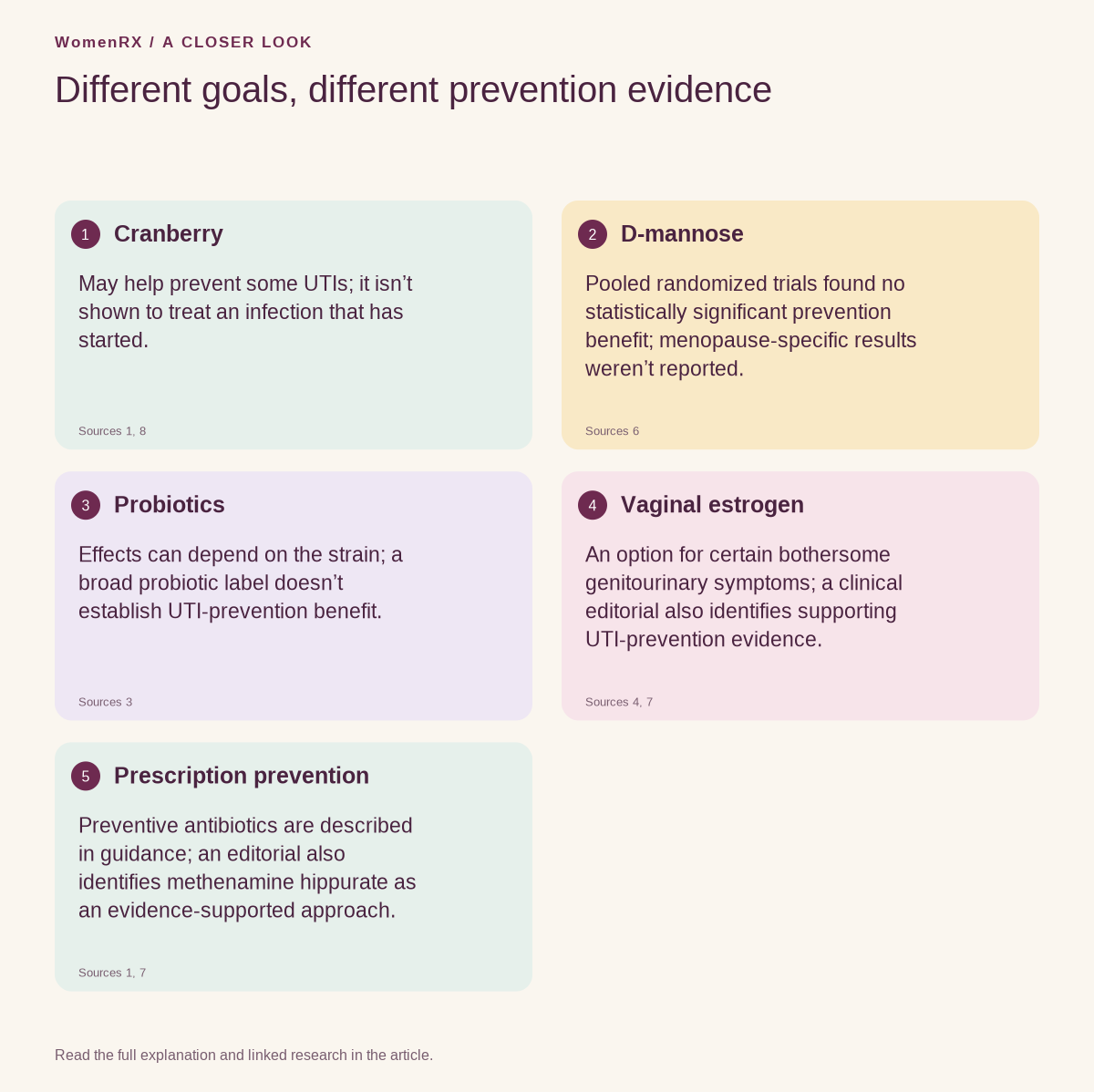
Different goals, different prevention evidence
Cranberry: May help prevent some UTIs; it isn’t shown to treat an infection that has started.18
D-mannose: Pooled randomized trials found no statistically significant prevention benefit; menopause-specific results weren’t reported.6
Probiotics: Effects can depend on the strain; a broad probiotic label doesn’t establish UTI-prevention benefit.3
Vaginal estrogen: An option for certain bothersome genitourinary symptoms; a clinical editorial also identifies supporting UTI-prevention evidence.47
Prescription prevention: Preventive antibiotics are described in guidance; an editorial also identifies methenamine hippurate as an evidence-supported approach.17
Read the figure as text
Use this comparison to separate supplement findings from other options and from treatment of symptoms happening now.- Cranberry: May help prevent some UTIs; it isn’t shown to treat an infection that has started.18
- D-mannose: Pooled randomized trials found no statistically significant prevention benefit; menopause-specific results weren’t reported.6
- Probiotics: Effects can depend on the strain; a broad probiotic label doesn’t establish UTI-prevention benefit.3
- Vaginal estrogen: An option for certain bothersome genitourinary symptoms; a clinical editorial also identifies supporting UTI-prevention evidence.47
- Prescription prevention: Preventive antibiotics are described in guidance; an editorial also identifies methenamine hippurate as an evidence-supported approach.17
Sources you can check
- Urinary tract infections (UTIs) - NHSAccessed 2026-09-25Return to first citation
- Urinary Tract Infections | UTI | UTI Symptoms | MedlinePlusAccessed 2026-09-25Return to first citation
- Probiotics - Health Professional Fact SheetAccessed 2026-09-25Return to first citation
- The 2022 hormone therapy position statement of The North American Menopause Society.“The 2022 Hormone Therapy Position Statement of The North American Menopause Society” Advisory Panel. · Menopause (New York, N.Y.) · 2022Return to first citation
- Comparison of increased hydration, D-mannose, and antibiotic prophylaxis for recurrent urinary tract infection prevention in premenopausal women: a three-arm randomized-controlled study.Iossa V, Masciovecchio S, Clemente GB, Chiaramonti F, Ciotta C, Pandolfo SD, Aveta A, Buonopane R, Di Girolamo A, Fiore F, Sessa G, Vitale R, di Mauro E, Di Pasquale AB, Imperatore... · International urology and nephrology · 2026Return to first citation
- D-Mannose for prevention of recurrent urinary tract infection in adult women: An updated systematic review and meta-analysis of randomized controlled trials.Murali Krishna M, Joseph M, Pereira V, Nizami A, Ezenna C, Sadasivan Sreemathy L. · Journal of infection prevention · 2025Return to first citation
- Recurrent urinary tract infection is not one disease: moving from antibiotic suppression to phenotype-guided prevention.Ahmad B, Khan K. · Annals of medicine and surgery (2012) · 2026Return to first citation
- Literature Review of Ascorbic Acid, Cranberry, and D-mannose for Urinary Tract Infection Prophylaxis in Older People.Song G, Koro M, Leung V, Loh G. · The Senior care pharmacist · 2023Return to first citation