Recurrent UTIs and Pregnancy: What to Plan For
A history of repeated UTIs is worth discussing before pregnancy, especially if you use prevention medicine; new urinary symptoms during pregnancy call for prompt assessment.
Pregnancy studies don’t tell us whether recurrent UTIs affect your chances of conceiving. 3 4 Before trying, review your infection history and prevention medicines with the prescriber. If you develop burning or pain when you pee during pregnancy, contact your pregnancy care team promptly rather than wait for a routine visit or use leftover medicine. 1 2 4 5 An early urine culture may also check for bacteria when you feel well. 4
Recurrent UTIs and the ability to conceive
If you’ve had UTIs repeatedly, it’s understandable to wonder whether they’ll affect your chances of getting pregnant. Studies of urinary infections during pregnancy follow people who have already conceived. They can help answer questions about pregnancy outcomes, but not whether recurrent UTIs affect fertility. 3 4
If infections keep coming back, it may help to bring a simple record of when they happened, what treatment you received, and whether symptoms returned. Recurrent UTI is commonly defined as two infections in six months or three in a year. A clinician can review the pattern and decide whether further assessment or a prevention plan makes sense. 1
Before pregnancy: review the prevention plan
Use a preconception visit to discuss how often infections happen, what has helped, and what medicines or supplements you use. This is especially useful if you take a preventive medicine rather than treating infections only when they occur. Nitrofurantoin is one medicine a pregnancy review includes among possible short-course treatments for bacteria found in the urine, but that does not make it right for every infection or every person. The choice depends on the clinical situation. Ask the prescriber to review any prevention medicine before pregnancy, and don’t start, stop, or change a medicine without their advice. 2 4
If you use methenamine hippurate, name it specifically in that conversation so your prescriber can review your plan for pregnancy. Don’t assume that advice about treating an infection also applies to a medicine you take to prevent one. Discuss medicine changes with the person managing your care. 2 4
Simple habits may be worth discussing too, but they can’t guarantee prevention. The NHS lists wiping from front to back as one measure to try and advises asking a doctor before using cranberry products during pregnancy. Cranberry products aren’t treatments for an infection that has already started. 1
During pregnancy: symptoms and urine cultures are different questions
Pregnancy changes how a possible urinary infection is assessed. If you’re pregnant and notice burning or pain when you pee, contact your pregnancy care team promptly for an assessment rather than waiting for your next routine visit. Tell them you’re pregnant and have had repeat UTIs. Don’t use leftover prescription medicine to treat the symptoms: pregnancy medicine decisions depend on the infection and your circumstances. 1 2 4 5
You may also be offered a urine culture when you have no symptoms. That checks for asymptomatic bacteriuria, meaning bacteria are found in the urine without the usual signs of a bladder infection. A review of pregnancy UTI guidance describes screening with a single urine culture early in pregnancy. It also notes that newer studies do not provide good-quality evidence linking untreated asymptomatic bacteriuria to acute kidney infection, while evidence that treatment reduces preterm birth and low birth weight is low to moderate quality. Screening while you feel well is therefore a separate question from assessing new symptoms. 4
What pregnancy outcome research can, and can’t, tell you
A UTI during pregnancy has been associated with complications, but an association doesn’t prove the infection caused an outcome. In one retrospective study of 549 pregnant women with a UTI and 329 without one, the UTI group had more preterm deliveries; low birth weight was not significantly associated with UTI in that study. Because this was an observational study at one hospital, it can’t establish cause and effect or predict an individual pregnancy. 3
A pregnancy review describes kidney infection, or pyelonephritis, as a more serious form of UTI associated with maternal complications and, in some studies, preterm delivery and low birth weight. This is why new urinary symptoms during pregnancy deserve assessment, even if past UTIs have felt familiar. 4 5
If you’re planning pregnancy, the practical next step is to review your repeat-infection history and every prevention medicine with your care team. If you become pregnant and develop urinary symptoms, contact your pregnancy care team promptly; ask whether an early urine culture is part of your care while you feel well. 2 4 5
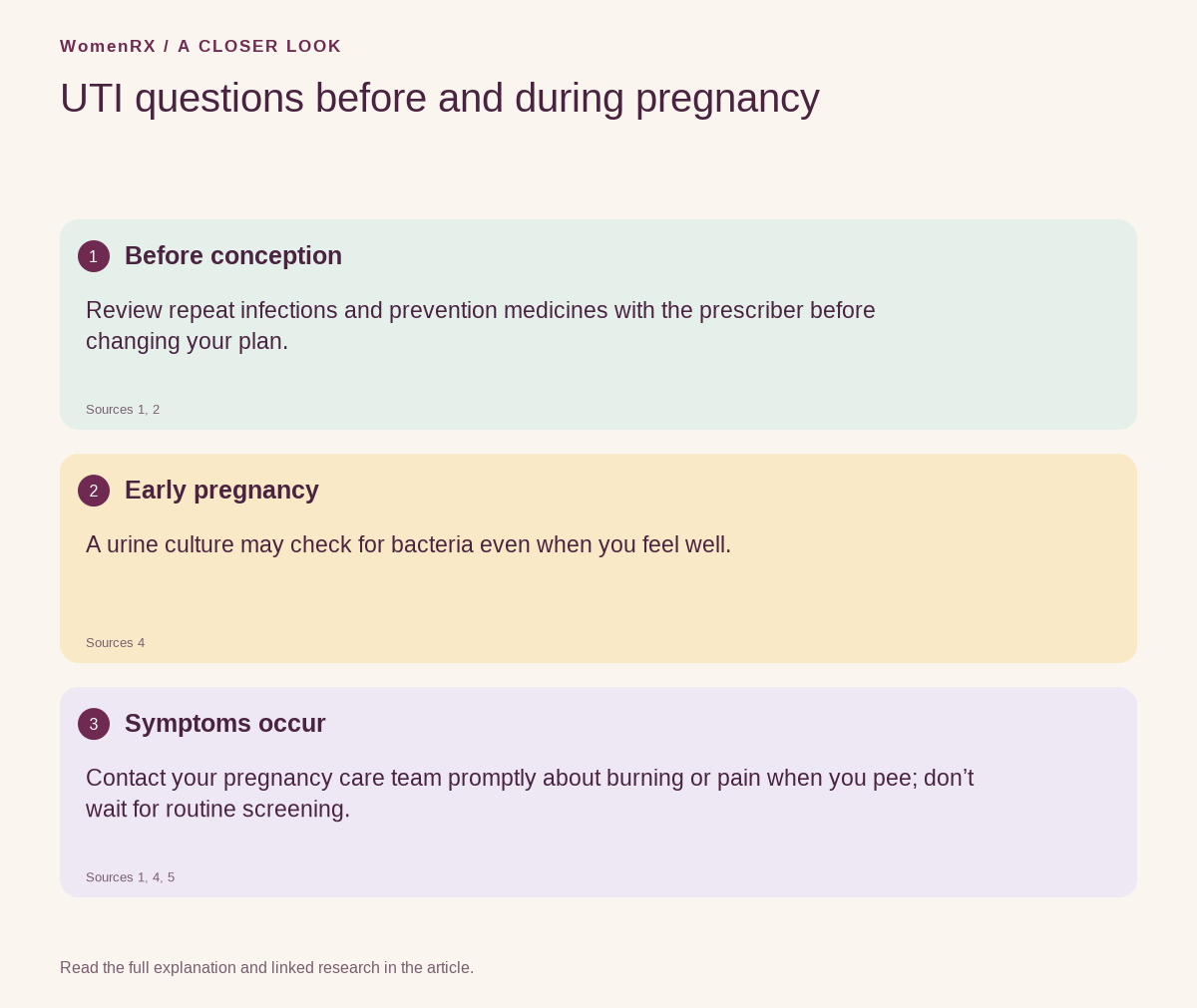
UTI questions before and during pregnancy
Before conception: Review repeat infections and prevention medicines with the prescriber before changing your plan.12
Early pregnancy: A urine culture may check for bacteria even when you feel well.4
Symptoms occur: Contact your pregnancy care team promptly about burning or pain when you pee; don’t wait for routine screening.145
Read the figure as text
The focus changes from reviewing a prevention plan before conception to screening while symptom-free and assessing new symptoms during pregnancy.- Before conception: Review repeat infections and prevention medicines with the prescriber before changing your plan.12
- Early pregnancy: A urine culture may check for bacteria even when you feel well.4
- Symptoms occur: Contact your pregnancy care team promptly about burning or pain when you pee; don’t wait for routine screening.145
More questions, answered
Should I stop my UTI prevention medicine when trying to conceive?
Don’t make that decision from a general rule. Ask the prescriber to review your specific medicine before pregnancy, whether you take nitrofurantoin, methenamine hippurate, or something else. A medicine considered for treating bacteria found during pregnancy isn’t automatically an appropriate prevention plan. 2 4
What should I do if I have urinary symptoms during pregnancy?
Contact your pregnancy care team promptly if you notice burning or pain when you pee. Tell them about your history of repeat UTIs, and don’t use leftover prescription medicine while waiting for an assessment. Screening with a urine culture when you feel well doesn’t replace assessment of new symptoms. 1 2 4 5
Sources you can check
- Urinary tract infections (UTIs) - NHSAccessed 2026-09-25Return to first citation
- Pregnancy and Medicines | MedlinePlusAccessed 2026-09-25Return to first citation
- Urinary Tract Infection in Pregnancy and Its Effects on Maternal and Perinatal Outcome: A Retrospective Study.Balachandran L, Jacob L, Al Awadhi R, Yahya LO, Catroon KM, Soundararajan LP, Wani S, Alabadla S, Hussein YA. · Cureus · 2022Return to first citation
- Urinary tract infections in pregnancy.Ansaldi Y, Martinez de Tejada Weber B. · Clinical microbiology and infection : the official publication of the European Society of Clinical Microbiology and Infectious Diseases · 2023Return to first citation
- Complicated Urinary Tract InfectionsSabih A, Leslie SW. · 2024Return to first citation