Recurrent UTIs: What Helps, and What’s Still Unclear
Several prevention options can help, but the right choice depends on confirming repeat infections and weighing likely benefit against medication trade-offs.
Recurrent UTI is commonly defined as at least two infections in six months or three in a year. Prevention can include hydration, topical estrogen after menopause, methenamine, or clinician-directed antibiotic prevention; each has different evidence and trade-offs. Cranberry may help some people, but it won’t treat an infection already underway, and no single measure guarantees you won’t have another UTI. 1 4 5 6
First, make sure “recurrent” means repeated infections
A common definition is at least two UTIs in six months or three within a year. If symptoms keep returning, that’s a reason to reassess what’s happening rather than assume every episode is the same infection. Urine testing can help identify a UTI, and antibiotics work against bacterial infections, not every cause of urinary symptoms. 1 2 3
This matters because prevention aimed at bacterial UTIs may not help if the recurring problem hasn’t been confirmed as infection. Before starting a long-term prevention plan, ask how your clinician will determine whether a new episode is a UTI and what to do if symptoms return.
Prevention options, compared
Hydration and everyday habits
Drinking more fluids is a relatively simple option to discuss. In one 12-month randomized study of 75 premenopausal women with recurrent UTIs, the hydration group averaged 1.08 episodes per year. Antibiotic prevention had fewer episodes in that study, while the D-mannose group’s results fell between the two. The small study doesn’t establish that extra fluids will prevent recurrence for everyone. 4
The NHS also lists wiping from front to back as something people can try. These steps are reasonable low-burden measures, not guarantees. 1
Cranberry and D-mannose
Cranberry products may help prevent UTIs for some people, but the NHS notes they don’t ease symptoms or treat an infection once it has started. That distinction matters: a prevention product isn’t a substitute for evaluating new symptoms. 1
One small randomized study offers a tentative comparison, not a firm answer on D-mannose. In that study, it showed intermediate results compared with hydration and antibiotic prevention, with its difference from hydration not reaching statistical significance. That finding is a reason for caution, not proof that D-mannose reliably prevents recurrent UTIs. 4
Topical estrogen after menopause
For someone who is postmenopausal, topical estrogen is a specific option to ask about. A 2026 review describes it as an effective prevention approach that addresses changes associated with recurrent UTIs after menopause. This isn’t a general recommendation for every woman: whether it fits depends on your situation and should be discussed with your clinician. 5
Methenamine or preventive antibiotics
Clinician-directed antibiotic prevention can reduce recurrences, but it also means repeated antibiotic exposure. Antibiotics can cause side effects, and using them when they aren’t needed contributes to resistance, in which bacteria become harder to treat. The goal isn’t to avoid antibiotics at all costs; it’s to use them when the expected benefit makes sense. 3 4
Methenamine hippurate is another prevention option to ask about. In a retrospective study of 100 women followed for 12 months, recurrence rates were similar between the methenamine and low-dose nitrofurantoin groups, and resistance was detected in the nitrofurantoin group but not the methenamine group. Because this was a small, nonrandomized study, it doesn’t settle which option is better for an individual or establish that methenamine prevents resistance in general. 6
Your life stage changes the conversation
After menopause, ask whether topical estrogen is appropriate. If you’re pregnant, these prevention findings don’t establish which approach works during pregnancy; the randomized comparison enrolled premenopausal women but did not report pregnancy-specific results. 4 5
Anatomy matters, too. Bacteria from stool can enter the urinary tract through the urethra, and front-to-back wiping is one habit the NHS suggests trying. That doesn’t mean your hygiene caused your UTIs. 1
A useful question is: “What evidence do we have that these episodes are UTIs, and which prevention option best balances recurrence, side effects, and antibiotic use for me?” That keeps the discussion focused on confirming the problem and choosing among real trade-offs, rather than treating every prevention claim as equally proven.
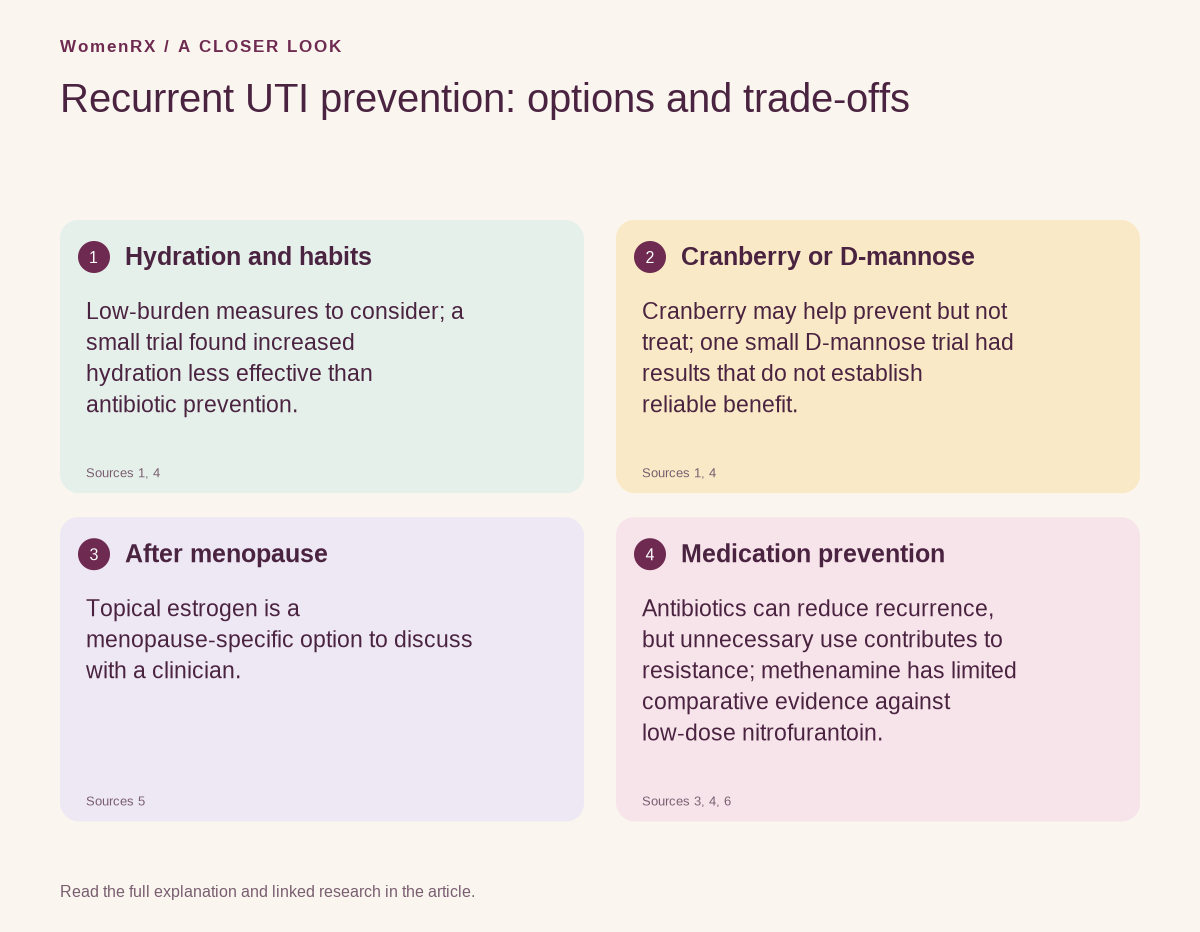
Recurrent UTI prevention: options and trade-offs
Hydration and habits: Low-burden measures to consider; a small trial found increased hydration less effective than antibiotic prevention.14
Cranberry or D-mannose: Cranberry may help prevent but not treat; one small D-mannose trial had results that do not establish reliable benefit.14
After menopause: Topical estrogen is a menopause-specific option to discuss with a clinician.5
Medication prevention: Antibiotics can reduce recurrence, but unnecessary use contributes to resistance; methenamine has limited comparative evidence against low-dose nitrofurantoin.346
Read the figure as text
These approaches differ in who they may suit, how much evidence is available, and whether they involve antibiotic exposure.- Hydration and habits: Low-burden measures to consider; a small trial found increased hydration less effective than antibiotic prevention.14
- Cranberry or D-mannose: Cranberry may help prevent but not treat; one small D-mannose trial had results that do not establish reliable benefit.14
- After menopause: Topical estrogen is a menopause-specific option to discuss with a clinician.5
- Medication prevention: Antibiotics can reduce recurrence, but unnecessary use contributes to resistance; methenamine has limited comparative evidence against low-dose nitrofurantoin.346
More questions, answered
Can cranberry treat a UTI that has already started?
No. Cranberry products may help prevent UTIs for some people, but they don’t treat an active infection or relieve its symptoms. 1
Does recurrent UTI always mean I need preventive antibiotics?
No. Prevention options include non-antibiotic approaches, and the choice depends on your circumstances. Antibiotic prevention can reduce recurrences, but repeated use can cause side effects and contribute to resistance. 3 4 6
Sources you can check
- Urinary tract infections (UTIs) - NHSAccessed 2026-09-25Return to first citation
- Urinary Tract Infections | UTI | UTI Symptoms | MedlinePlusAccessed 2026-09-25Return to first citation
- Antibiotics: MedlinePlusAccessed 2026-09-25Return to first citation
- Comparison of increased hydration, D-mannose, and antibiotic prophylaxis for recurrent urinary tract infection prevention in premenopausal women: a three-arm randomized-controlled study.Iossa V, Masciovecchio S, Clemente GB, Chiaramonti F, Ciotta C, Pandolfo SD, Aveta A, Buonopane R, Di Girolamo A, Fiore F, Sessa G, Vitale R, di Mauro E, Di Pasquale AB, Imperatore... · International urology and nephrology · 2026Return to first citation
- The role of estrogen in prevention of recurrent urinary tract infections in postmenopausal women.Wiese E, Amjad A, Bartoli G, Beyzarov M, Gigliotti S, Hanna C, Myers O, Galarza C, Adler J. · JAAPA : official journal of the American Academy of Physician Assistants · 2026Return to first citation
- Methenamine Hippurate versus Low-Dose Nitrofurantoin for Recurrent Urinary Tract Infection Prophylaxis in Women.Yang Y, Jiang J, Wang D. · Urologia internationalis · 2026Return to first citation