Preventing Recurrent UTIs: Which Options Are Worth Discussing?
Repeated infections call for a prevention plan matched to your pattern, not just another round of the same advice.
Two UTIs in six months or three in a year are a reason to discuss prevention. Options include simple hygiene measures, vaginal estrogen after menopause, methenamine hippurate for some women, and clinician-directed preventive antibiotics, including post-coital prevention for selected patients whose UTIs follow sex. 1 3 4 These aim to prevent future infections, not treat one you have now. Pain or burning when peeing can be a UTI symptom. 1 If you suspect a UTI while pregnant, contact a clinician for assessment. 2 If you suspect a UTI and you’re 65 or older or have a weakened immune system, seek prompt medical advice. 1
Start by confirming the pattern
Two UTIs in six months or three in a year is a commonly used threshold for recurrent infection. If you’re reaching that point, arrange an evaluation to discuss prevention and whether the episodes have been confirmed as bacterial infections. A recurrence count is a reason to look at options, not a complete explanation of why symptoms keep coming back. 1 3
Prevention is different from treating an active infection. For people who are not pregnant, cranberry products may help prevent UTIs, but they aren’t a treatment once symptoms have started. 1
Match the option to your situation
Everyday prevention: Wiping from front to back after using the toilet is one measure you can try. The guidance lists it as a prevention step, but doesn’t establish how much it reduces recurrent infections. It’s a simple habit, not a replacement for assessing repeated symptoms. 1
After menopause: Vaginal estrogen is an option to discuss if you’re postmenopausal and UTIs keep returning. The rationale is that estrogen can address changes associated with recurrent UTIs after menopause; it’s a targeted prevention option, not a general recommendation for every woman. 4
A randomized trial in postmenopausal people with recurrent UTIs compared two ways of applying estrogen cream. At six months, about half of participants in each group were UTI-free. That comparison helps explain that application method can be a practical discussion, but it doesn’t show that estrogen prevents every recurrence or establish that the study applies to women who aren’t postmenopausal. 5
Methenamine hippurate: This is a non-antibiotic prevention option to ask about. An editorial describing the ALTAR randomized trial reports that methenamine had preventive efficacy comparable to daily low-dose antibiotic prevention in women with recurrent UTIs. That makes it a possible antibiotic-sparing choice for some people. The guidance discussed in the editorial advises specialist input for pregnancy, recurrent upper UTIs, and complicated lower UTIs. 3
Preventive antibiotics: A clinician may discuss a low-dose antibiotic plan for selected people with recurring infections. For selected patients whose infections recur after sex, the recurrent-UTI editorial identifies post-coital antibiotic prevention as an option to discuss with a clinician. 3 Antibiotics remain an option, but they require an individualized decision; the NHS guidance describes a course of low-dose prevention lasting up to six months. Whether that’s appropriate depends on your infection history and clinical circumstances. 1 3
Cranberry and other supplements: Cranberry products may help prevent UTIs for some people who are not pregnant, but the cited guidance doesn’t establish how well they work or which product to choose. The recurrent-UTI editorial also reports that a 2024 randomized trial found daily D-mannose did not reduce medically attended UTIs among women with recurrent UTIs. A supplement being popular isn’t proof that it prevents infection. 1 3
Pregnancy changes the decision
Pregnancy is a reason to make prevention and treatment decisions with a clinician rather than assume that a strategy used at another stage of life is suitable. A clinical guideline summary classifies UTIs in pregnancy as complicated, and the recurrent-UTI editorial advises specialist input about methenamine during pregnancy. These sources support individualized care, but they don’t establish a specific urgency timeline for every pregnant person with urinary symptoms. 2 3
What to do when another episode starts
Pain or burning when peeing can be a UTI symptom. 1 If you think you have another UTI, contact a clinician to discuss whether testing or treatment is appropriate. If you suspect a UTI while pregnant, seek clinical assessment. 2 Seek prompt medical advice if you suspect a UTI and you’re 65 or older or have a weakened immune system. 1 Don’t rely on a prevention plan while symptoms continue.
For recurring infections, the useful next step is a conversation about confirming the episodes and choosing among prevention options, rather than relying on a home remedy as treatment. 1 3
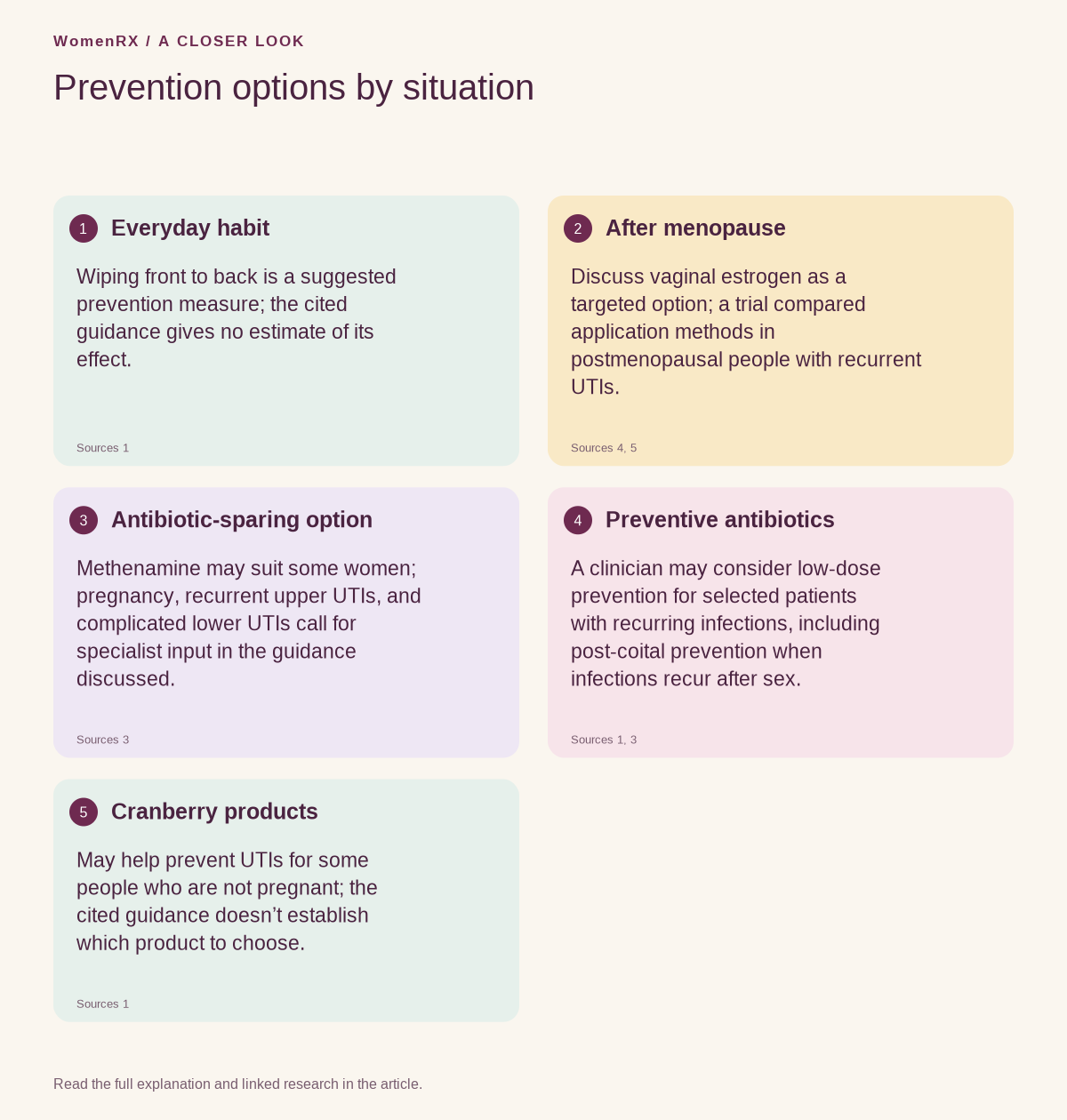
Prevention options by situation
Everyday habit: Wiping front to back is a suggested prevention measure; the cited guidance gives no estimate of its effect.1
After menopause: Discuss vaginal estrogen as a targeted option; a trial compared application methods in postmenopausal people with recurrent UTIs.45
Antibiotic-sparing option: Methenamine may suit some women; pregnancy, recurrent upper UTIs, and complicated lower UTIs call for specialist input in the guidance discussed.3
Preventive antibiotics: A clinician may consider low-dose prevention for selected patients with recurring infections, including post-coital prevention when infections recur after sex.13
Cranberry products: May help prevent UTIs for some people who are not pregnant; the cited guidance doesn’t establish which product to choose.1
Read the figure as text
Compare a simple habit with options that call for a discussion about your infection pattern and life stage.- Everyday habit: Wiping front to back is a suggested prevention measure; the cited guidance gives no estimate of its effect.1
- After menopause: Discuss vaginal estrogen as a targeted option; a trial compared application methods in postmenopausal people with recurrent UTIs.45
- Antibiotic-sparing option: Methenamine may suit some women; pregnancy, recurrent upper UTIs, and complicated lower UTIs call for specialist input in the guidance discussed.3
- Preventive antibiotics: A clinician may consider low-dose prevention for selected patients with recurring infections, including post-coital prevention when infections recur after sex.13
- Cranberry products: May help prevent UTIs for some people who are not pregnant; the cited guidance doesn’t establish which product to choose.1
More questions, answered
When does a UTI count as recurrent?
A commonly used threshold is two UTIs in six months or three in a year. Reaching it is a reason to discuss evaluation and prevention with a clinician. 1
Sources you can check
- Urinary tract infections (UTIs) - NHSAccessed 2026-09-25Return to first citation
- [Summary of the practice guideline 'Urinary-tract infections' (second revision) from the Dutch College of General Practitioners].van Pinxteren B, van Vliet SM, Wiersma TJ, Goudswaard AN, Nederlands Huisartsen Genootschap. · Nederlands tijdschrift voor geneeskunde · 2006Return to first citation
- Recurrent urinary tract infection is not one disease: moving from antibiotic suppression to phenotype-guided prevention.Ahmad B, Khan K. · Annals of medicine and surgery (2012) · 2026Return to first citation
- The role of estrogen in prevention of recurrent urinary tract infections in postmenopausal women.Wiese E, Amjad A, Bartoli G, Beyzarov M, Gigliotti S, Hanna C, Myers O, Galarza C, Adler J. · JAAPA : official journal of the American Academy of Physician Assistants · 2026Return to first citation
- Vaginal Estrogen Application Techniques for Prevention of Urinary Tract Infection: A Randomized Trial.Zuo SW, Mowers EE, Hem S, Bradley M, Zyczynski HM, Hillier SL, Ackenbom MF. · Obstetrics and gynecology · 2026Return to first citation