Why UTIs Can Become a Concern Around Menopause
Menopause-related urinary and vaginal changes can mimic some UTI symptoms, while lower estrogen may also be part of the picture for women with repeated infections.
Around perimenopause and after menopause, lower estrogen can contribute to vaginal dryness and irritation and may play a part in recurrent UTIs. Burning when you pee can suggest a UTI, while urgency and frequency can also occur with menopause-related symptoms. If symptoms keep returning, ask whether infections were confirmed and which prevention approach fits your health history. 1 2 4 7
Similar symptoms, different problems
Burning when you pee can be a UTI symptom. But urinary urgency and frequency can also accompany genitourinary syndrome of menopause (GSM), which includes vaginal dryness and irritation as well as urinary symptoms. So a familiar symptom doesn’t, by itself, confirm that bacteria are causing a new infection. 1 2 6 7
That distinction matters when symptoms recur. Some women have repeated, symptomatic bacterial infections; others have ongoing or recurring discomfort that may have another explanation. Research and clinical definitions of recurrent UTI commonly use at least two symptomatic episodes in six months or three in a year, though studies differ in how they require microbiological confirmation. 4 A useful starting question is whether prior episodes were supported by urine testing, such as a culture, rather than counted only from similar-feeling symptoms. A recent review identifies urine culture as part of the clinical foundation for recurrent UTI care. 4
If symptoms return but infection isn’t confirmed, ask whether GSM or another urinary or vulvovaginal cause could be contributing. That isn’t a reason to dismiss your symptoms; it’s a reason to make sure the explanation matches them.
Why menopause can change the picture
Estrogen levels fall during and after menopause. Reviews describe a shift in the vaginal environment after menopause, including higher vaginal pH and fewer Lactobacillus bacteria, which often dominate before menopause. These changes may contribute to susceptibility to recurrent UTIs, but they don’t explain every infection or predict who will have one. Separately, lower estrogen can cause vaginal dryness and irritation even when an infection hasn’t been shown. 2 4 6
This can create two overlapping issues: a genuine bacterial infection and menopause-related tissue symptoms that feel similar, or symptoms that persist even when an infection hasn’t been shown. Urinary urgency and frequency are among the symptoms that have improved with vaginal estrogen in studies of GSM, but symptom improvement doesn’t establish that every episode was an infection. 7
Where vaginal estrogen fits
Vaginal estrogen is a prevention option to discuss if you’re peri- or postmenopausal and having recurrent UTIs, especially when vaginal dryness or irritation is also part of the picture. A 2026 narrative review reported that five randomized trials found low-dose vaginal estrogen reduced culture-confirmed recurrent UTI episodes and improved vaginal health measures. The reviewed trials did not establish one vaginal formulation as better than another. 5
This is prevention evidence, not evidence that vaginal estrogen treats an acute UTI. The trials mainly studied it as a preventive approach or after antibiotic treatment; the review identified no trial testing vaginal estrogen started together with antibiotics at the onset of an acute UTI. 5
Vaginal estrogen can also help dryness and irritation, but it isn’t automatically the right choice for everyone. Menopause guidance recommends individualizing hormone therapy and discusses low-dose vaginal estrogen for bothersome GSM symptoms that haven’t improved with over-the-counter options, for women without a reason to use systemic hormone therapy. Your symptoms, health history, preferences, and any other treatments are part of that decision. 2 3
Other prevention discussions
Antibiotic prevention is another possible discussion when recurrent bacterial infections are documented. The evidence review found one trial in which estriol pessaries were less effective than antibiotic prophylaxis, but there are no head-to-head trials showing which vaginal estrogen formulation works best, and the review found no trial directly evaluating estrogen combined with antibiotic prevention. The right comparison depends on your recurrence pattern and circumstances, not on a single option being best for everyone. 1 5
At a visit, you might ask: Were my recent episodes confirmed as bacterial infections? If not, what else could explain the burning, urgency, or dryness? If infections were confirmed, could vaginal estrogen be appropriate for me, and what are the tradeoffs compared with antibiotic prevention? Those questions help keep the conversation focused on both the symptoms you feel and the cause that has been established.
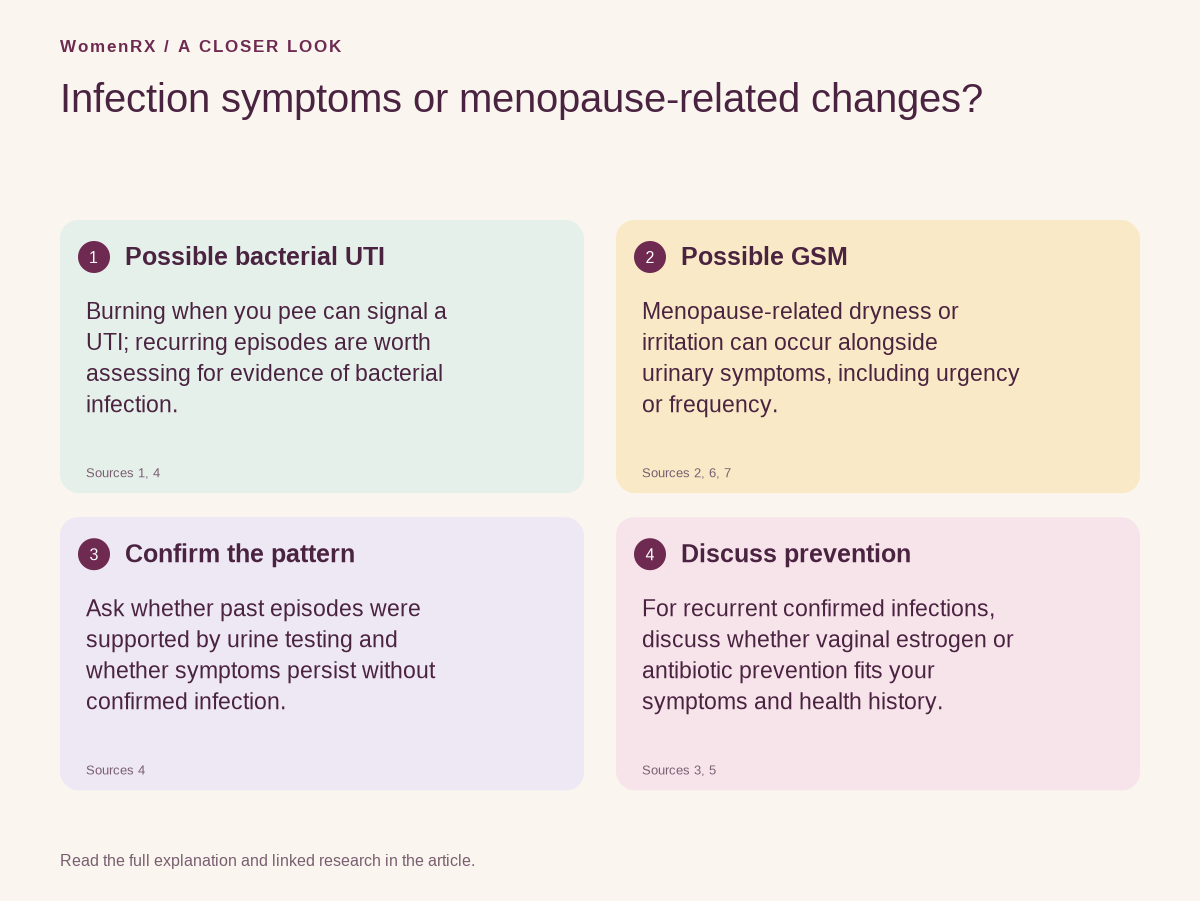
Infection symptoms or menopause-related changes?
Possible bacterial UTI: Burning when you pee can signal a UTI; recurring episodes are worth assessing for evidence of bacterial infection.14
Possible GSM: Menopause-related dryness or irritation can occur alongside urinary symptoms, including urgency or frequency.267
Confirm the pattern: Ask whether past episodes were supported by urine testing and whether symptoms persist without confirmed infection.4
Discuss prevention: For recurrent confirmed infections, discuss whether vaginal estrogen or antibiotic prevention fits your symptoms and health history.35
Read the figure as text
Some urinary symptoms overlap. This comparison shows what to clarify before choosing a prevention approach.- Possible bacterial UTI: Burning when you pee can signal a UTI; recurring episodes are worth assessing for evidence of bacterial infection.14
- Possible GSM: Menopause-related dryness or irritation can occur alongside urinary symptoms, including urgency or frequency.267
- Confirm the pattern: Ask whether past episodes were supported by urine testing and whether symptoms persist without confirmed infection.4
- Discuss prevention: For recurrent confirmed infections, discuss whether vaginal estrogen or antibiotic prevention fits your symptoms and health history.35
More questions, answered
Does vaginal estrogen treat a UTI that has already started?
The evidence described for vaginal estrogen concerns prevention, not treatment of an acute infection. Trials mainly started it preventively or after antibiotic treatment; a 2026 review identified no trial testing its start alongside antibiotics at acute UTI onset. 5
How is recurrent UTI commonly defined?
A commonly used definition is at least two symptomatic episodes in six months or three in twelve months. Studies vary in how they require microbiological confirmation, so it’s useful to ask whether your episodes were confirmed rather than relying on the symptom pattern alone. 4
Sources you can check
- Urinary tract infections (UTIs) - NHSAccessed 2026-09-25Return to first citation
- About vaginal oestrogen - NHSAccessed 2026-09-25Return to first citation
- The 2022 hormone therapy position statement of The North American Menopause Society.“The 2022 Hormone Therapy Position Statement of The North American Menopause Society” Advisory Panel. · Menopause (New York, N.Y.) · 2022Return to first citation
- The Urogenital Microbiome-Metabolic Interface in Postmenopausal Recurrent Urinary Tract Infection: Estrogen Deficiency, Diabetes, Obesity, and Microbial Reservoirs.Alghoul WI, Ashraf R, Rafiuddin S, Kharoufeh AZH, Al-Shammari WBJ, Abedi M, Alabid I, Patni MM, Yousef AJ, Hamdy HA. · Journal of clinical medicine · 2026Return to first citation
- Vaginal Estrogen for Urinary Tract Infection Prevention: A Narrative Review of Evidence, Guidelines, and Regulatory Gaps.Ghasoub R, Mackay W, Shepherd A. · Gynecologic and obstetric investigation · 2026Return to first citation
- Gut, vaginal, and urinary microbiome alterations in women with genitourinary syndrome of menopause: A systematic review.Tsuboi I, Inoue S, Hirayama T, Mitsui Y, Watanabe M, Hirakawa H, Sadahira T. · Maturitas · 2026Return to first citation
- Vaginal estrogen for genitourinary syndrome of menopause: a systematic review.Rahn DD, Carberry C, Sanses TV, Mamik MM, Ward RM, Meriwether KV, Olivera CK, Abed H, Balk EM, Murphy M, Society of Gynecologic Surgeons Systematic Review Group. · Obstetrics and gynecology · 2014Return to first citation