Repeated UTIs Around Perimenopause: How to Confirm the Pattern and Discuss Prevention
A symptom-and-test history can help separate confirmed infections from urinary symptoms that persist between episodes, and make prevention options easier to weigh.
Repeated burning, urgency, or frequency around perimenopause doesn’t by itself confirm repeated UTIs. Note when each episode began, what urine testing showed, what treatment you received, and whether symptoms fully cleared. A practical recurrence threshold used in guidance is two UTIs in six months or three in a year. Vaginal estrogen may be one prevention option to discuss during perimenopause. 1

First separate the pattern from the symptoms
Burning when you pee can occur with a UTI, but recurring urinary symptoms alone don’t establish that each episode was an infection. Guidance notes that urinary symptoms can overlap with other conditions, and urine tests don’t always identify an infection. That makes the details of each episode useful, rather than treating a tally of symptoms as a diagnosis. 1
For each suspected episode, jot down the date, the symptoms, whether a urine test was done and what you were told about the result, any treatment, and whether symptoms went away afterward. Note whether you felt completely well between episodes or had ongoing urgency, frequency, burning, or discomfort. This history can help a clinician assess whether the episodes fit recurrent infections or whether another cause deserves attention.
A practical recurrence threshold in guidance is two UTIs within six months or three within 12 months. That’s a reason to discuss the pattern and prevention, not a way to confirm an infection based on symptoms alone. 1
Symptoms between episodes can change the question
If urgency or frequent urination continues when you don’t have a clear new episode, ask whether the symptoms could have another explanation. Overactive bladder, for example, involves urgency, often with frequency or nighttime urination, in the absence of a UTI. That doesn’t mean you have overactive bladder; it’s one reason persistent symptoms shouldn’t automatically be counted as another infection. 5
Perimenopause can also bring vaginal dryness or irritation. If those symptoms are part of your experience, mention them too. They may be relevant to a discussion of local vaginal estrogen, which is used for menopause-related vaginal symptoms and is listed in guidance as an option clinicians may consider for recurrent UTIs during perimenopause or after menopause. 12
Make prevention a shared decision
If your history suggests confirmed recurrences, ask which prevention options fit your situation and what evidence from your past episodes supports that choice. Vaginal estrogen is one option to raise, particularly if you also have vaginal dryness or irritation. The guidance supports discussing it, but the information here doesn’t establish how much it will reduce infections for any one person. 12
Preventive antibiotics are another option clinicians may consider for some people with recurring UTIs. They aren’t an automatic next step: first clarify the episode pattern and discuss the possible benefits and downsides of prevention. Don’t start or reuse leftover antibiotics on your own. 1
Useful questions include: “Which of my episodes were supported by urine testing?” “What should I do if symptoms return, and should a sample be tested?” “Could my symptoms between episodes have another cause?” and “Would vaginal estrogen or another prevention approach make sense for me?”
Know when symptoms need urgent attention
Fever, chills, pain in your side or back, or feeling severely ill can occur with kidney infection, which can become serious. Seek urgent medical care if these symptoms accompany urinary problems rather than waiting to sort out a recurrence history. 34
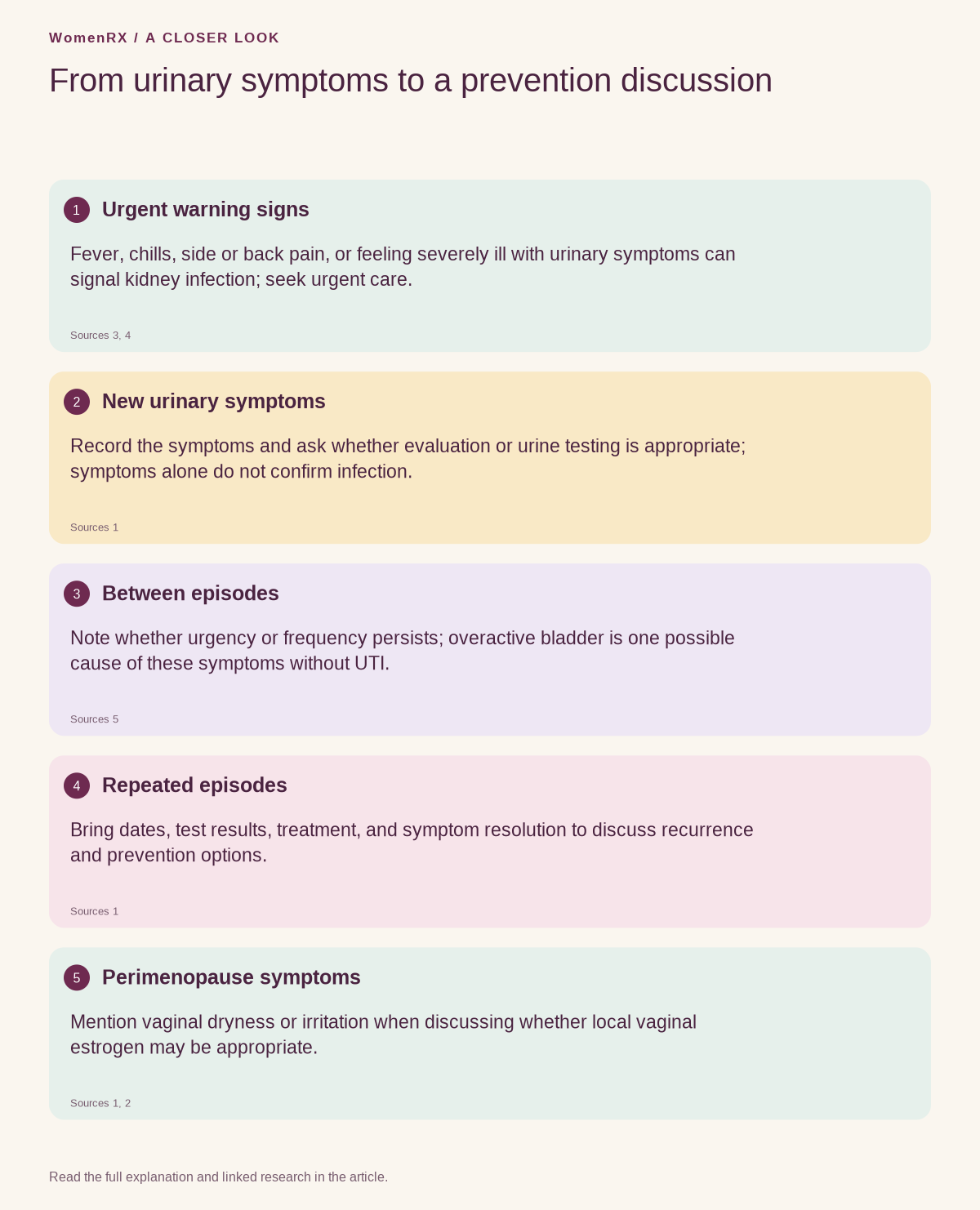
From urinary symptoms to a prevention discussion
Urgent warning signs: Fever, chills, side or back pain, or feeling severely ill with urinary symptoms can signal kidney infection; seek urgent care.34
New urinary symptoms: Record the symptoms and ask whether evaluation or urine testing is appropriate; symptoms alone do not confirm infection.1
Between episodes: Note whether urgency or frequency persists; overactive bladder is one possible cause of these symptoms without UTI.5
Repeated episodes: Bring dates, test results, treatment, and symptom resolution to discuss recurrence and prevention options.1
Perimenopause symptoms: Mention vaginal dryness or irritation when discussing whether local vaginal estrogen may be appropriate.12
Read the figure as text
A simple route from symptoms that need urgent attention to documenting possible episodes and discussing prevention.- Urgent warning signs: Fever, chills, side or back pain, or feeling severely ill with urinary symptoms can signal kidney infection; seek urgent care.34
- New urinary symptoms: Record the symptoms and ask whether evaluation or urine testing is appropriate; symptoms alone do not confirm infection.1
- Between episodes: Note whether urgency or frequency persists; overactive bladder is one possible cause of these symptoms without UTI.5
- Repeated episodes: Bring dates, test results, treatment, and symptom resolution to discuss recurrence and prevention options.1
- Perimenopause symptoms: Mention vaginal dryness or irritation when discussing whether local vaginal estrogen may be appropriate.12
More questions, answered
Does having two episodes mean I definitely have recurrent UTIs?
No. The two-in-six-months threshold is a reason to discuss recurrence and prevention, not proof that both episodes were infections. Review symptoms and any urine-test results with a clinician. 1
Can vaginal estrogen be relevant before menopause?
Guidance includes vaginal estrogen as an option clinicians may consider for recurrent UTIs during perimenopause as well as after menopause. It is also used for vaginal dryness and irritation associated with menopause. Whether it fits your situation is a discussion to have with your clinician. 12
Sources you can check
- Urinary tract infections (UTIs) - NHSAccessed 2026-09-25Return to first citation
- About vaginal oestrogen - NHSAccessed 2026-09-25Return to first citation
- [Epidemiology, risk factors, diagnosis, and microbiology of suppurative pyelonephritis: a systematic review and meta-analysis, part 1].Pavlov V N, Vorobyev V A, Ananyev V A. · Urologiia (Moscow, Russia : 1999) · 2025Return to first citation
- Fluoroquinolone-Resistant and Extended-Spectrum β-Lactamase-Producing Escherichia coli Infections in Patients with Pyelonephritis, United States(1).Talan DA, Takhar SS, Krishnadasan A, Abrahamian FM, Mower WR, Moran GJ, EMERGEncy ID Net Study Group. · Emerging infectious diseases · 2016Return to first citation
- Comparing the safety and efficacy of vibegron, mirabegron and tolterodine in patients with overactive bladder: a systematic review and network meta-analysis.Mohamed-Ahmed R, Rantell A, Robinson D. · European journal of obstetrics, gynecology, and reproductive biology · 2026Return to first citation