Recurrent UTIs, Fertility, and Pregnancy: What Changes?
Repeated bladder infections call for a closer look, but the site and type of infection matter more to fertility and pregnancy plans than the word “recurrent.”
Repeated, confirmed bladder infections don’t, by themselves, establish a fertility problem. That history also can’t tell you whether your chance of conceiving has changed. An STI is a separate infection with different fertility implications. If you think you have a UTI during pregnancy, contact your prenatal care team; back or side pain with urinary concerns calls for prompt assessment. 124678
Before pregnancy: separate a bladder problem from a fertility problem
The urinary tract includes both the bladder and kidneys, but a bladder infection is a lower-tract infection, distinct from a kidney infection. Conception depends on a different set of factors. Even if your repeated bladder infections were confirmed, that history alone cannot tell you whether your chance of conceiving has changed. It isn't an infertility diagnosis, but that isn't proof the infections have no effect on fertility, either. When someone is having trouble getting pregnant, a fertility evaluation looks at ovulation, the structure and openness of the reproductive tract, and sperm, rather than treating a history of bladder UTIs as an explanation on its own. 126
That distinction doesn't mean recurring symptoms should be ignored. If you've had two UTIs in six months or three in a year, that's a useful reason to have the pattern assessed. A clinician may need to establish whether the episodes really are bladder infections, especially if symptoms persist after treatment. Urinary urgency or frequency can occur with other conditions, too. 15 If back or side pain below the ribs occurs along with urinary concerns before pregnancy, arrange an assessment rather than assuming it's your usual bladder infection. The pain alone doesn't identify where an infection is. 12
An STI is a separate question worth raising when it's relevant to you. Several STIs, including chlamydia, can affect fertility. If there's a possibility of an STI, ask about testing rather than assuming every urinary concern is another bladder infection. The distinction matters because a history described simply as “recurrent UTIs” doesn't identify which infection was present. 41
If you've already been trying to conceive without success, don't let the UTI question delay a broader fertility evaluation. In US patient guidance, infertility may be assessed after a year of frequent unprotected sex, or after six months if you're 35 or older. Evaluation can consider factors affecting either partner. 36
During pregnancy: the infection's location matters more
Pregnancy changes the stakes for a current urinary infection. Bacteria in the urine may be found even without symptoms, which is one reason early-pregnancy urine screening is recommended. A bladder infection and a kidney infection are not interchangeable: infection involving the kidneys, called pyelonephritis, is associated with maternal complications and, in some studies, preterm birth or low birth weight. 89
For example, frequent or urgent urination, or pain in your back or side below the ribs, may raise a urinary concern. Those symptoms don't establish whether an infection is in the bladder or kidneys. If you're pregnant and think you have a UTI, contact your prenatal care team about assessment and treatment rather than relying on how a previous infection felt. If you also have back or side pain below the ribs, seek prompt assessment so the cause can be evaluated. 278
Antibiotic choices during pregnancy need to account for the infection being treated as well as pregnancy. A medicine considered for bacteria in the urine or a bladder infection isn't automatically the right treatment for a kidney infection. Research on preventing recurrent UTIs specifically during pregnancy remains limited, so a past treatment plan shouldn't simply be carried over into pregnancy. 8
The practical question is not just “How many UTIs have I had?” It's “Were these confirmed bladder infections, could another infection explain the concern, and is there concern about kidney involvement?” Those answers point to different next steps before conception and during pregnancy. 1468
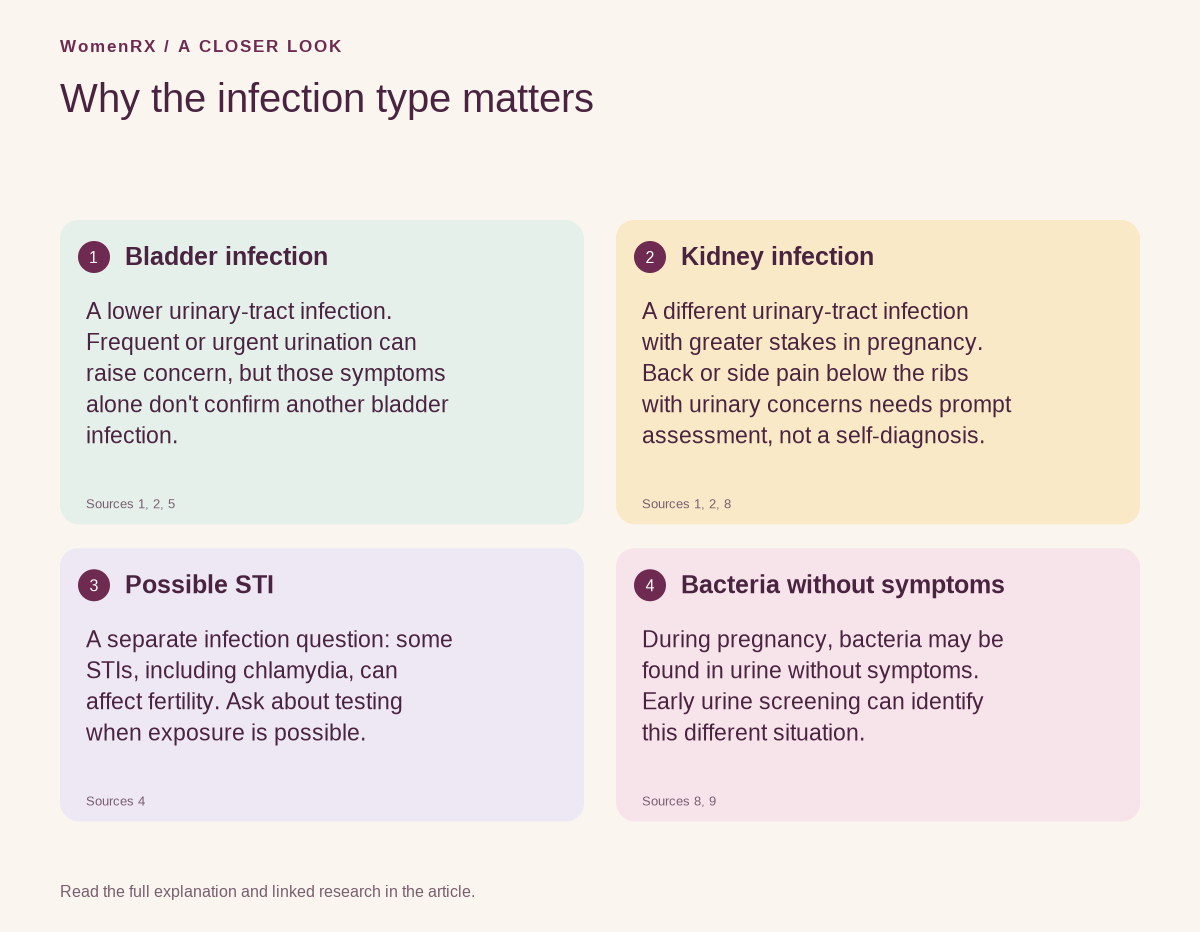
Why the infection type matters
Bladder infection: A lower urinary-tract infection. Frequent or urgent urination can raise concern, but those symptoms alone don't confirm another bladder infection.125
Kidney infection: A different urinary-tract infection with greater stakes in pregnancy. Back or side pain below the ribs with urinary concerns needs prompt assessment, not a self-diagnosis.128
Possible STI: A separate infection question: some STIs, including chlamydia, can affect fertility. Ask about testing when exposure is possible.4
Bacteria without symptoms: During pregnancy, bacteria may be found in urine without symptoms. Early urine screening can identify this different situation.89
Read the figure as text
Compare where an infection or finding occurs, what symptoms may raise a urinary concern, and why the distinction matters for fertility or pregnancy. Symptoms alone can't identify the cause.- Bladder infection: A lower urinary-tract infection. Frequent or urgent urination can raise concern, but those symptoms alone don't confirm another bladder infection.125
- Kidney infection: A different urinary-tract infection with greater stakes in pregnancy. Back or side pain below the ribs with urinary concerns needs prompt assessment, not a self-diagnosis.128
- Possible STI: A separate infection question: some STIs, including chlamydia, can affect fertility. Ask about testing when exposure is possible.4
- Bacteria without symptoms: During pregnancy, bacteria may be found in urine without symptoms. Early urine screening can identify this different situation.89
More questions, answered
Should I wait for UTI symptoms before mentioning my history in pregnancy?
No. Bacteria can be present in urine without symptoms during pregnancy, and early-pregnancy urine screening is recommended. Tell your prenatal care team about your recurrent UTI history so they can interpret any current symptoms or test results in context. 89
Sources you can check
- Urinary tract infections (UTIs) - NHSAccessed 2026-09-25Return to first citation
- Urinary Tract Infections | UTI | UTI Symptoms | MedlinePlusAccessed 2026-09-25Return to first citation
- Infertility | Infertility Treatments | MedlinePlusAccessed 2026-09-25Return to first citation
- Infertility - NHSAccessed 2026-09-25Return to first citation
- Invasive urodynamic investigations in the management of women with refractory overactive bladder symptoms: FUTURE, a superiority RCT and economic evaluation.Abdel-Fattah M, Chapple C, Breeman S, Cooper D, Bell-Gorrod H, Kuppanda P, Guerrero K, Dixon S, Cotterill N, Ward K, Hashim H, Monga A, Brown K, Drake M, Gammie A, Mostafa A, Bruce... · Health technology assessment (Winchester, England) · 2025Return to first citation
- Fertility evaluation of infertile women: a committee opinion (2021) | American Society for Reproductive Medicine | ASRMAccessed 2026-09-25Return to first citation
- Infections and Pregnancy | Antibiotics | MedlinePlusAccessed 2026-09-25Return to first citation
- Urinary tract infections in pregnancy.Ansaldi Y, Martinez de Tejada Weber B. · Clinical microbiology and infection : the official publication of the European Society of Clinical Microbiology and Infectious Diseases · 2023Return to first citation
- Urinary Tract Infection and Bacteriuria in Pregnancy.Glaser AP, Schaeffer AJ. · The Urologic clinics of North America · 2015Return to first citation