Can Perimenopause Be Linked to Recurrent UTIs?
Changing estrogen levels may play a part in urinary symptoms, but recurring discomfort doesn’t always mean another infection.
Yes, perimenopause may be part of the picture when UTIs keep returning. Falling estrogen can contribute to vaginal dryness and irritation, and vaginal estrogen is an option to discuss for recurrent UTIs around menopause. But symptoms alone can’t confirm an infection or show that hormones caused it. If symptoms recur, ask whether urine testing or a culture would help clarify the pattern. 1 2 5
Menopause can play a part, but it isn’t a diagnosis
UTIs are usually caused by bacteria entering the urinary tract. Around menopause, falling estrogen can also contribute to vaginal dryness and irritation. Discomfort in this area can be hard to interpret from the sensation alone: burning or irritation doesn’t tell you whether you have an infection, menopause-related symptoms, or both. 1 2
There may also be a connection between estrogen changes and infection risk. Research reviews describe changes in vaginal microbial communities after menopause, including less Lactobacillus dominance, and report that vaginal estrogen can reduce UTI recurrence. Those findings don’t make estrogen loss the sole explanation. Recurrent infections can have several contributors, including difficulty fully emptying the bladder. 5 6
Most of the research on these microbial changes concerns postmenopause. It helps explain why menopause may be relevant to a prevention discussion, but it cannot establish that perimenopause caused one person’s urinary symptoms. 5 6
Count episodes, then ask what they were
A commonly used definition of recurrent UTI is two symptomatic episodes within six months or three within twelve months. The number is a reason to assess the pattern, not proof that every episode was an infection. Requirements for confirming episodes with urine tests vary. 1 5
For example, if burning has returned several times but none of those episodes was assessed, ask whether a urine test or culture would help the next time symptoms appear. Testing isn’t always needed for a suspected UTI, but repeated symptoms make it useful to clarify what has happened. In one observational study of adult women with recurrent UTIs, researchers counted an episode only when a positive urine culture appeared alongside a diagnosis related to relevant symptoms. That was the study’s definition, not a rule for every person or every episode. 1 4
A test result isn’t the whole story, either. Symptoms can resemble other conditions, and urine tests do not always detect infection in cases described as chronic UTI. If discomfort keeps coming back, neither “it must be menopause” nor “it must be another UTI” is a reliable shortcut. 1
Where vaginal estrogen fits
Vaginal estrogen is a local treatment for menopausal vaginal symptoms such as dryness and irritation. The North American Menopause Society recommends low-dose vaginal estrogen, among other options, for bothersome genitourinary symptoms that haven’t improved with over-the-counter treatments when systemic hormone therapy isn’t otherwise indicated. Separately, UTI guidance includes vaginal estrogen among options to consider when infections recur during perimenopause or after menopause. 1 2 3
These are related but different discussions: treating vaginal symptoms and trying to prevent future UTIs. Vaginal estrogen is not a treatment for an active infection. A recent review reports reduced UTI recurrence with vaginal estrogen, but it does not provide an effect estimate here that could predict how much one person might benefit. Much of the menopause-specific research concerns women after menopause rather than those in perimenopause. 1 2 5
The most useful next question is which problem needs attention. Have your past episodes been assessed as infections? Is vaginal dryness or irritation present between episodes? Could more than one thing be happening? The answers can shape a discussion about testing, symptom relief, and prevention without treating them as interchangeable.
If it happens again, bring the pattern into focus
Note what symptoms return, when they occur, whether a urine test or culture was done, and what happened afterward. That gives you a way to distinguish episodes assessed as UTIs from discomfort whose cause remains unclear.
If you’ve had two suspected UTIs in six months or three in a year, seek an assessment of the recurring pattern. Ask whether testing would help with a future episode and whether menopause-related vaginal symptoms or vaginal estrogen belong in the conversation. You don’t need to decide on your own which explanation is right before asking for help. 1 2 5
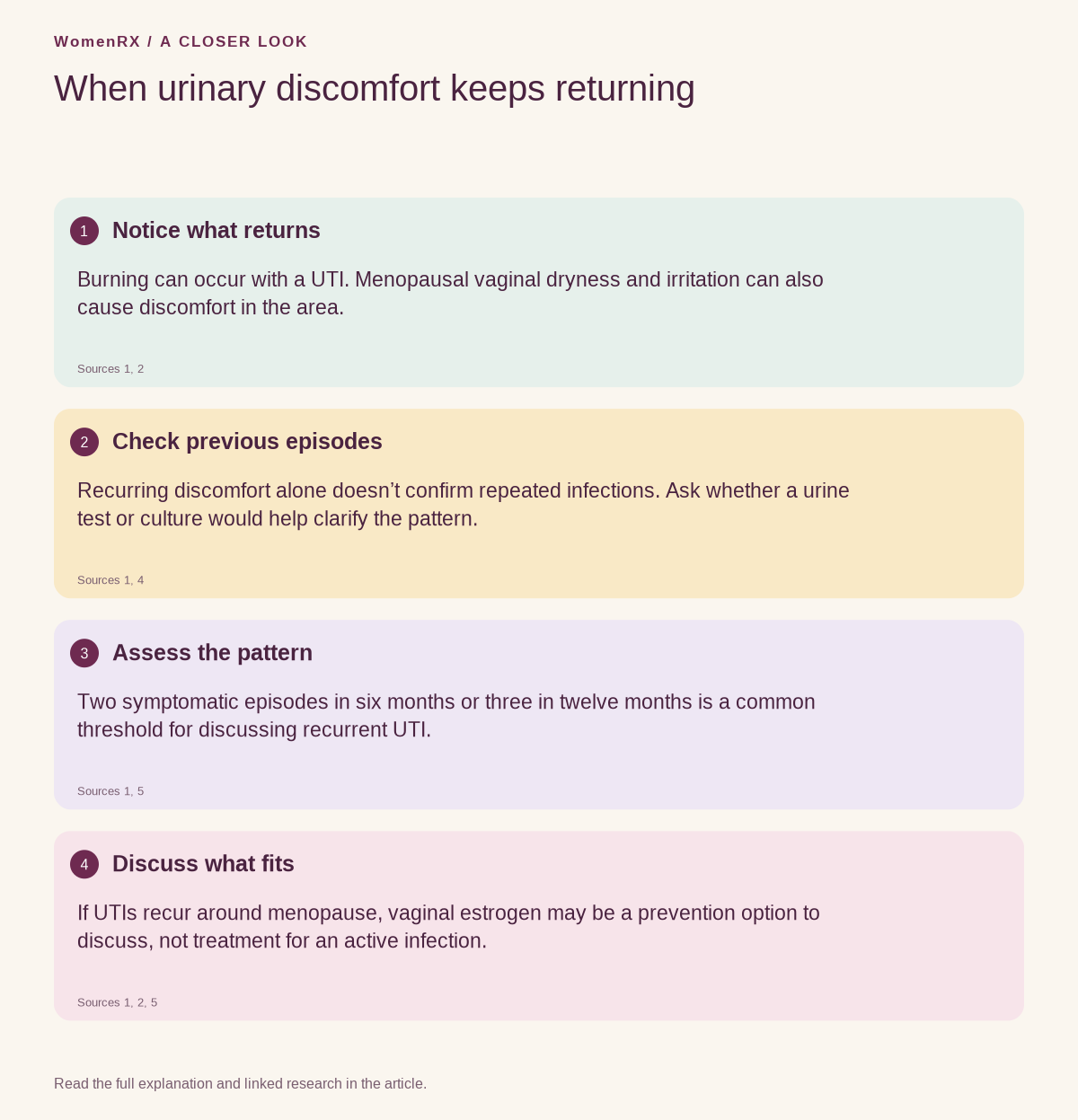
When urinary discomfort keeps returning
Notice what returns: Burning can occur with a UTI. Menopausal vaginal dryness and irritation can also cause discomfort in the area.12
Check previous episodes: Recurring discomfort alone doesn’t confirm repeated infections. Ask whether a urine test or culture would help clarify the pattern.14
Assess the pattern: Two symptomatic episodes in six months or three in twelve months is a common threshold for discussing recurrent UTI.15
Discuss what fits: If UTIs recur around menopause, vaginal estrogen may be a prevention option to discuss, not treatment for an active infection.125
Read the figure as text
This flow shows why symptoms, previous test results, and vaginal symptoms answer different questions.- Notice what returns: Burning can occur with a UTI. Menopausal vaginal dryness and irritation can also cause discomfort in the area.12
- Check previous episodes: Recurring discomfort alone doesn’t confirm repeated infections. Ask whether a urine test or culture would help clarify the pattern.14
- Assess the pattern: Two symptomatic episodes in six months or three in twelve months is a common threshold for discussing recurrent UTI.15
- Discuss what fits: If UTIs recur around menopause, vaginal estrogen may be a prevention option to discuss, not treatment for an active infection.125
More questions, answered
Is vaginal estrogen the same as systemic hormone therapy?
No. Vaginal estrogen acts locally and is used for symptoms such as menopausal vaginal dryness and irritation. It isn’t intended to treat symptoms such as hot flashes. Its possible role in preventing recurrent UTIs is a separate question from treating an infection that’s happening now. 1 2
Sources you can check
- Urinary tract infections (UTIs) - NHSAccessed 2026-09-25Return to first citation
- About vaginal oestrogen - NHSAccessed 2026-09-25Return to first citation
- The 2022 hormone therapy position statement of The North American Menopause Society.“The 2022 Hormone Therapy Position Statement of The North American Menopause Society” Advisory Panel. · Menopause (New York, N.Y.) · 2022Return to first citation
- Culture-confirmed Bacterial Species Causing Recurrent Urinary Tract Infection Among Adult Women.Tuddenham S, Brotman RM, Handa VL. · Urogynecology (Philadelphia, Pa.) · 2026Return to first citation
- The Urogenital Microbiome-Metabolic Interface in Postmenopausal Recurrent Urinary Tract Infection: Estrogen Deficiency, Diabetes, Obesity, and Microbial Reservoirs.Alghoul WI, Ashraf R, Rafiuddin S, Kharoufeh AZH, Al-Shammari WBJ, Abedi M, Alabid I, Patni MM, Yousef AJ, Hamdy HA. · Journal of clinical medicine · 2026Return to first citation
- Gut, vaginal, and urinary microbiome alterations in women with genitourinary syndrome of menopause: A systematic review.Tsuboi I, Inoue S, Hirayama T, Mitsui Y, Watanabe M, Hirakawa H, Sadahira T. · Maturitas · 2026Return to first citation