Recurrent UTIs in Your 40s: Is Perimenopause the Cause?
Cycle changes may be relevant, but they can’t tell you whether recurring urinary symptoms are bacterial infections or whether hormones are involved.
Being in your 40s doesn’t establish perimenopause as the cause of recurrent UTIs. First, separate confirmed infections from urinary symptoms that persist or return without a confirmed infection. Urgency and frequency can overlap with overactive bladder symptoms. 5 A urine test may be used when assessing a suspected UTI, though it isn’t always needed; vaginal dryness or irritation may also be relevant context. 1 3
First, separate infections from recurring symptoms
When burning or urgency returns, it’s understandable to call it another UTI. But a symptom pattern and a confirmed bacterial infection aren’t quite the same thing. UTIs usually happen when bacteria enter the urinary tract, and a clinician may use a urine test when assessing a suspected infection, although testing isn’t always needed for an individual episode. 1
Think back over each episode. Was there a urine test or culture? What did it show? Did the symptoms clear after treatment, or have you felt uncomfortable most of the time? Those details can distinguish separate bouts from symptoms that never fully settled. If you’ve had two UTIs in six months or three within twelve months, that’s a recurrent pattern worth discussing. The count alone doesn’t explain why it’s happening. 1
Urgency and frequent urination can overlap with overactive bladder symptoms. In a small study of premenopausal women with overactive bladder, recurrent lower UTI, or neither condition, the urine marker researchers examined did not distinguish the groups. That doesn’t mean symptoms or testing are useless. It means there isn’t a shortcut in that marker for deciding what’s behind one person’s urgency. 5
Where perimenopause fits
If your periods are changing, include that in the picture. Your age or cycle changes alone, though, can’t establish that hormones caused bacterial infections. It’s especially useful to describe vaginal dryness or irritation separately from urinary burning, urgency, or frequency. Vaginal estrogen is used to treat menopause-related vaginal dryness and irritation; it doesn’t address every menopause symptom. 3
A menopause position statement recommends low-dose vaginal estrogen for bothersome genitourinary symptoms that haven’t improved with over-the-counter therapies in women who don’t have an indication for systemic hormone therapy. Separately, a review discussing topical estrogen for recurrent UTI prevention focuses on postmenopausal women. Neither point shows that recurrent symptoms in a particular person in her 40s are hormonal, or that vaginal estrogen will prevent bacterial UTIs during perimenopause. 4 6
If dryness or irritation is bothering you, that’s worth discussing on its own terms. Whether vaginal estrogen is appropriate depends on your health history; for example, unexplained vaginal bleeding or a history of breast cancer calls for a discussion before use. 2
The details that can change the next step
A short, episode-by-episode account is more useful than trying to decide in advance that this is either “UTIs” or “hormones.” Note when symptoms started, which episodes had urine testing, what the results showed, what treatment you used, and whether you felt well between episodes. Add any cycle changes, vaginal dryness or irritation, and medicines or hormone treatments you use as background. 3
Those details lead to different questions. If tests have shown repeated infections, the question is what may be contributing to their return. If urgency or frequency continues between episodes, ask whether something besides a new infection could explain it. And if a test didn’t show infection but symptoms persist, don’t force either conclusion: discuss the result alongside the symptoms rather than assuming it proves, or rules out, a UTI. 1 5
Perimenopause may be part of the conversation. Getting clear about what has actually recurred is the more useful place to start.
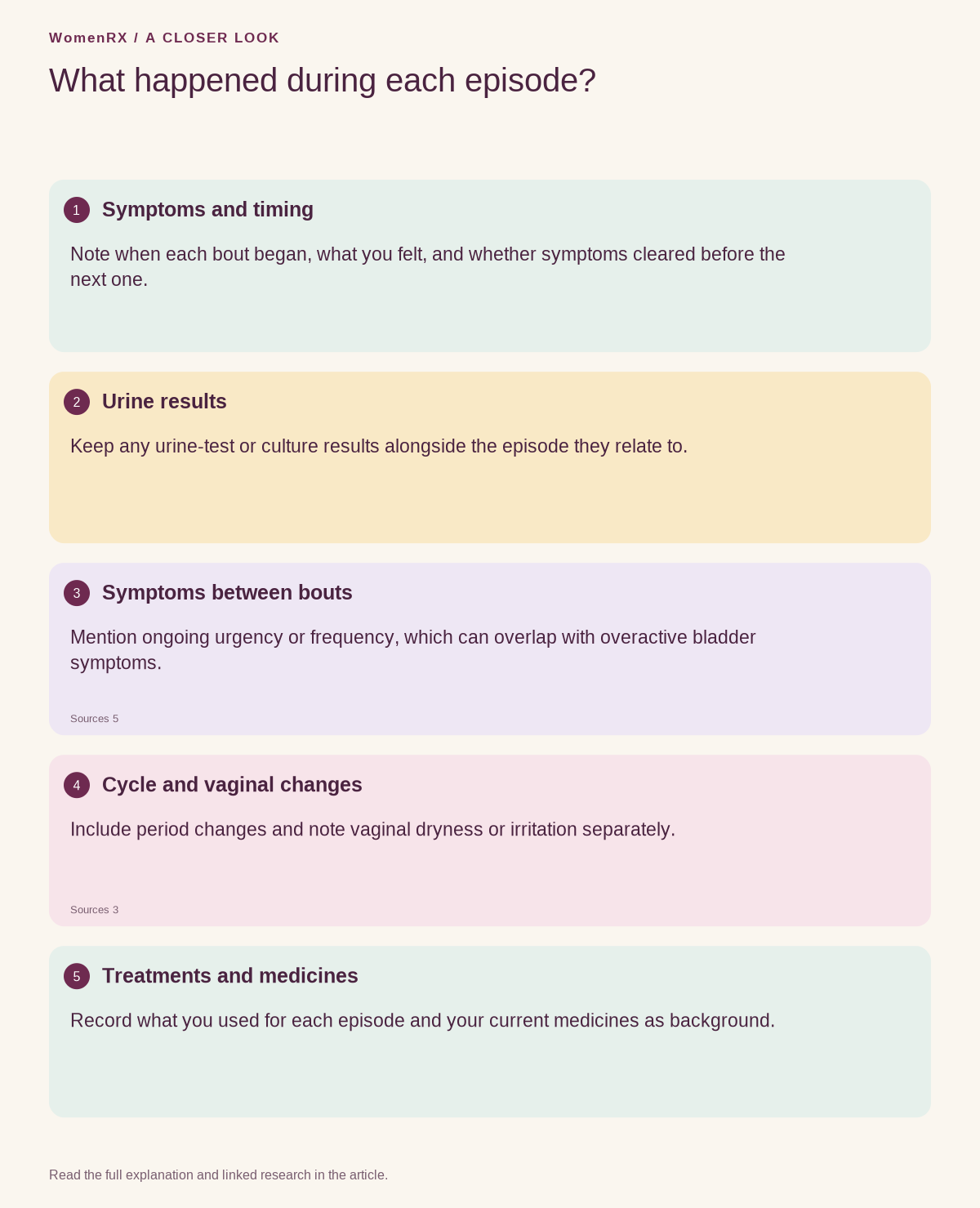
What happened during each episode?
Symptoms and timing: Note when each bout began, what you felt, and whether symptoms cleared before the next one.
Urine results: Keep any urine-test or culture results alongside the episode they relate to.
Symptoms between bouts: Mention ongoing urgency or frequency, which can overlap with overactive bladder symptoms.5
Cycle and vaginal changes: Include period changes and note vaginal dryness or irritation separately.3
Treatments and medicines: Record what you used for each episode and your current medicines as background.
Read the figure as text
Use these details to describe the pattern without assuming every return of symptoms has the same cause.- Symptoms and timing: Note when each bout began, what you felt, and whether symptoms cleared before the next one.
- Urine results: Keep any urine-test or culture results alongside the episode they relate to.
- Symptoms between bouts: Mention ongoing urgency or frequency, which can overlap with overactive bladder symptoms.5
- Cycle and vaginal changes: Include period changes and note vaginal dryness or irritation separately.3
- Treatments and medicines: Record what you used for each episode and your current medicines as background.
Sources you can check
- Urinary tract infections (UTIs) - NHSAccessed 2026-09-25Return to first citation
- Who can and cannot use vaginal oestrogen - NHSAccessed 2026-09-25Return to first citation
- About vaginal oestrogen - NHSAccessed 2026-09-25Return to first citation
- The 2022 hormone therapy position statement of The North American Menopause Society.“The 2022 Hormone Therapy Position Statement of The North American Menopause Society” Advisory Panel. · Menopause (New York, N.Y.) · 2022Return to first citation
- Urine Epidermal Growth Factor/Creatinine Ratio in Female Patients with Overactive Bladder and Recurrent Lower Urinary Tract Infection.Yang TH, Chen CC, Chou YM, Liu JM, Huang KH, Chuang FC. · Gynecology and minimally invasive therapy · 2026Return to first citation
- The role of estrogen in prevention of recurrent urinary tract infections in postmenopausal women.Wiese E, Amjad A, Bartoli G, Beyzarov M, Gigliotti S, Hanna C, Myers O, Galarza C, Adler J. · JAAPA : official journal of the American Academy of Physician Assistants · 2026Return to first citation