What Can You Discuss Instead of Estradiol for Menopause Symptoms?
The right alternative depends on whether you’re treating hot flashes, vaginal symptoms, or both, because these options don’t do the same job.
If estradiol isn’t suitable or isn’t your preference, start with the symptom you most want to address. For hot flashes and night sweats, evidence-supported options include certain SSRIs or SNRIs, gabapentin, fezolinetant, and oxybutynin, as well as cognitive behavioral therapy or clinical hypnosis. Vaginal moisturizers, lubricants, and some prescription treatments target vaginal symptoms instead. Local vaginal estrogen is still estrogen, and it won’t treat hot flashes. 1 3 4
Start with the symptom, not a substitute
Estradiol isn’t right for everyone, and there isn’t one alternative that does everything it can. Menopause hormone therapy is the most effective treatment for hot flashes and genitourinary symptoms, but its benefits and risks depend on factors such as age, time since menopause, the treatment and route, and whether a progestogen is used. If you’re weighing hormone therapy, those details and your medical history matter. 3
It can also help to be precise about what you want to avoid. Are you avoiding systemic estrogen, any estrogen, or a particular estradiol product or route? Local vaginal estrogen contains estrogen too, but it is used for vaginal symptoms rather than whole-body symptoms such as hot flashes. 1
For hot flashes and night sweats
The 2023 North American Menopause Society position statement recommends several nonhormonal options for vasomotor symptoms: SSRIs or SNRIs, gabapentin, and fezolinetant. It also supports oxybutynin. These are distinct medicines, not interchangeable forms of estradiol, and they won’t necessarily suit every person or symptom mix. Medication-specific risks and interactions matter, so the particular medicine needs to be considered alongside your health history and other medicines. 4
Non-drug approaches can be worth considering, too. Cognitive behavioral therapy and clinical hypnosis are recommended for vasomotor symptoms. Weight loss has some support, at a lower evidence level. By contrast, the position statement did not recommend supplements or herbal remedies, exercise, yoga, cooling techniques, or paced respiration as treatments for hot flashes. That assessment is about treating vasomotor symptoms, not whether an activity might have other benefits for your wellbeing. 4
A practical distinction: behavioral treatment and medication are options for hot flashes, while vaginal products and treatments generally have a different target. If hot flashes are the main issue, a vaginal treatment is not a direct substitute for systemic estradiol. 1 4
For vaginal dryness or irritation
Vaginal moisturizers and lubricants may help with vaginal symptoms. Menopause guidance also identifies vaginal dehydroepiandrosterone (DHEA) and oral ospemifene as treatment options for bothersome genitourinary symptoms. These choices belong in a different conversation from medicines aimed at hot flashes; the right fit depends on your symptoms and medical circumstances. 2 3
Low-dose vaginal estrogen is another option for vaginal symptoms, particularly when over-the-counter treatments haven’t helped and systemic hormone therapy isn’t otherwise indicated. It is local treatment: it can help vaginal dryness and irritation, but it does not treat hot flashes. Because it still contains estrogen, it may not fit someone who wants to avoid estrogen altogether. Local treatment and systemic estradiol are different approaches, not equivalent substitutes. 1 3
When symptoms overlap
If hot flashes are disrupting sleep, you may want to weigh that priority alongside vaginal discomfort or other concerns. No single option is best for every combination of symptoms. The main comparison is whether a treatment targets hot flashes, vaginal symptoms, or both, and what its specific considerations are for you. The options above shouldn’t be treated as a ranking or as interchangeable treatments. 3 4
A useful way to frame the decision is: “Which symptom is this option meant to treat, and am I trying to avoid systemic estrogen or all estrogen?” That can help prevent a mismatch, such as expecting local vaginal estrogen to ease night sweats or expecting a hot-flash treatment to resolve vaginal dryness.
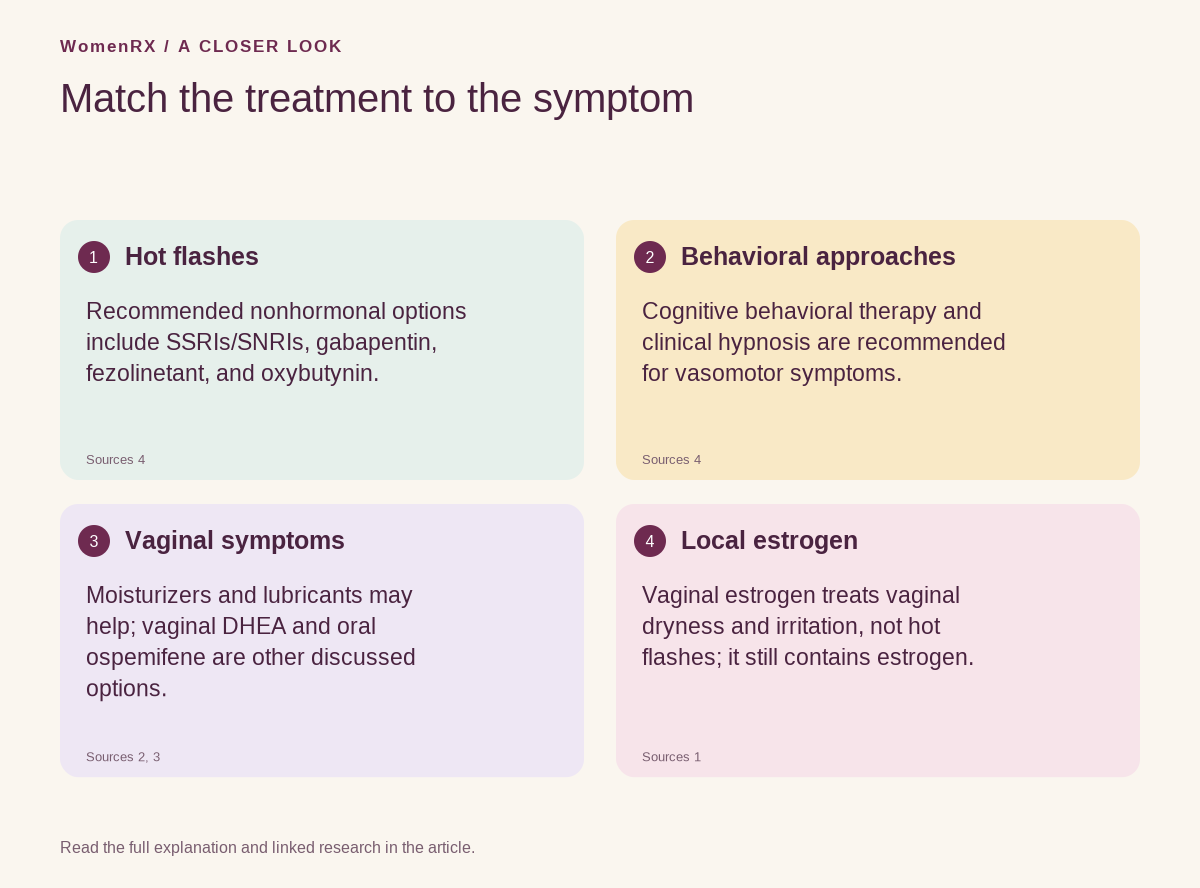
Match the treatment to the symptom
Hot flashes: Recommended nonhormonal options include SSRIs/SNRIs, gabapentin, fezolinetant, and oxybutynin.4
Behavioral approaches: Cognitive behavioral therapy and clinical hypnosis are recommended for vasomotor symptoms.4
Vaginal symptoms: Moisturizers and lubricants may help; vaginal DHEA and oral ospemifene are other discussed options.23
Local estrogen: Vaginal estrogen treats vaginal dryness and irritation, not hot flashes; it still contains estrogen.1
Read the figure as text
These categories have different targets. The comparison separates hot-flash approaches from options for vaginal symptoms and shows why local vaginal estrogen is not a substitute for systemic estradiol.- Hot flashes: Recommended nonhormonal options include SSRIs/SNRIs, gabapentin, fezolinetant, and oxybutynin.4
- Behavioral approaches: Cognitive behavioral therapy and clinical hypnosis are recommended for vasomotor symptoms.4
- Vaginal symptoms: Moisturizers and lubricants may help; vaginal DHEA and oral ospemifene are other discussed options.23
- Local estrogen: Vaginal estrogen treats vaginal dryness and irritation, not hot flashes; it still contains estrogen.1
More questions, answered
Can vaginal estrogen help hot flashes?
No. Vaginal estrogen is a local treatment for vaginal symptoms such as dryness and irritation; it does not treat hot flashes. It still contains estrogen, so it may not suit someone who wants to avoid estrogen altogether. 1
Are exercise or supplements proven treatments for hot flashes?
The 2023 North American Menopause Society position statement did not recommend exercise or supplements and herbal remedies as treatments for vasomotor symptoms. That doesn’t determine whether they have other benefits, but they shouldn’t be presented as proven substitutes for symptom treatment. 4
Sources you can check
- About vaginal oestrogen - NHSAccessed 2026-09-25Return to first citation
- Common questions about vaginal oestrogen - NHSAccessed 2026-09-25Return to first citation
- The 2022 hormone therapy position statement of The North American Menopause Society.“The 2022 Hormone Therapy Position Statement of The North American Menopause Society” Advisory Panel. · Menopause (New York, N.Y.) · 2022Return to first citation
- The 2023 nonhormone therapy position statement of The North American Menopause Society.Menopause (New York, N.Y.) · 2023Return to first citation