Could Vaginal Estrogen Help With Genitourinary Menopause Symptoms?
If dryness, pain with sex, or urinary symptoms are bothering you around or after menopause, vaginal estrogen may be worth discussing, even if you don’t need hormone therapy for hot flashes.
Vaginal estrogen may be an option if menopause-related vaginal or urinary symptoms are bothering you, especially when nonhormonal products haven’t helped enough. It works mainly in vaginal tissues and can be used on its own or alongside systemic hormone therapy. Symptoms can have other causes, so discuss what’s happening rather than assuming menopause is the explanation. A personal history of breast cancer calls for a more individualized conversation. 1 2
Dryness, burning, irritation, discomfort with sex, and some urinary symptoms can happen with genitourinary syndrome of menopause (GSM). If these changes are affecting your comfort or daily life, vaginal estrogen is one treatment to ask about. It’s a local treatment, not the same as taking systemic hormone therapy for symptoms such as hot flashes. 1 2
First, make sure the symptoms fit
Symptoms alone don’t confirm that menopause is the cause. Vaginal discomfort or urinary changes can have other explanations, too, so it’s reasonable to ask for an assessment, particularly if the symptoms are new, persistent, or not responding to what you’ve tried. The treatment discussion depends on what symptoms you have and what may be causing them.
GSM can include both vaginal symptoms and urinary symptoms. But a urinary concern such as recurrent urinary tract infections or overactive bladder may need a more specific management discussion; NICE directs clinicians to separate guidance for those situations. 1
When vaginal estrogen may be a fit
Guidelines recommend offering vaginal estrogen for symptoms associated with menopause. The North American Menopause Society also recommends low-dose vaginal estrogen, or other treatments, for bothersome GSM symptoms that haven’t improved with over-the-counter therapies when there’s no reason to use systemic hormone therapy. 1 2
That distinction can be useful if you’re weighing treatment for symptoms mainly affecting the vagina or urinary tract. Vaginal estrogen acts locally, with much less entering the bloodstream than with systemic hormone therapy. NICE describes the absorbed amount as minimal compared with systemic treatment and unlikely to have a significant effect throughout the body. That doesn’t mean it has no considerations for every person or medical history. 1
Vaginal estrogen comes in forms including cream, gel, tablet, pessary, and ring. A shared decision with your clinician can take your preferences and practical needs into account. It can also be used alongside nonhormonal vaginal moisturizers or lubricants; these products serve different roles and can be part of the same plan. 1
If you’d rather not use hormones
If vaginal estrogen isn’t suitable for you or you’d prefer not to use it, NICE recommends considering vaginal moisturizers or lubricants. If these options and vaginal estrogen haven’t worked or aren’t tolerated, other prescription treatments may be discussed. The right next step depends on your symptoms and circumstances. 1
If you’ve had breast cancer
This calls for an individualized discussion, not a blanket yes or no. NICE recommends offering nonhormonal moisturizers or lubricants first for people with a personal history of breast cancer. If symptoms continue despite trying them, vaginal estrogen can be considered. The guideline says it’s unknown whether vaginal estrogen affects breast cancer recurrence risk. 1
If you’re currently taking an aromatase inhibitor as part of breast cancer treatment, NICE recommends working with a breast cancer specialist to identify options when symptoms persist despite nonhormonal treatment. Mention your cancer history and current treatment before choosing a product. 1
Plan for a check-in
Treatment should be reviewed regularly. Symptoms often return after vaginal estrogen is stopped, and NICE says treatment can be restarted if needed. A useful follow-up is a chance to say which symptoms have changed, which haven’t, and whether the form of treatment still suits you. 1
You might ask: “Could these symptoms be GSM, or should we look for another cause?” “Would a local treatment make sense for me, or do I have a reason to consider systemic therapy?” If you’ve had breast cancer, ask how your history or current treatment affects the options. These questions keep the conversation focused on your symptoms and the tradeoffs that matter to you.
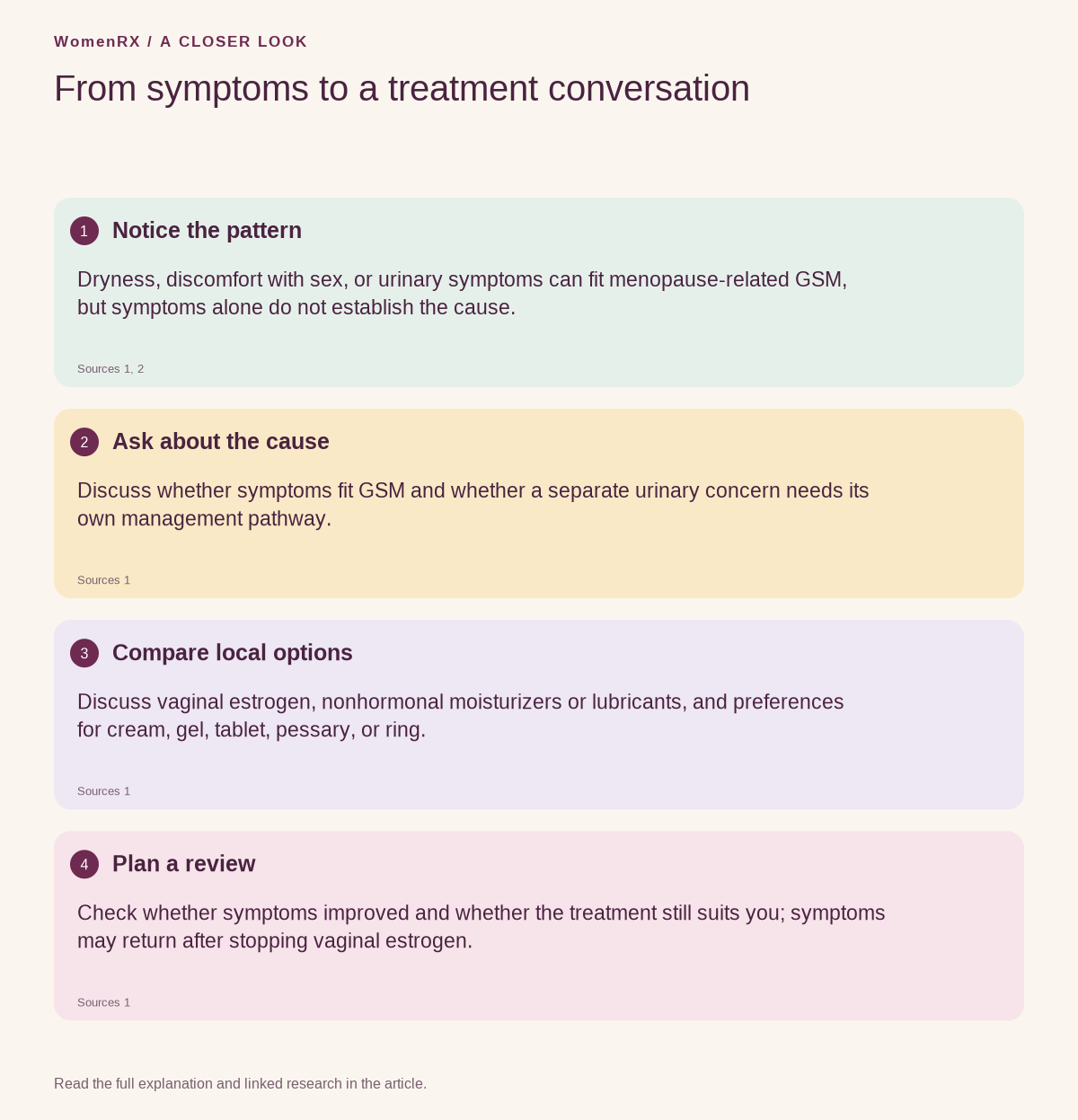
From symptoms to a treatment conversation
Notice the pattern: Dryness, discomfort with sex, or urinary symptoms can fit menopause-related GSM, but symptoms alone do not establish the cause.12
Ask about the cause: Discuss whether symptoms fit GSM and whether a separate urinary concern needs its own management pathway.1
Compare local options: Discuss vaginal estrogen, nonhormonal moisturizers or lubricants, and preferences for cream, gel, tablet, pessary, or ring.1
Plan a review: Check whether symptoms improved and whether the treatment still suits you; symptoms may return after stopping vaginal estrogen.1
Read the figure as text
A simple path from noticing symptoms to choosing what to discuss, without treating symptoms alone as a diagnosis.- Notice the pattern: Dryness, discomfort with sex, or urinary symptoms can fit menopause-related GSM, but symptoms alone do not establish the cause.12
- Ask about the cause: Discuss whether symptoms fit GSM and whether a separate urinary concern needs its own management pathway.1
- Compare local options: Discuss vaginal estrogen, nonhormonal moisturizers or lubricants, and preferences for cream, gel, tablet, pessary, or ring.1
- Plan a review: Check whether symptoms improved and whether the treatment still suits you; symptoms may return after stopping vaginal estrogen.1
More questions, answered
Can vaginal estrogen be used with systemic hormone therapy?
Yes. NICE says vaginal estrogen can be offered for menopause-related genitourinary symptoms, including for people already using systemic hormone therapy. The two approaches address different treatment needs, so it’s worth discussing whether local treatment could help the symptoms you still have. 1
Does vaginal estrogen replace lubricant or moisturizer?
Not necessarily. NICE says vaginal estrogen can be used alone or alongside nonhormonal moisturizers or lubricants. Your symptoms and preferences can guide whether one approach or a combination makes sense. 1
Sources you can check
- Recommendations | Menopause: identification and management | Guidance | NICEAccessed 2026-09-25Return to first citation
- The 2022 hormone therapy position statement of The North American Menopause Society.“The 2022 Hormone Therapy Position Statement of The North American Menopause Society” Advisory Panel. · Menopause (New York, N.Y.) · 2022Return to first citation