Alternatives to estradiol: what options have evidence for menopause symptoms?
The best-supported alternative depends on whether your main concern is hot flashes, vaginal symptoms, or both.
For hot flashes and night sweats, evidence-supported nonhormonal options include certain prescription medicines, cognitive behavioral therapy, and clinical hypnosis; weight loss may help some people. For vaginal dryness or pain with sex, lubricants and moisturizers can ease symptoms. These choices don’t work like estradiol, and supplements aren’t established substitutes. The right comparison starts with the symptom you want to treat. 2 4
Estradiol isn’t the only way to treat menopause symptoms, but there isn’t one nonhormonal option that replaces all of its effects. Start by separating the problem you most want to relieve: hot flashes and night sweats call for a different comparison than vaginal dryness or pain with sex. Some people have both and may need separate approaches.
Hormone therapy remains the most effective treatment for hot flashes and genitourinary symptoms of menopause. Its benefits and risks depend on factors such as treatment type, route, timing, and personal health context, so avoiding or changing estradiol is a preference to discuss, not proof that every form is unsuitable. 1
For hot flashes, compare treatments with evidence
The Menopause Society’s 2023 position statement recommends several nonhormonal options for vasomotor symptoms, which include hot flashes and night sweats: cognitive behavioral therapy, clinical hypnosis, certain antidepressants called SSRIs or SNRIs, gabapentin, and fezolinetant. Oxybutynin is also recommended, with somewhat less consistent evidence. These options differ in what kind of treatment they are, so a discussion can focus on what fits your health history and preferences rather than searching for a single “natural” substitute. 4
Fezolinetant is a nonhormonal medicine that targets a brain signaling pathway involved in temperature regulation. It doesn’t replace estrogen. An early, 12-week randomized trial in generally healthy menopausal women found fewer moderate-to-severe hot flashes with fezolinetant than with placebo, but the broader reason to consider it as an option is the later position statement’s evidence review, not that one small trial alone establishes its effects for everyone. 3 4
Cognitive behavioral therapy and clinical hypnosis are evidence-supported options too. They’re not hormone treatments and may be worth discussing if you want a behavioral approach. Weight loss is another option the position statement supports, but at a lower evidence level. By contrast, cooling strategies, avoiding triggers, exercise, yoga, mindfulness, and relaxation weren’t recommended as treatments for hot flashes in that evidence review. They may still be personally useful for comfort or general wellbeing; the distinction is that they shouldn’t be presented as proven substitutes for symptom treatment. 4
What about herbal products?
“Natural” doesn’t mean equivalent to estradiol or free of risk. The 2023 position statement did not recommend supplements or herbal remedies for hot flashes. One later randomized trial tested a particular multi-ingredient botanical product for 12 weeks in 74 participants, of whom 68 completed the study. The product reduced hot flashes more than placebo in that trial, but a result for one formulation doesn’t establish that other supplements work, or show how well it works over longer periods. It’s a reason for further study, not a basis for treating botanical products as proven estradiol alternatives. 4 5
For vaginal dryness, start with the symptom
For dryness or discomfort with sex, over-the-counter lubricants can be used during sexual activity, while vaginal moisturizers are intended to ease symptoms more generally. A review found that both can help, though products vary in ingredients and properties. If choosing one, the review suggests looking for products designed to be similar to vaginal secretions in pH and concentration, and avoiding products with potentially harmful ingredients. 2
If symptoms remain bothersome, ask about options for genitourinary symptoms of menopause. Low-dose vaginal estrogen, vaginal dehydroepiandrosterone, and oral ospemifene are among the therapies named in the Menopause Society’s hormone therapy statement. Low-dose vaginal estrogen is still estrogen, so it isn’t an estrogen-free alternative to estradiol, even though the treatment is directed at vaginal symptoms. These options aren’t interchangeable with hot-flash treatments. 1
A useful way to weigh the choice
Bring the comparison back to four questions: Which symptom is most disruptive? Are you looking for a medicine, a behavioral treatment, or an over-the-counter product? Are you hoping to treat hot flashes, vaginal symptoms, or both? And what personal health factors or treatment preferences should shape the choice? The answer may be different for someone who wants to avoid systemic hormone therapy than for someone who wants to avoid estrogen in every form.
If hot flashes and vaginal discomfort are both affecting you, ask about treating each symptom on its own merits. A moisturizer may help dryness but isn’t a hot-flash treatment; a nonhormonal hot-flash medicine isn’t a treatment for vaginal symptoms. That distinction can make the options easier to compare without expecting any one choice to do everything. 1 2 4
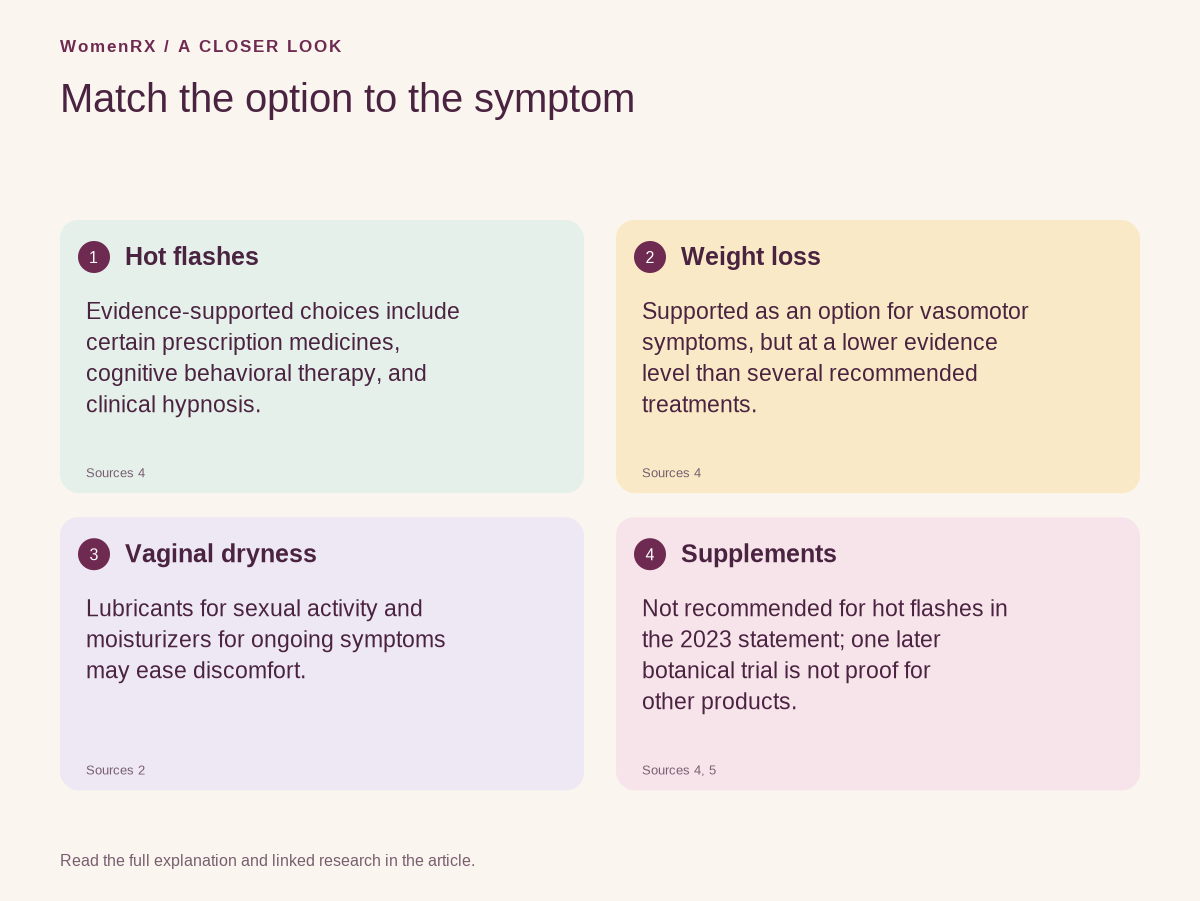
Match the option to the symptom
Hot flashes: Evidence-supported choices include certain prescription medicines, cognitive behavioral therapy, and clinical hypnosis.4
Weight loss: Supported as an option for vasomotor symptoms, but at a lower evidence level than several recommended treatments.4
Vaginal dryness: Lubricants for sexual activity and moisturizers for ongoing symptoms may ease discomfort.2
Supplements: Not recommended for hot flashes in the 2023 statement; one later botanical trial is not proof for other products.45
Read the figure as text
Hot flashes and vaginal symptoms call for different comparisons. This guide separates evidence-supported approaches from products or habits that shouldn’t be assumed to substitute for estradiol.- Hot flashes: Evidence-supported choices include certain prescription medicines, cognitive behavioral therapy, and clinical hypnosis.4
- Weight loss: Supported as an option for vasomotor symptoms, but at a lower evidence level than several recommended treatments.4
- Vaginal dryness: Lubricants for sexual activity and moisturizers for ongoing symptoms may ease discomfort.2
- Supplements: Not recommended for hot flashes in the 2023 statement; one later botanical trial is not proof for other products.45
More questions, answered
Can lifestyle changes replace estradiol for hot flashes?
Some approaches, including cognitive behavioral therapy and clinical hypnosis, are evidence-supported treatments. But the 2023 position statement did not recommend cooling strategies, exercise, yoga, mindfulness, or relaxation as treatments for hot flashes. They may still suit your preferences or support general wellbeing, but they shouldn’t be assumed to replace an evidence-supported treatment. 4
If I want to avoid estradiol, are vaginal treatments still an option?
Lubricants and moisturizers are nonhormonal options that may ease vaginal dryness or discomfort. Low-dose vaginal estrogen is still estrogen; vaginal dehydroepiandrosterone and oral ospemifene are other therapies discussed for genitourinary symptoms. These options address a different symptom target than treatments for hot flashes. 1 2
Sources you can check
- The 2022 hormone therapy position statement of The North American Menopause Society.“The 2022 Hormone Therapy Position Statement of The North American Menopause Society” Advisory Panel. · Menopause (New York, N.Y.) · 2022Return to first citation
- Vaginal lubricants and moisturizers: a review into use, efficacy, and safety.Potter N, Panay N. · Climacteric : the journal of the International Menopause Society · 2021Return to first citation
- Treatment of Menopausal Vasomotor Symptoms With Fezolinetant, a Neurokinin 3 Receptor Antagonist: A Phase 2a Trial.Depypere H, Timmerman D, Donders G, Sieprath P, Ramael S, Combalbert J, Hoveyda HR, Fraser GL. · The Journal of clinical endocrinology and metabolism · 2019Return to first citation
- The 2023 nonhormone therapy position statement of The North American Menopause Society.Menopause (New York, N.Y.) · 2023Return to first citation
- Neurokinin pathway botanical antagonist for menopausal vasomotor symptoms: A randomized, double-blind, placebo-controlled study.Lederman S, Minkin MJ, Doyle AL, Rubio J, Recker S, Lin LX, VanDusseldorp T. · Maturitas · 2026Return to first citation