Depression and Menopause: More Than a Hormone Story
Depression risk appears higher during perimenopause, but the transition is one part of a bigger picture that includes past depression, sleep, symptoms, and life stress.
Perimenopause is associated with a higher risk of depressive symptoms and depression diagnoses than premenopause; research has not found the same increase for postmenopause compared with premenopause. That pattern does not show that hormones alone cause depression. A history of depression, disrupted sleep, menopausal symptoms, and stressful life events can also matter. Menopause-stage risk studies do not establish menopausal hormone therapy as a depression treatment. 5 2 4 1
The risk signal is strongest in perimenopause
Depression isn’t inevitable in midlife, and feeling low doesn’t automatically mean hormones are the cause. Still, the transition deserves attention: a 2024 systematic review and meta-analysis of prospective studies found that women in perimenopause had higher odds of depressive symptoms or a depression diagnosis than women before menopause. The pooled odds ratio was 1.40, with a 95% confidence interval of 1.21 to 1.61. The analysis did not find a statistically significant increase for postmenopausal compared with premenopausal women. 5
That result describes groups, not an individual woman’s odds or a certain outcome. The review included 17 prospective cohort studies with 16,061 women, while seven studies with 9,141 participants contributed to the meta-analyses. Studies used different definitions of menopause stages and depression, which may help explain variation in results. The researchers also could not make a reliable direct comparison between perimenopause and postmenopause. 5
The finding points to a period when some women may be more vulnerable, not proof that a hormone change by itself causes depression. Stage-based studies can show that experiences overlap in time; they don’t identify one explanation for every woman’s mood.
Past depression can change the picture
A personal history of depression is a meaningful part of the story. In a Danish register-based cohort of 270,613 people who had given birth, a recorded history of postpartum depression was associated with a higher hazard of a depression diagnosis during perimenopause. A history of depression before the study’s baseline was also associated with higher hazard. The researchers concluded that postpartum depression did not confer greater risk than depression at other times; the broader signal was that prior depression, regardless of timing, mattered. These are associations from records, not a prediction of what will happen to any one person. 2
A smaller Swiss study adds context about day-to-day experience. Among 135 perimenopausal women, those with prior depression reported more depressive symptoms, menopausal symptoms, and sleep problems than those without that history. Because the comparison was cross-sectional and relied on self-report, it cannot show which factor caused another. 3
Life circumstances belong in the picture too. Stressful life events and having a close relative with depression are recognized general risk factors, though that does not make them menopause-specific explanations. 1 Work, caregiving, relationships, health concerns, or several pressures at once may be part of what’s weighing on you. The point isn’t to pick one “real” cause; more than one influence can be present.
Sleep and physical symptoms can feed into how you feel
Hot flashes and night sweats can interrupt sleep, and sleep disruption can make daily life harder. A systematic review found that sleep problems are common during and after the menopause transition, are associated with depression and poorer quality of life, and can occur even without hot flashes or night sweats. These findings describe links, not proof that sleep problems cause depression. 4
It may help to notice whether mood changes track with nights of poor sleep, hot flashes, or other symptoms, but you don’t need to solve the pattern before asking for help. Treating a disruptive sleep or menopause symptom may be worthwhile in its own right. It should not replace assessment of depression when low mood or loss of interest is taking over.
What hormone therapy can and can’t be said to do
The menopause-stage meta-analysis measured depression risk; it did not test whether menopausal hormone therapy treats depression. A separate review describes hormone therapy as an option for some menopausal symptoms, including vasomotor and urogenital symptoms, but does not establish it as a depression treatment. So these findings can’t support starting hormone therapy to treat depression, or prove that it would never help a particular person. 5 6
Depression has treatments of its own. MedlinePlus describes psychotherapy and medication as common treatment approaches. A clinician can help assess whether your symptoms meet criteria for depression, whether another medical condition or a medicine could contribute, and which treatment makes sense for you. 1
When low mood deserves support
Depression is more than feeling sad for a few days. MedlinePlus describes symptoms that affect daily activities and last at least two weeks as a reason to seek assessment; symptoms can make ordinary tasks such as sleeping, eating, or working difficult. You don’t have to wait for a particular duration if you’re concerned or struggling. 1
You can say plainly: “My mood has changed, and I’m wondering whether perimenopause, sleep, or my depression history could be part of it.” Sharing what else has changed can help make the conversation more specific. Menopause may be part of the context, but your low mood still deserves attention on its own.
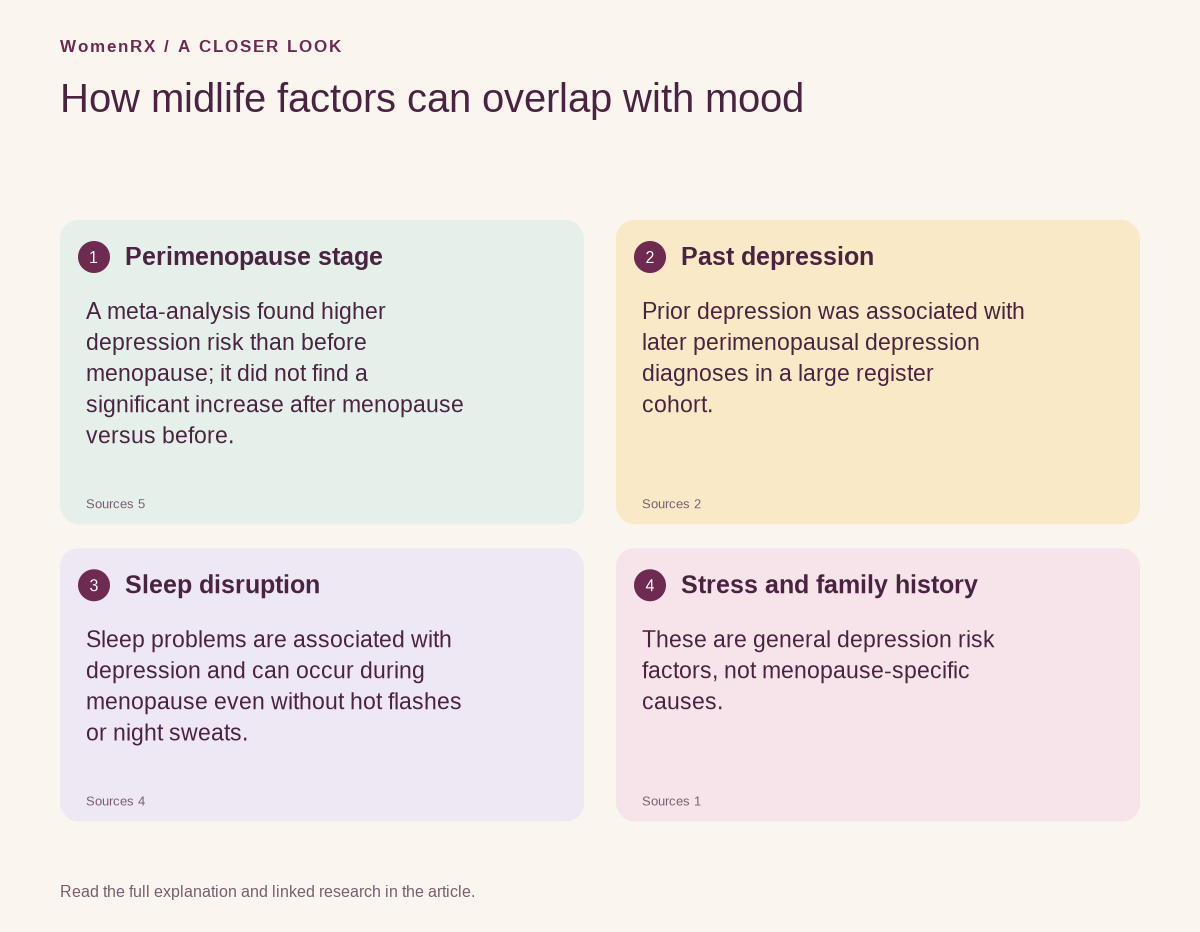
How midlife factors can overlap with mood
Perimenopause stage: A meta-analysis found higher depression risk than before menopause; it did not find a significant increase after menopause versus before.5
Past depression: Prior depression was associated with later perimenopausal depression diagnoses in a large register cohort.2
Sleep disruption: Sleep problems are associated with depression and can occur during menopause even without hot flashes or night sweats.4
Stress and family history: These are general depression risk factors, not menopause-specific causes.1
Read the figure as text
These factors may occur together, but evidence of an association does not prove that one caused another.- Perimenopause stage: A meta-analysis found higher depression risk than before menopause; it did not find a significant increase after menopause versus before.5
- Past depression: Prior depression was associated with later perimenopausal depression diagnoses in a large register cohort.2
- Sleep disruption: Sleep problems are associated with depression and can occur during menopause even without hot flashes or night sweats.4
- Stress and family history: These are general depression risk factors, not menopause-specific causes.1
More questions, answered
Does depression risk stay higher after menopause?
A meta-analysis found higher risk during perimenopause compared with premenopause, but no statistically significant increase for postmenopause compared with premenopause. It could not reliably compare perimenopause directly with postmenopause, so it does not establish an exact point when risk changes. 5
Does a history of postpartum depression mean perimenopausal depression is inevitable?
No. A Danish register study found an association between prior depression, including postpartum depression, and later depression diagnoses during perimenopause. An association raises awareness of possible vulnerability; it does not predict an individual outcome. 2
Sources you can check
- Depression: MedlinePlusAccessed 2026-09-25Return to first citation
- The association between postpartum depression and perimenopausal depression: A nationwide register-based cohort study.Venborg E, Osler M, Jørgensen TSH. · Maturitas · 2023Return to first citation
- Prior depression affects the experience of the perimenopause - findings from the Swiss Perimenopause Study.Willi J, Süss H, Grub J, Ehlert U. · Journal of affective disorders · 2020Return to first citation
- Impact of sleep disturbances on health-related quality of life in postmenopausal women: a systematic review.Soares CN, Bajbouj M, Schoof N, Kishore A, Caetano C. · Menopause (New York, N.Y.) · 2026Return to first citation
- The risk of depression in the menopausal stages: A systematic review and meta-analysis.Badawy Y, Spector A, Li Z, Desai R. · Journal of affective disorders · 2024Return to first citation
- The effectiveness of psychosocial interventions on physiological symptoms of menopause: a systematic review and meta-analysis.Robinson K, Hardy R, Melville M, Saidel S, Desai R, Spector A. · BMC women's health · 2026Return to first citation