Can Menopause Hormone Therapy Treat Depression?
Estradiol may ease depressive symptoms for some women during perimenopause, but depression still deserves its own assessment and care.
Possibly, in a specific setting: research reviews report short-term antidepressant effects from estradiol in some perimenopausal women. That doesn’t show hormone therapy treats depression in everyone, or that it works for depression after menopause. Psychotherapy and medication remain established depression treatments. Hormone therapy may be considered as part of individualized care, especially when bothersome menopause symptoms are also a concern. 1 2 6
Why perimenopause is a different context
Perimenopause is the transition toward menopause. Menstrual cycles may change, and estradiol can fluctuate; menopause is reached one year after the final menstrual period, when estradiol is largely depleted. Depression risk may rise during the transition, and sensitivity to hormone fluctuations is one possible contributor. It’s not the only possible cause of low mood. 4
Reviews report short-term antidepressant effects from estradiol in some perimenopausal women. But a finding in this group doesn’t mean hormone therapy is a general depression treatment. One randomized trial enrolled 66 community-recruited perimenopausal women, most of whom did not meet diagnostic criteria for depression or anxiety. It examined reward-seeking behavior, not whether estradiol treats diagnosed depression. 3 6
After menopause, the hormone pattern differs from the fluctuations of perimenopause. The research described in the reviews and trial abstracts centers on perimenopause, so it doesn’t establish hormone therapy as a treatment for depression that begins or continues after menopause. That’s a limit on what can be concluded, not proof that no relevant research exists. 4 6
Depression care and hormone therapy have different roles
Hormone therapy is an established option for bothersome hot flashes and other vasomotor symptoms, as well as genitourinary symptoms of menopause. Its benefits and risks depend on factors such as the type of therapy, route, timing, and whether a progestogen is used. Menopause guidance recommends individualizing the decision and revisiting it over time. 2
Depression deserves attention in its own right. It can involve low mood or loss of interest that affects everyday life. Depression assessment may also consider medical conditions and medicines that can cause similar symptoms. Psychotherapy and medication are established treatment approaches; hormone therapy shouldn’t be assumed to replace them. 1
For example, if low mood and loss of interest are interfering with daily life while hot flashes are also disrupting sleep, both concerns can be discussed together. Treating menopause symptoms may be one part of a plan, but it doesn’t remove the need to assess persistent depressive symptoms and decide whether depression treatment is needed. Menopause guidance describes care as individualized and may include psychological support and hormone therapy. 1 5
What to consider when weighing options
Separate two questions: “Do I need care for depression?” and “Do I also want treatment for menopause symptoms?” If symptoms are lasting, affecting daily activities, or difficult to explain, an assessment can help clarify whether depression, another health issue, menopause-related changes, or more than one factor may be involved. MedlinePlus describes depression symptoms as occurring most of the day, nearly every day, for at least two weeks, with depressed mood or loss of interest among the symptoms used in diagnosis. 1
If you’re considering hormone therapy, the practical discussion is whether it fits your menopause symptoms and health context, not whether it can be counted on to treat depression. If you might hurt yourself or can’t keep yourself safe, seek immediate help rather than waiting for a routine appointment. Depression can be serious, and suicide risk is one concern associated with it. 1 6
Mood care by menopause stage
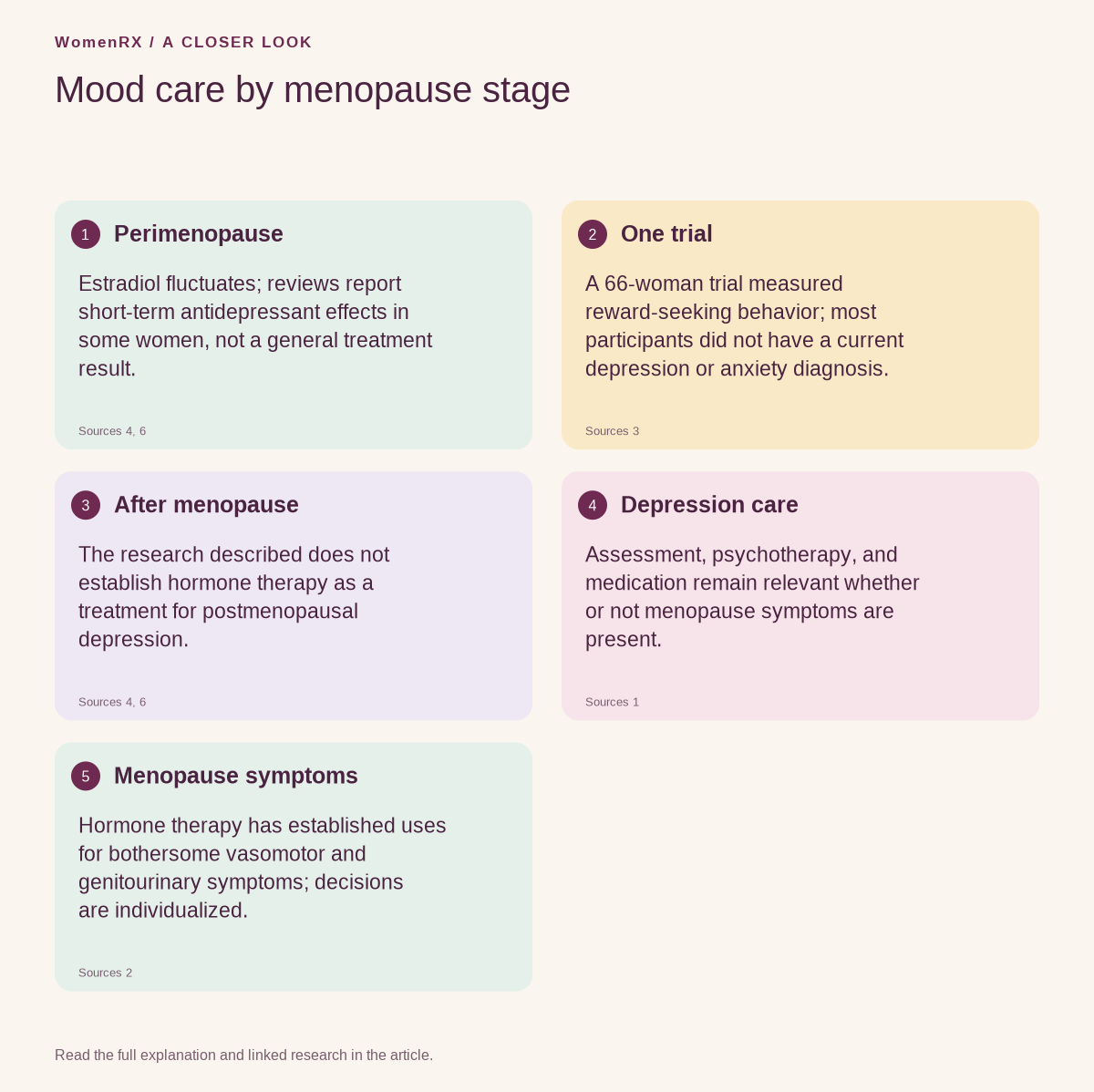
Perimenopause: Estradiol fluctuates; reviews report short-term antidepressant effects in some women, not a general treatment result.46
One trial: A 66-woman trial measured reward-seeking behavior; most participants did not have a current depression or anxiety diagnosis.3
After menopause: The research described does not establish hormone therapy as a treatment for postmenopausal depression.46
Depression care: Assessment, psychotherapy, and medication remain relevant whether or not menopause symptoms are present.1
Menopause symptoms: Hormone therapy has established uses for bothersome vasomotor and genitourinary symptoms; decisions are individualized.2
Read the figure as text
This map separates the possible mood role of estradiol during perimenopause from depression care and hormone therapy’s established menopause-symptom uses.- Perimenopause: Estradiol fluctuates; reviews report short-term antidepressant effects in some women, not a general treatment result.46
- One trial: A 66-woman trial measured reward-seeking behavior; most participants did not have a current depression or anxiety diagnosis.3
- After menopause: The research described does not establish hormone therapy as a treatment for postmenopausal depression.46
- Depression care: Assessment, psychotherapy, and medication remain relevant whether or not menopause symptoms are present.1
- Menopause symptoms: Hormone therapy has established uses for bothersome vasomotor and genitourinary symptoms; decisions are individualized.2
More questions, answered
Does hormone therapy replace an antidepressant?
It shouldn’t be assumed to. Psychotherapy and medication are established depression treatments, while hormone therapy has established uses for certain menopause symptoms. Its possible mood benefit during perimenopause doesn’t establish it as a general substitute for depression care. 1 2 6
Does the possible mood benefit apply after menopause?
It isn’t established by this research. The mood findings discussed focus on perimenopause, when estradiol fluctuates; they don’t show that hormone therapy treats depression after menopause. 4 6
Sources you can check
- Depression: MedlinePlusAccessed 2026-09-25Return to first citation
- The 2022 hormone therapy position statement of The North American Menopause Society.“The 2022 Hormone Therapy Position Statement of The North American Menopause Society” Advisory Panel. · Menopause (New York, N.Y.) · 2022Return to first citation
- Hormone sensitivity predicts the beneficial effects of transdermal estradiol on reward-seeking behaviors in perimenopausal women: A randomized controlled trial.Swales DA, Lozza-Fiacco S, Andersen EH, Cooper JA, Treadway MT, Xia K, Schiller CE, Girdler SS, Dichter GS. · Psychoneuroendocrinology · 2023Return to first citation
- Considering the role of estradiol in the psychoneuroimmunology of perimenopausal depression.Bondy E. · Brain, behavior, & immunity - health · 2024Return to first citation
- FIGO best practice recommendations for the mental health of women at menopausal age.Khadilkar S, Divakar H, Benedetto C, Genazzani A, Ramos D, Argale E, Deshpande G, Hicky M, Filho ALDS, Herrera E, Balkrishnan M. · International journal of gynaecology and obstetrics: the official organ of the International Federation of Gynaecology and Obstetrics · 2026Return to first citation
- The Role and Mechanism of Estrogen in Perimenopausal Depression.Liu Y, Fu X, Guan B, Cui R, Yang W. · Current neuropharmacology · 2026Return to first citation