Does menopause hormone therapy treat peripheral neuropathy?
HRT has established uses for menopause symptoms, but current evidence does not show that it treats peripheral nerve damage.
Menopause hormone therapy (HRT) is an established option for certain menopause symptoms and can help prevent bone loss, but it is not an established treatment for peripheral neuropathy. One observational study found an association between past exogenous hormone use and lower odds of sensory neuropathy; it did not test whether HRT improved nerve symptoms. New or persistent numbness, tingling, pain, or weakness calls for evaluation of possible causes. 461
HRT evidence and neuropathy evidence answer different questions
Menopause hormone therapy can help with bothersome hot flashes and genitourinary symptoms, and it can prevent bone loss. Those established uses do not show that HRT repairs peripheral nerves or treats neuropathy. 4
A US study offers a clue about hormones and nerve symptoms, but not proof of treatment. It looked at 1,144 postmenopausal women and found that a history of exogenous hormone use was associated with lower odds of distal sensory polyneuropathy. The study was cross-sectional, meaning it examined hormone-use history and nerve findings rather than testing whether HRT improved neuropathy over time. It cannot show that hormone use prevented or treated nerve damage, or explain what caused the association. 6
The study also excluded women with several health conditions, including diabetes and thyroid disease, and assessed sensation with a 10-g monofilament test. Its findings therefore do not settle what HRT does for women with diagnosed neuropathy, or apply to every kind of nerve problem. 6
A separate cross-sectional study of 298 postmenopausal women with type 2 diabetes found no association between age at menopause and diabetic neuropathy. It assessed menopause timing, not hormone therapy as a treatment. Together, these studies are not a basis for using HRT to treat neuropathy or assuming that menopause caused nerve symptoms. 5
The pattern of symptoms can point to different nerves
Peripheral neuropathy involves damage to nerves outside the brain and spinal cord. Symptoms depend on which nerves are affected. Sensory nerve problems can cause pins and needles, numbness, burning or sharp pain, or reduced ability to feel pain and temperature. If sensation in the feet is affected, balance or coordination can suffer. Motor nerve problems can cause cramps, twitching, weakness, or muscle thinning. 12
That range matters: tingling during perimenopause or after periods stop is not, by itself, evidence of a hormone-related nerve problem. Peripheral neuropathy has multiple possible causes. Examples include diabetes, vitamin B12 deficiency, and side effects of some medicines. An evaluation can help distinguish among possible explanations rather than treating the timing as the diagnosis. 13
If you have new or persistent numbness, tingling, or pain, arrange an assessment. Weakness, balance problems, or a foot sore that is not healing are also reasons to seek care. A clinician may ask about the symptoms and arrange tests to look for an underlying cause; a neurologist may be involved when appropriate. 1
Treating a cause is different from treating nerve pain
When a cause can be addressed, doing so may help improve neuropathy or keep it from getting worse. For example, guidance describes treating vitamin B12 deficiency, reviewing a medicine that may be contributing, and improving blood sugar control for diabetes-related neuropathy. Not every cause is reversible, so what helps depends on the diagnosis. 13
Pain relief may be a separate part of care. Common painkillers such as ibuprofen or acetaminophen often do not work well for neuropathic pain; medicines specifically used for nerve pain may be considered. Weakness can also call for separate support, such as physiotherapy. These options address nerve symptoms or their effects, not menopause symptoms. 3
If you use HRT or are considering it, keep the two questions distinct: whether it fits your menopause symptoms and health circumstances, and what may be causing your nerve symptoms. The first can be discussed as a menopause treatment decision. The second deserves an evaluation focused on the nerves and possible causes.
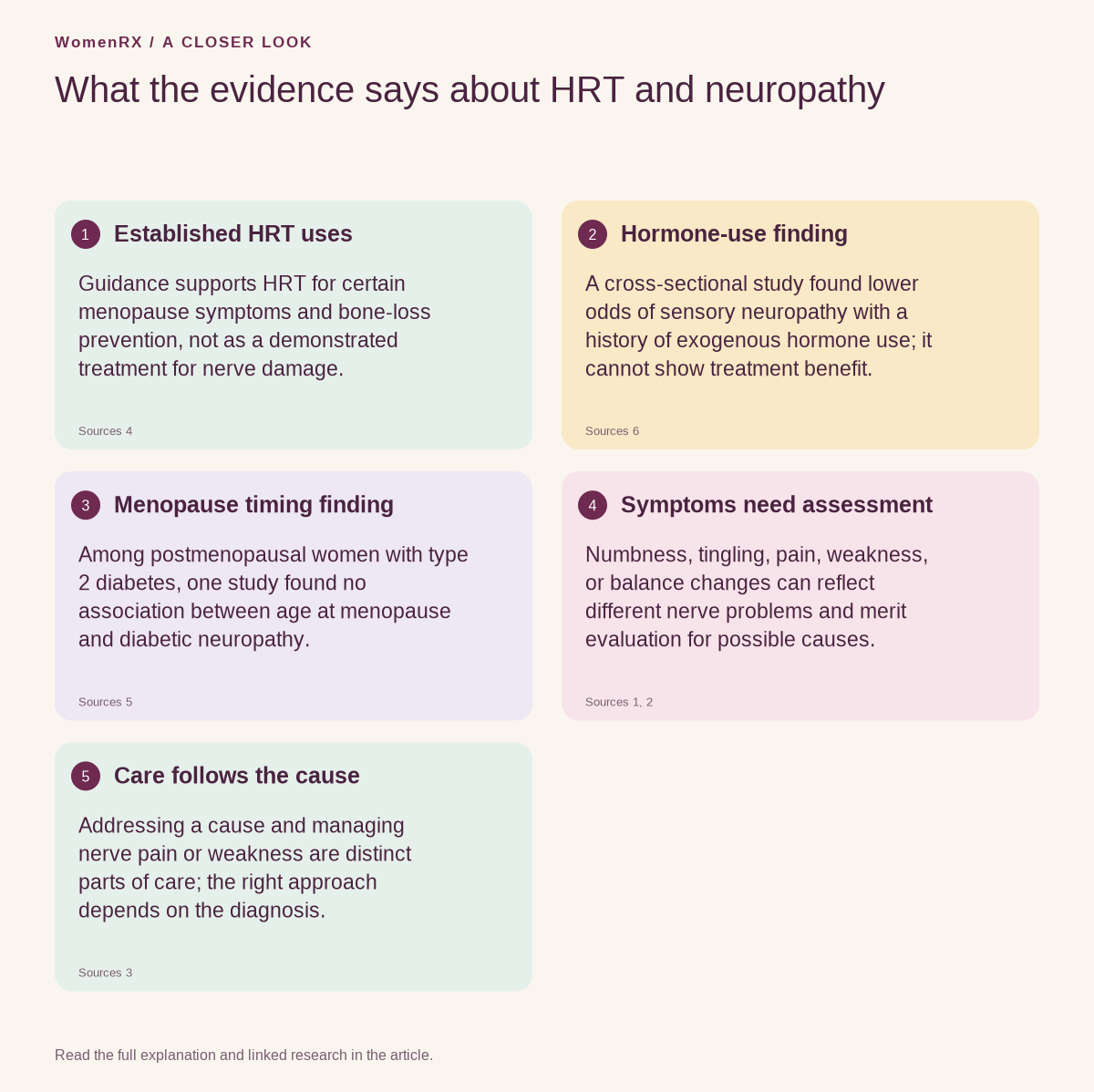
What the evidence says about HRT and neuropathy
Established HRT uses: Guidance supports HRT for certain menopause symptoms and bone-loss prevention, not as a demonstrated treatment for nerve damage.4
Hormone-use finding: A cross-sectional study found lower odds of sensory neuropathy with a history of exogenous hormone use; it cannot show treatment benefit.6
Menopause timing finding: Among postmenopausal women with type 2 diabetes, one study found no association between age at menopause and diabetic neuropathy.5
Symptoms need assessment: Numbness, tingling, pain, weakness, or balance changes can reflect different nerve problems and merit evaluation for possible causes.12
Care follows the cause: Addressing a cause and managing nerve pain or weakness are distinct parts of care; the right approach depends on the diagnosis.3
Read the figure as text
Separate established menopause uses of HRT from observational hormone findings and the cause-focused evaluation of nerve symptoms.- Established HRT uses: Guidance supports HRT for certain menopause symptoms and bone-loss prevention, not as a demonstrated treatment for nerve damage.4
- Hormone-use finding: A cross-sectional study found lower odds of sensory neuropathy with a history of exogenous hormone use; it cannot show treatment benefit.6
- Menopause timing finding: Among postmenopausal women with type 2 diabetes, one study found no association between age at menopause and diabetic neuropathy.5
- Symptoms need assessment: Numbness, tingling, pain, weakness, or balance changes can reflect different nerve problems and merit evaluation for possible causes.12
- Care follows the cause: Addressing a cause and managing nerve pain or weakness are distinct parts of care; the right approach depends on the diagnosis.3
More questions, answered
Does tingling that starts during menopause mean hormones caused it?
No. Symptoms can begin during the menopause transition without proving that menopause caused them. Nerve symptoms have several possible causes, so new or persistent symptoms should be assessed rather than assumed to be hormonal. 13
Sources you can check
- Peripheral neuropathy - NHSAccessed 2026-09-25Return to first citation
- Peripheral neuropathy - Symptoms - NHSAccessed 2026-09-25Return to first citation
- Peripheral neuropathy - Treatment - NHSAccessed 2026-09-25Return to first citation
- The 2022 hormone therapy position statement of The North American Menopause Society.“The 2022 Hormone Therapy Position Statement of The North American Menopause Society” Advisory Panel. · Menopause (New York, N.Y.) · 2022Return to first citation
- Age at menopause was not associated with microvascular complications in patients with type 2 diabetes mellitus.Sun S, Du R, Wang S, Guo Y, He H, Wang X, Zhang D, Yin W, Li M, Wu Y, Zhang C. · Medicine · 2023Return to first citation
- Association of reproductive factors and exogenous hormone use with distal sensory polyneuropathy among postmenopausal women in the United States: results from 1999 to 2004 NHANES.Li J, Chongpison Y, Amornvit J, Chaikittisilpa S, Santibenchakul S, Jaisamrarn U. · Scientific reports · 2023Return to first citation