Can Menopause-Related Hormone Changes Explain Tingling or Numbness?
Symptoms that start around menopause may raise a hormone question, but timing alone can’t show what’s causing them.
Tingling or numbness that begins around menopause doesn’t, by itself, show that estrogen changes caused it. A study of postmenopausal women with type 2 diabetes found no link between age at menopause and diabetic neuropathy, but it didn’t measure estrogen changes or answer the broader question. Several other conditions and some medicines can cause nerve symptoms, so consider their pattern and seek an assessment if they persist or worsen. 6 1 2
Menopause timing raises a question, not an answer
If tingling, numbness, or burning appears during perimenopause or after your periods stop, it’s understandable to wonder whether hormones are involved. But the timing alone can’t tell you what caused the symptoms. The evidence described by a study of menopause timing in women with diabetes doesn’t resolve the broader question of whether estrogen changes contribute to nerve symptoms.
That 2023 cross-sectional study included 298 postmenopausal women with type 2 diabetes. It found no association between their age at menopause and diabetic peripheral neuropathy. The study looked at menopause timing, not estrogen fluctuations, and its findings don’t establish what causes symptoms in other midlife or postmenopausal people. 6
Tingling can come from different nerve problems
Peripheral neuropathy means damage to nerves outside the brain and spinal cord. It can affect sensation, movement, or automatic functions such as digestion and blood pressure. Tingling is one possible sensory symptom, but it doesn’t identify a particular cause on its own. 2 3
Possible causes include diabetes, low vitamin B12 or other vitamins, long-term heavy alcohol use, injury, and certain medicines. Sometimes a single nerve is compressed rather than many nerves being affected. Carpal tunnel, for example, involves pressure on a nerve at the wrist and can cause tingling, pain, or numbness in the fingers. 1 3
The pattern can help describe what’s happening, even though it can’t diagnose the cause. Sensory nerve problems may also involve burning or sharp pain, reduced ability to feel pain or temperature, unusual pain from light touch, or trouble sensing the position of your hands or feet. Weakness, cramps, or difficulty lifting the front of a foot are other possible nerve symptoms. 3
What a useful assessment can clarify
If symptoms are persistent, worsening, or affecting everyday activities, arrange an assessment instead of assuming they’re a menopause symptom. A clinician can ask where the symptoms occur and how they’ve changed, and may arrange tests to help look for an underlying cause. Mention changes in sensation, strength, or balance, as well as relevant health conditions and medicines. 2 3
A sore or cut on your foot that isn’t healing deserves attention, particularly if numbness makes it harder to notice an injury. 2
Finding a cause can change what happens next. For example, vitamin B12 deficiency may be treated with B12, and neuropathy caused by a medicine may improve if that medicine is stopped. Any medication change needs to be considered with the prescriber; treatment depends on the cause, and not every cause can be treated directly. 4
Keep hormone therapy and nerve symptoms as separate questions
The North American Menopause Society’s 2022 position statement describes hormone therapy as an effective treatment for hot flashes and other vasomotor symptoms, a treatment for genitourinary syndrome of menopause, and a way to prevent bone loss. Those benefits are not evidence that hormone therapy treats tingling, numbness, or peripheral neuropathy. 5
So if you’re considering hormone therapy for menopause symptoms, that can be a separate discussion from figuring out why your hands or feet feel different. Don’t use the timing of nerve symptoms, or the possibility of a hormone connection, as a substitute for assessing other causes.
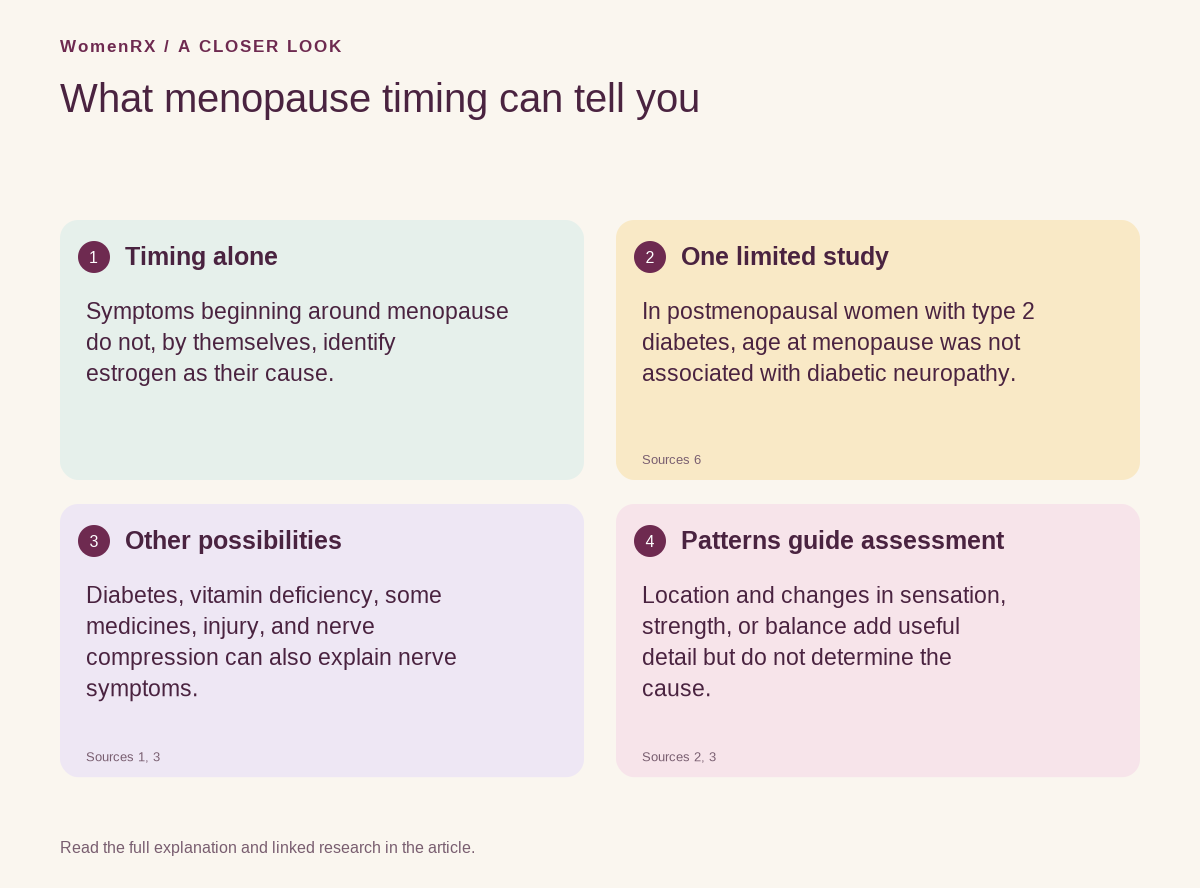
What menopause timing can tell you
Timing alone: Symptoms beginning around menopause do not, by themselves, identify estrogen as their cause.
One limited study: In postmenopausal women with type 2 diabetes, age at menopause was not associated with diabetic neuropathy.6
Other possibilities: Diabetes, vitamin deficiency, some medicines, injury, and nerve compression can also explain nerve symptoms.13
Patterns guide assessment: Location and changes in sensation, strength, or balance add useful detail but do not determine the cause.23
Read the figure as text
These distinctions separate the limited menopause-specific finding from other possible causes and show why symptom patterns can guide, but not replace, assessment.- Timing alone: Symptoms beginning around menopause do not, by themselves, identify estrogen as their cause.
- One limited study: In postmenopausal women with type 2 diabetes, age at menopause was not associated with diabetic neuropathy.6
- Other possibilities: Diabetes, vitamin deficiency, some medicines, injury, and nerve compression can also explain nerve symptoms.13
- Patterns guide assessment: Location and changes in sensation, strength, or balance add useful detail but do not determine the cause.23
Sources you can check
- Peripheral neuropathy - Causes - NHSAccessed 2026-09-25Return to first citation
- Peripheral neuropathy - NHSAccessed 2026-09-25Return to first citation
- Peripheral neuropathy - Symptoms - NHSAccessed 2026-09-25Return to first citation
- Peripheral neuropathy - Treatment - NHSAccessed 2026-09-25Return to first citation
- The 2022 hormone therapy position statement of The North American Menopause Society.“The 2022 Hormone Therapy Position Statement of The North American Menopause Society” Advisory Panel. · Menopause (New York, N.Y.) · 2022Return to first citation
- Age at menopause was not associated with microvascular complications in patients with type 2 diabetes mellitus.Sun S, Du R, Wang S, Guo Y, He H, Wang X, Zhang D, Yin W, Li M, Wu Y, Zhang C. · Medicine · 2023Return to first citation