Can Menopause Hormone Changes Affect Bladder Control?
Estrogen-related tissue changes may contribute to some urinary symptoms, but leakage patterns often point to other bladder or pelvic-floor causes too.
Menopause can bring genitourinary symptoms such as urgency, frequency, and discomfort with urination, and reviews find vaginal estrogen may improve some urinary symptoms. But menopause or lower estrogen alone doesn’t explain every leak: coughing-related leakage often involves pelvic-floor or urethral support, while sudden urgency can reflect bladder overactivity. The pattern helps guide assessment and treatment. 1 2 4 5
The hormone link is possible, not a complete explanation
As estrogen levels fall around menopause, some women develop genitourinary symptoms such as vaginal dryness or irritation, urinary urgency, and frequent urination. These symptoms can overlap with bladder-control problems, which is why estrogen may be part of the picture. But research has not confirmed that menopause itself is associated with urinary symptoms overall. A change in bladder control during midlife deserves its own explanation, rather than being automatically attributed to hormones or age. 3 4
A systematic review found that vaginal estrogen improved urinary urgency, frequency, and both stress and urgency incontinence in menopausal women. The same review reported that systemic hormone therapy may cause incontinence or worsen existing urinary symptoms. These findings point to an important distinction: evidence about estrogen used locally in the vagina doesn’t mean that systemic hormone therapy will improve bladder control. And neither treatment is a universal answer to leakage. 4 5
The kind of leakage can offer clues
If you leak when you cough, sneeze, laugh, or exercise, that pattern is called stress incontinence. It’s usually linked to weakness or damage in the pelvic-floor muscles or urethral sphincter, the structures that help prevent urine from passing. That’s a different proposed route to leakage than an estrogen-related change in genitourinary symptoms. 1 2
If a sudden, intense urge comes just before leakage, that’s urge incontinence. It often occurs with overactive bladder symptoms, such as needing to urinate frequently or several times overnight. Some women have both stress and urge symptoms, called mixed incontinence. 1 2
Frequent small leaks, a feeling that your bladder doesn’t empty, or trouble emptying can suggest a different problem, such as overflow incontinence. Blockage or another cause of incomplete emptying may be involved. These patterns are reasons not to assume that every midlife bladder change is a hormone symptom. 1 2
What assessment can clarify
A clinician can ask what happens before a leak, how strong and sudden the urge feels, and whether you also have dryness, irritation, discomfort with urination, or frequent urination. Depending on your symptoms, assessment may include a pelvic examination and a record of how often you urinate and how much you drink. The goal is to distinguish the type of incontinence and consider other bladder or pelvic issues, not simply to confirm that you’re in menopause. 1 2
It’s reasonable to seek an assessment if leakage or urgency is bothering you, changing, or limiting activities. The symptom pattern matters: leakage with exertion differs from a sudden urge, and both differ from persistent dribbling or difficulty emptying. Those distinctions can shape which management options are relevant. 1 2
Where vaginal estrogen may fit
If urinary symptoms occur alongside vaginal dryness or irritation, ask whether genitourinary syndrome of menopause could be contributing. Low-dose vaginal estrogen is an option for bothersome genitourinary symptoms that haven’t improved with over-the-counter therapies for women without a reason to use systemic hormone therapy, according to the North American Menopause Society. It’s a treatment to discuss in context, not a general prescription for incontinence. 6
The evidence review reporting improvements in stress and urgency incontinence with vaginal estrogen supports discussing the option, but it doesn’t establish that estrogen loss caused an individual woman’s leakage or that treatment will work for every type of bladder problem. Vaginal and systemic estrogen aren’t interchangeable for this purpose: the review found different urinary effects by type. 4 5
A useful next step is to describe the pattern plainly: “I leak when I cough,” “I can’t delay once the urge hits,” or “I feel like I don’t empty fully.” Add any vaginal or urinary discomfort. That gives an assessment a clearer starting point than the broad label “menopause bladder problems.”
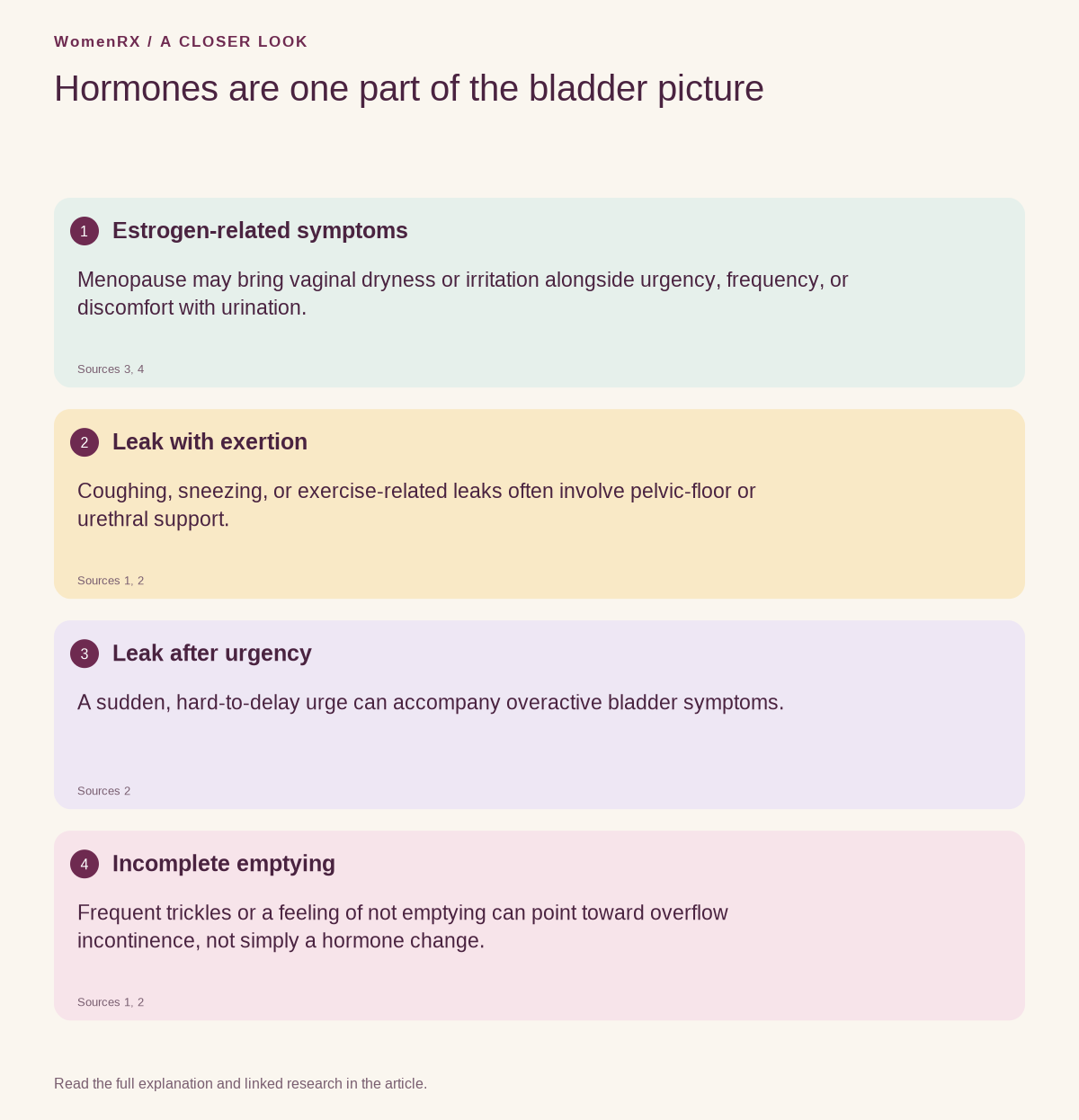
Hormones are one part of the bladder picture
Estrogen-related symptoms: Menopause may bring vaginal dryness or irritation alongside urgency, frequency, or discomfort with urination.34
Leak with exertion: Coughing, sneezing, or exercise-related leaks often involve pelvic-floor or urethral support.12
Leak after urgency: A sudden, hard-to-delay urge can accompany overactive bladder symptoms.2
Incomplete emptying: Frequent trickles or a feeling of not emptying can point toward overflow incontinence, not simply a hormone change.12
Read the figure as text
This comparison shows how menopause-related genitourinary symptoms may overlap with bladder-control problems, while common incontinence patterns can have other causes.- Estrogen-related symptoms: Menopause may bring vaginal dryness or irritation alongside urgency, frequency, or discomfort with urination.34
- Leak with exertion: Coughing, sneezing, or exercise-related leaks often involve pelvic-floor or urethral support.12
- Leak after urgency: A sudden, hard-to-delay urge can accompany overactive bladder symptoms.2
- Incomplete emptying: Frequent trickles or a feeling of not emptying can point toward overflow incontinence, not simply a hormone change.12
More questions, answered
Does bladder leakage mean my estrogen is low?
No. Menopause-related genitourinary symptoms can overlap with urinary problems, but menopause has not been confirmed as a cause of urinary symptoms overall. Stress leakage, sudden urgency, and incomplete emptying can have different explanations. 1 2 4
Is vaginal estrogen the same as systemic hormone therapy for bladder symptoms?
No. A systematic review reported improvement in some urinary symptoms with vaginal estrogen, while systemic hormone therapy may cause or worsen incontinence. The evidence does not make either treatment right for everyone. 4 5
Sources you can check
- Urinary incontinence - NHSAccessed 2026-09-25Return to first citation
- Urinary incontinence - Symptoms - NHSAccessed 2026-09-25Return to first citation
- About vaginal oestrogen - NHSAccessed 2026-09-25Return to first citation
- Menopause hormone therapy and urinary symptoms: a systematic review.Christmas MM, Iyer S, Daisy C, Maristany S, Letko J, Hickey M. · Menopause (New York, N.Y.) · 2023Return to first citation
- Vaginal estrogen for genitourinary syndrome of menopause: a systematic review.Rahn DD, Carberry C, Sanses TV, Mamik MM, Ward RM, Meriwether KV, Olivera CK, Abed H, Balk EM, Murphy M, Society of Gynecologic Surgeons Systematic Review Group. · Obstetrics and gynecology · 2014Return to first citation
- The 2022 hormone therapy position statement of The North American Menopause Society.“The 2022 Hormone Therapy Position Statement of The North American Menopause Society” Advisory Panel. · Menopause (New York, N.Y.) · 2022Return to first citation