Urinary Leakage During Menopause: Match the Pattern to Care
When leakage happens offers a useful first clue: coughing, sudden urges, or both point toward different patterns and care discussions.
Leakage with coughing, sneezing, or exercise fits a stress pattern; leaking after a sudden, hard-to-delay urge fits an urgency pattern. Having both is called mixed incontinence. Menopause-related tissue changes can contribute to urinary symptoms, but leakage has other possible causes too. A clinician can help identify the pattern and discuss options such as pelvic-floor muscle training, bladder training, or treatment for menopausal vaginal and urinary symptoms. 126
Start with what happens just before the leak
If urine escapes when you cough, sneeze, laugh, or exercise, that pattern is called stress incontinence. “Stress” means pressure on the bladder, not emotional stress. It is often linked to weakness or damage in muscles that help control urine flow, including the pelvic floor. Pregnancy and childbirth can contribute to that muscle history, whether or not the leakage first appears around menopause. 12
If a sudden, intense urge comes first and you can’t make it to the toilet in time, that fits urgency incontinence. Urgency may also come with frequent urination or waking at night to urinate. When both urgency leaks and pressure-related leaks happen, the pattern is mixed incontinence. 2
These are clues, not a diagnosis. Frequent small trickles, difficulty starting or maintaining a stream, or a feeling that your bladder never empties fully can suggest a different issue, such as incomplete emptying. Mention those symptoms rather than assuming every leak is stress or urgency incontinence. 12
Where menopause may fit
After menopause, lower estrogen can affect tissues in the vagina and lower urinary tract. Genitourinary syndrome of menopause, or GSM, can include urinary urgency, frequency, nighttime urination, pain or burning with urination, and incontinence. Vaginal dryness or irritation may occur alongside these symptoms. That makes menopause one possible part of the picture, not a complete explanation for every leak. 6
A study of 439 menopausal women found that incontinence was common in that sample, and reported weak associations between urinary symptom scores and age, number of pregnancies and births, and time since menopause. Those associations don’t show that menopause or childbirth caused an individual woman’s leakage, and the study doesn’t establish that leakage is inevitable. 5
Match the next step to the pattern
For leaks with pressure or movement: Ask whether pelvic-floor muscle training is suitable. Pelvic-floor exercises are a common option for strengthening the muscles involved in controlling urine flow. If you’re unsure whether you’re using the right muscles, ask about guidance rather than relying on guesswork. 1
For urgency leaks: Ask whether bladder training might fit your symptoms. It involves practicing ways to gradually wait longer between urges and urinating. Caffeine and alcohol may increase urine production or irritate the bladder for some people; changing intake may help, but don’t respond by restricting fluids so much that you aren’t drinking enough. 1
For both patterns: You may need to discuss more than one approach. Share which situations cause leaks and whether urgency, frequent urination, nighttime trips, or difficulty emptying also occur. Mixed symptoms are a recognized pattern, not a sign that you have failed at an exercise or missed an obvious cause. 12
If vaginal or urinary changes accompany menopause: Ask whether GSM could be contributing and what treatments are appropriate. Low-dose vaginal estrogen is a treatment for menopausal vaginal symptoms, and professional guidance also recognizes it as an option for bothersome GSM symptoms. It shouldn’t be treated as a universal fix for stress or urgency leakage; the urinary symptoms and the reason for them still need to be considered. 346
Make an assessment more useful
Urinary leakage is common, but you don’t have to wait for it to become severe to bring it up. Assessment can start with a conversation about your symptoms and may include an examination. A short record of when you urinate, what you were doing when leakage happened, whether there was a strong urge, and what you drank can help make the pattern clearer. 12
For example, note whether a leak happened during a workout, after a sudden urge, or in both situations. Also mention vaginal dryness or irritation, burning with urination, repeated nighttime trips, or a sense that your bladder hasn’t emptied. This information helps separate a pressure-related pattern from urgency, mixed symptoms, or possible emptying problems. 126
The useful question isn’t only “Is this menopause?” It’s “What pattern do these symptoms fit, and which cause-specific options make sense for me?” Your pelvic-floor and childbirth history, menopausal symptoms, and any trouble emptying your bladder can all add context to that conversation. 126
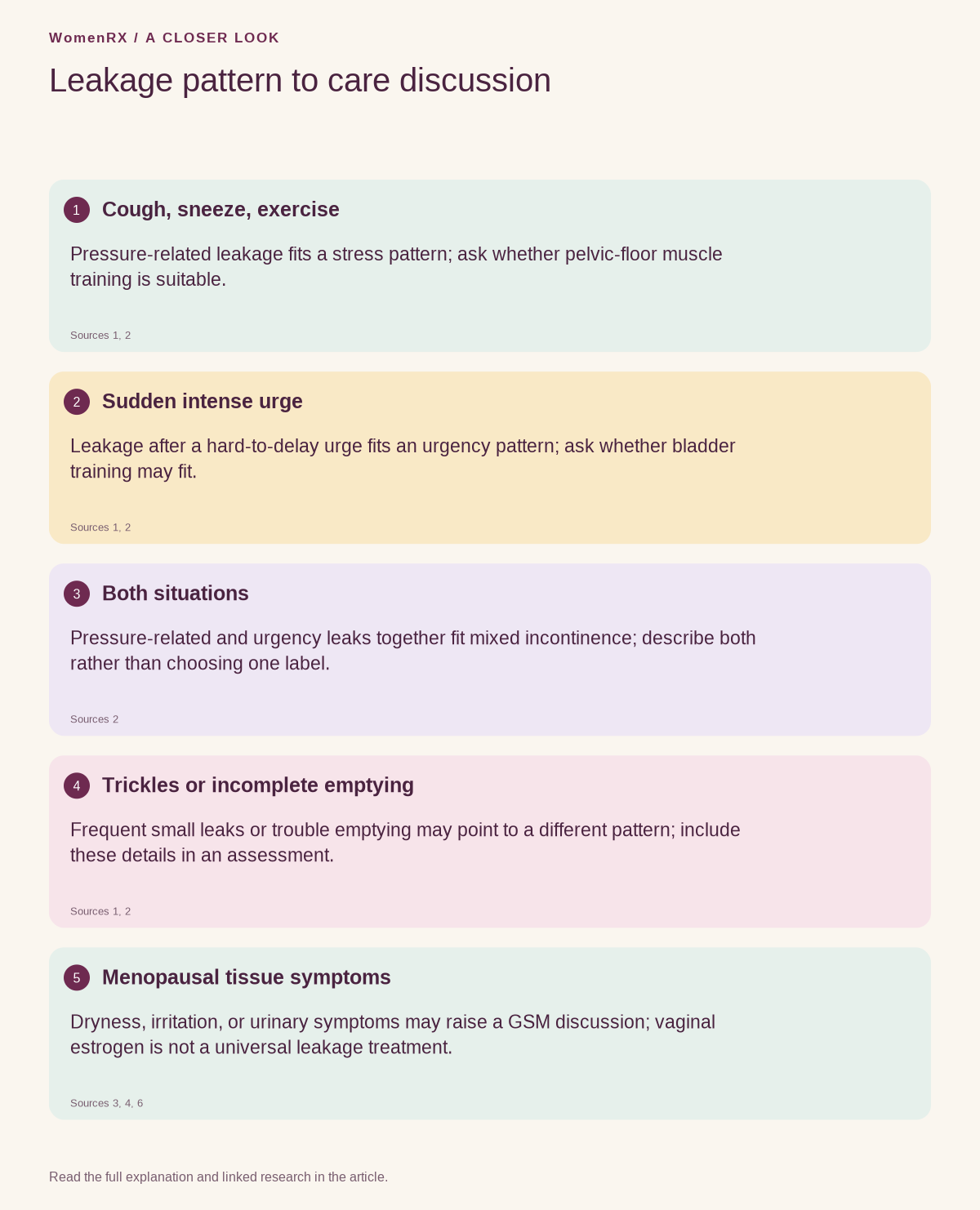
Leakage pattern to care discussion
Cough, sneeze, exercise: Pressure-related leakage fits a stress pattern; ask whether pelvic-floor muscle training is suitable.12
Sudden intense urge: Leakage after a hard-to-delay urge fits an urgency pattern; ask whether bladder training may fit.12
Both situations: Pressure-related and urgency leaks together fit mixed incontinence; describe both rather than choosing one label.2
Trickles or incomplete emptying: Frequent small leaks or trouble emptying may point to a different pattern; include these details in an assessment.12
Menopausal tissue symptoms: Dryness, irritation, or urinary symptoms may raise a GSM discussion; vaginal estrogen is not a universal leakage treatment.346
Read the figure as text
Use the situation before a leak as a starting clue, then share other urinary or vaginal symptoms to help clarify what to discuss.- Cough, sneeze, exercise: Pressure-related leakage fits a stress pattern; ask whether pelvic-floor muscle training is suitable.12
- Sudden intense urge: Leakage after a hard-to-delay urge fits an urgency pattern; ask whether bladder training may fit.12
- Both situations: Pressure-related and urgency leaks together fit mixed incontinence; describe both rather than choosing one label.2
- Trickles or incomplete emptying: Frequent small leaks or trouble emptying may point to a different pattern; include these details in an assessment.12
- Menopausal tissue symptoms: Dryness, irritation, or urinary symptoms may raise a GSM discussion; vaginal estrogen is not a universal leakage treatment.346
More questions, answered
Does vaginal estrogen treat every kind of urinary leakage?
No. Vaginal estrogen is used for menopausal vaginal symptoms, and professional guidance includes it among options for bothersome genitourinary symptoms of menopause. Urinary leakage can have different patterns and causes, so it’s worth discussing whether GSM is part of your symptoms rather than assuming estrogen will address every kind of leak. 346
Sources you can check
- Urinary incontinence - NHSAccessed 2026-09-25Return to first citation
- Urinary incontinence - Symptoms - NHSAccessed 2026-09-25Return to first citation
- About vaginal oestrogen - NHSAccessed 2026-09-25Return to first citation
- The 2022 hormone therapy position statement of The North American Menopause Society.“The 2022 Hormone Therapy Position Statement of The North American Menopause Society” Advisory Panel. · Menopause (New York, N.Y.) · 2022Return to first citation
- Menopause, urinary incontinence prevalence and impact on healthy living.Yakıt Ak E, Şen MA. · European journal of obstetrics, gynecology, and reproductive biology · 2025Return to first citation
- Urinary manifestations of genitourinary syndrome of menopause: a review of the pathophysiology, clinical presentation, and management.Saad JC, Brandon CA. · Gynecology and pelvic medicine · 2026Return to first citation