Urinary Leakage in Perimenopause: What Helps
When you leak, and what you feel just before it happens, can point toward different bladder patterns and treatment options.
Leaking with a cough, sneeze, or exercise fits a stress pattern; leaking after a sudden, hard-to-delay urge fits urgency incontinence. Both can happen together. Perimenopause may coincide with urinary changes, but leakage isn’t inevitable or explained by menopause alone. Describing the pattern helps guide assessment and options such as pelvic floor muscle training for stress leakage or bladder training for urgency. 127
Start with what happens just before the leak
Urinary incontinence means urine escapes when you don’t intend it to. The timing and trigger are useful clues, though they don’t replace an assessment.
Stress incontinence means leakage when pressure rises suddenly, such as with coughing, sneezing, laughing, or exercise. “Stress” here means physical pressure, not emotional stress. The amount may be small, but it can vary. 2
Urgency incontinence means a sudden, intense need to urinate followed by leakage before you can reach the bathroom. You might also need to urinate frequently or several times overnight, symptoms that can occur with overactive bladder. 2
Mixed incontinence means both patterns: for example, leakage with a cough and separate episodes when a powerful urge comes on. It’s worth describing each pattern rather than treating all leakage as one problem. 2
Frequent small trickles and a feeling that your bladder hasn’t emptied fully can point to a different pattern, called overflow incontinence. Mention these symptoms too, rather than assuming they’re the same as stress or urgency leakage. 2
Menopause can be part of the picture, not the whole explanation
Urinary leakage is reported by women in midlife, and it may occur alongside other menopause symptoms. In a cross-sectional survey of 2,084 Oregon residents, greater menopause symptom burden was associated with higher adjusted odds of stress, urgency, and mixed incontinence. Because the survey measured symptoms at one point in time, it can’t show that menopause caused the leakage. 7
Age and pelvic floor changes can matter as well. Pregnancy and childbirth can weaken muscles involved in controlling urine, and lower urinary tract symptoms also become more common with age. That makes your own history relevant alongside your menopause stage. 12
What an assessment can clarify
A clinician can ask when leaks happen, how strong the urge is, and whether you have signs such as frequent small trickles or incomplete emptying. A consultation and, when appropriate, a pelvic examination can help assess the problem. 12
A bladder diary can make everyday patterns easier to discuss: note how often you urinate and how much you drink. Separately, you may find it useful to jot down when leakage happens, such as during exercise or after a sudden urge. That extra note is a practical way to describe your experience, not a requirement of the diary guidance. 1
Match the approach to the pattern
For stress leakage, pelvic floor muscle training is a supported option. In a randomized study of 60 women aged 30 to 75 with stress incontinence, both individual and group training were associated with reduced leakage on pad tests and bladder diaries; the study found no difference between the two formats. It doesn’t establish that training will resolve leakage for everyone, but it supports asking about supervised or group-based training options. 4
For urgency leakage, bladder training is one option: it works on gradually changing the interval between feeling the need to urinate and going to the bathroom. Reducing caffeine or alcohol may also help some people, since these drinks can increase urine production or irritate the bladder. Your fluid needs are individual, so don’t assume that drinking less is the answer. 1
For mixed leakage, both patterns deserve attention. It may be useful to discuss pelvic floor training for pressure-related leaks and bladder training for urgency, then adjust the plan based on which symptoms are most bothersome and how things change. These approaches address different leakage patterns; a clinician can help tailor a plan without assuming one combined program works for everyone. 14
If urinary urgency comes with vaginal dryness, burning, or painful sex, mention those symptoms too. They can fit genitourinary syndrome of menopause, which has its own treatment options. Guidance supports considering vaginal estrogen for bothersome genitourinary symptoms in appropriate cases; it should not be presented as a universal treatment for every type of urine leakage. 356
Pads and other absorbent products can help manage leaks while you explore treatment. If leakage remains disruptive, ask which further options fit your pattern. Procedures differ: a sling procedure may be considered for stress incontinence, while procedures for urgency incontinence can include bladder enlargement or a device that stimulates the nerve controlling bladder contractions. These options aren’t right for everyone, and the type of incontinence matters. 1
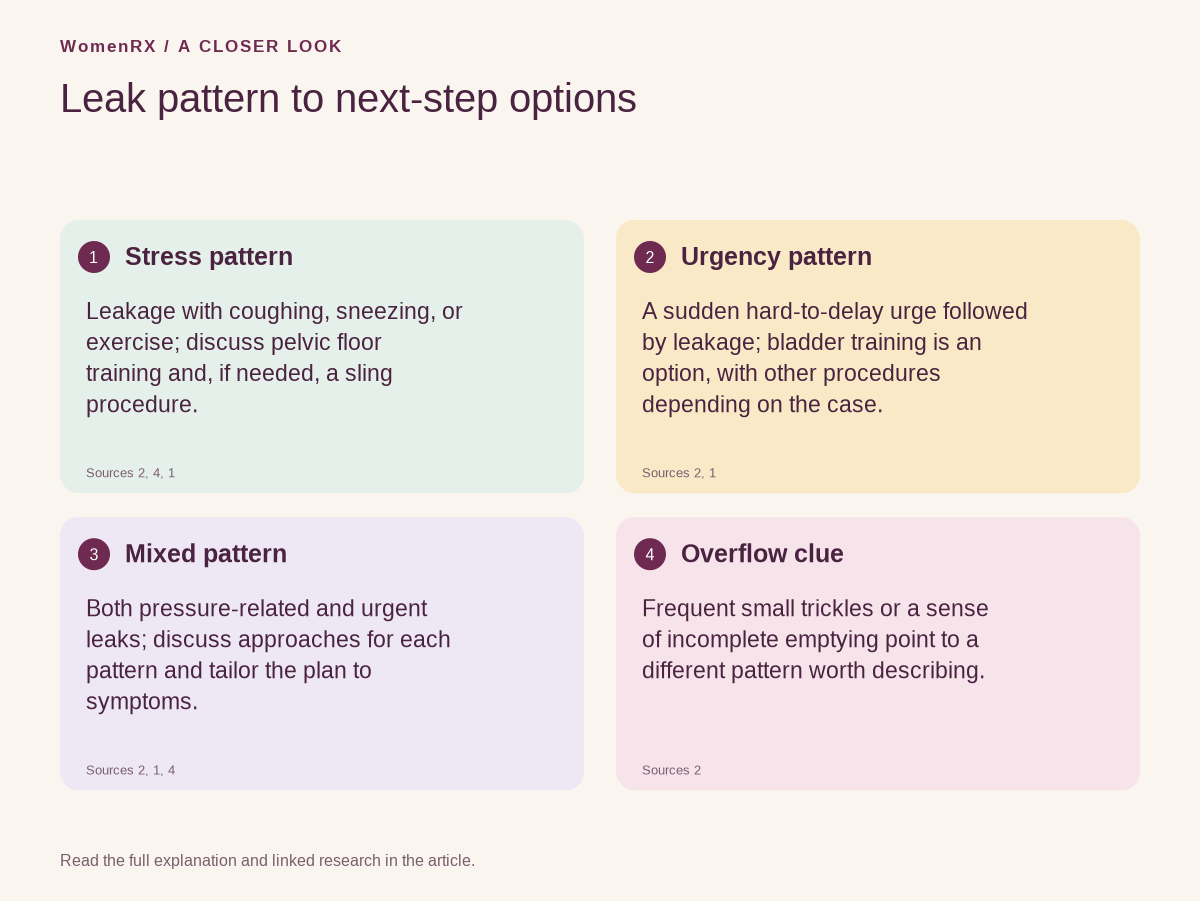
Leak pattern to next-step options
Stress pattern: Leakage with coughing, sneezing, or exercise; discuss pelvic floor training and, if needed, a sling procedure.241
Urgency pattern: A sudden hard-to-delay urge followed by leakage; bladder training is an option, with other procedures depending on the case.21
Mixed pattern: Both pressure-related and urgent leaks; discuss approaches for each pattern and tailor the plan to symptoms.214
Overflow clue: Frequent small trickles or a sense of incomplete emptying point to a different pattern worth describing.2
Read the figure as text
The trigger and sensation before a leak can help distinguish common patterns and focus a discussion about assessment and treatment.- Stress pattern: Leakage with coughing, sneezing, or exercise; discuss pelvic floor training and, if needed, a sling procedure.241
- Urgency pattern: A sudden hard-to-delay urge followed by leakage; bladder training is an option, with other procedures depending on the case.21
- Mixed pattern: Both pressure-related and urgent leaks; discuss approaches for each pattern and tailor the plan to symptoms.214
- Overflow clue: Frequent small trickles or a sense of incomplete emptying point to a different pattern worth describing.2
Sources you can check
- Urinary incontinence - NHSAccessed 2026-09-25Return to first citation
- Urinary incontinence - Symptoms - NHSAccessed 2026-09-25Return to first citation
- Types of hormone replacement therapy (HRT) - NHSAccessed 2026-09-25Return to first citation
- Pelvic floor muscle training in female stress urinary incontinence: comparison between group training and individual treatment using PERFECT assessment scheme.de Oliveira Camargo F, Rodrigues AM, Arruda RM, Ferreira Sartori MG, Girão MJ, Castro RA. · International urogynecology journal and pelvic floor dysfunction · 2009Return to first citation
- Case-Based Perspectives on the Management of Genitourinary Syndrome of Menopause.Cyriac J, Sood R. · Clinics and practice · 2026Return to first citation
- The 2022 hormone therapy position statement of The North American Menopause Society.“The 2022 Hormone Therapy Position Statement of The North American Menopause Society” Advisory Panel. · Menopause (New York, N.Y.) · 2022Return to first citation
- Urinary Incontinence and Menopausal Symptom Burden.Qiao E, Burns H, Rodriguez MI, Cichowski SB. · Obstetrics and gynecology · 2025Return to first citation