Urinary Leakage Around Menopause: What You Can Try
Noticing when leakage happens can help you describe it; the type of incontinence guides which training to try first.
If your incontinence is classified as stress or mixed, pelvic floor muscle training is a first-line option. For urgency or mixed incontinence, bladder training is a first-line option. You might leak in more than one situation; describing what happens can help with assessment, but neither approach is an instant cure. New leakage is worth discussing with a clinician, especially if you also have pain or blood in your urine.781024
Start with what happens before the leak
Leaking during a cough, a jump, or lifting groceries follows a stress-incontinence pattern. A sudden, hard-to-delay need to pee before a leak follows an urgency-incontinence pattern. Some women experience both patterns.9 Those details are useful to describe, but they do not establish the type of incontinence on their own. Clinical guidance calls for an assessment that classifies incontinence as stress, urgency, or mixed before choosing initial treatment; for mixed incontinence, it focuses first on the predominant symptom.7
For example, you might leak a little during an exercise class but also occasionally rush to the bathroom and not make it. You don't have to force that into one category. Notice which situation is more disruptive, and describe both if you seek care. An assessment can establish which type of incontinence you have.7 Having leakage begin during perimenopause or after menopause doesn't, by itself, tell you what type it is or rule out another urinary problem.93
For stress or mixed incontinence, consider pelvic floor training
Your pelvic floor muscles help control urine flow around the bladder and urethra. Pelvic floor muscle training means learning to contract those muscles and practicing that contraction as an exercise. Getting the right muscles matters: clinical guidance recommends checking that you can contract them before starting a supervised program. For stress or mixed incontinence, NICE recommends a trial of supervised training lasting at least three months as a first-line treatment.87
There's evidence for benefit, not a guarantee of staying dry. A 2026 review of randomized trials in women aged 60 and older found that pelvic floor muscle training reduced incontinence severity compared with usual care. The reported result concerns women aged 60 and older, not a group specifically identified by menopause status, so it cannot establish an outcome specific to postmenopausal women or to someone in perimenopause.5
If you're unsure whether you're contracting the right muscles, that's a concrete reason to ask about a pelvic floor assessment rather than guessing your way through an exercise routine. The training program can then be based on what you're able to do.78
For urgency or mixed incontinence, consider bladder training
Bladder training uses planned bathroom visits, with the intervals gradually adjusted. It's different from pelvic floor muscle training: the focus is on the pattern of urination rather than exercising a muscle contraction. NICE recommends bladder training lasting at least six weeks as a first-line treatment for urgency or mixed incontinence.67
The evidence calls for a measured expectation. A 2024 review of randomized trials found that studies varied and concluded that the effect of bladder training on overactive-bladder symptoms remains inconclusive. That doesn't mean you shouldn't try an approach recommended in clinical guidance. It means there's no sound promise that a particular schedule will stop your leaks.67
If your incontinence is classified as mixed, the two approaches aren't mutually exclusive. Guidance recommends both pelvic floor muscle training and bladder training for mixed incontinence, with initial treatment directed toward the predominant symptom.78
Know when self-care isn't the whole answer
You can ask for an assessment when leakage is new, worsening, or interfering with daily life. An initial assessment can sort out the leakage pattern; a urine test may help when infection or another urinary problem is suspected. The point isn't to wait until you've tried every exercise first.10731
Get prompt medical assessment if you see blood in your urine, even a small amount or just once. Burning when you pee can be a sign of a urinary tract infection, while pain in your back or side beneath the ribs can also need prompt attention when you suspect an infection. These symptoms need a different look than a self-care plan for leakage.42
The useful first move is to describe when leakage happens so an assessment can identify its type. Pelvic floor muscle training is a first-line option for stress or mixed incontinence, and bladder training is a first-line option for urgency or mixed incontinence. Seek assessment if other urinary symptoms appear.783
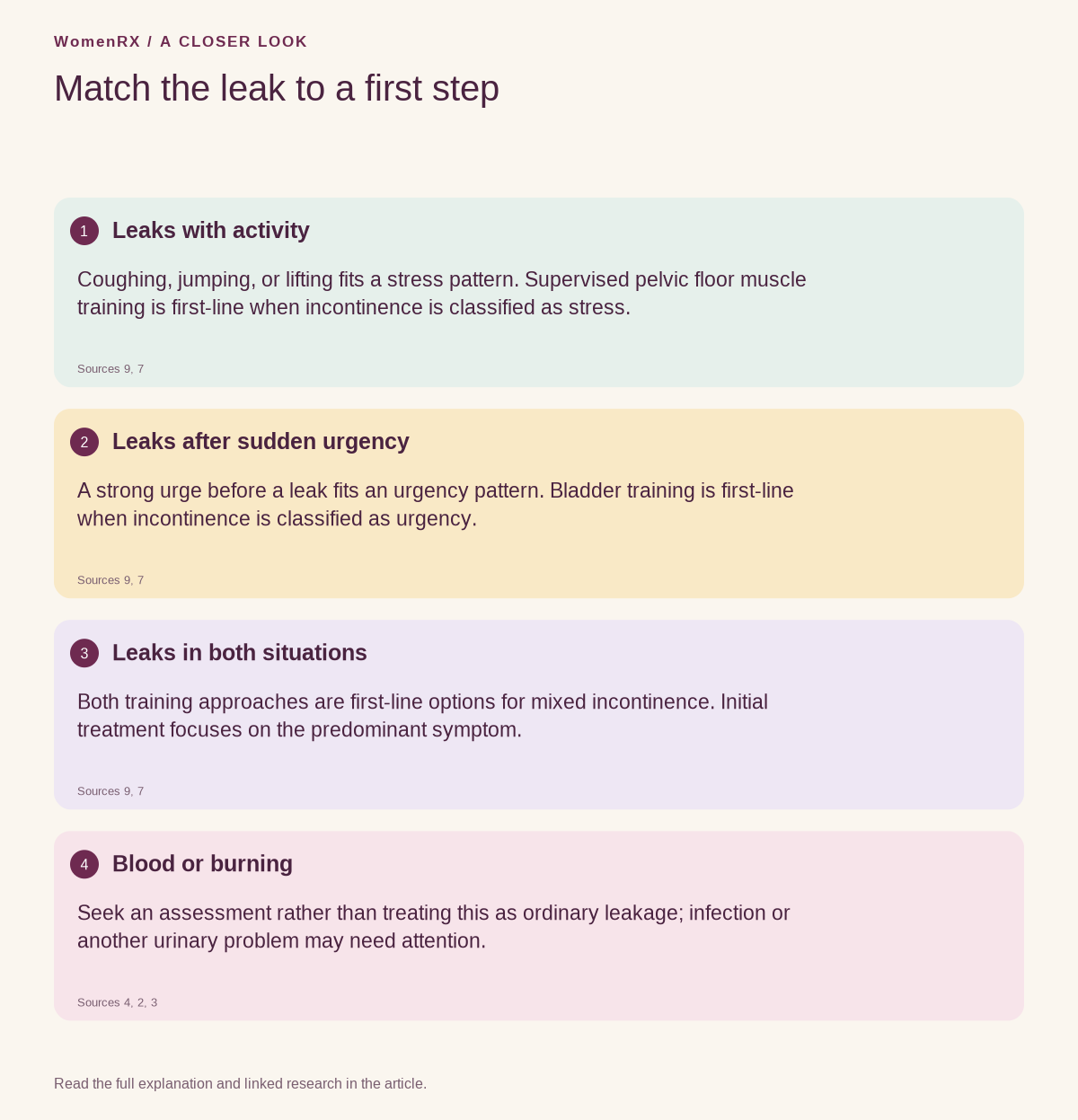
Match the leak to a first step
Leaks with activity: Coughing, jumping, or lifting fits a stress pattern. Supervised pelvic floor muscle training is first-line when incontinence is classified as stress.97
Leaks after sudden urgency: A strong urge before a leak fits an urgency pattern. Bladder training is first-line when incontinence is classified as urgency.97
Leaks in both situations: Both training approaches are first-line options for mixed incontinence. Initial treatment focuses on the predominant symptom.97
Blood or burning: Seek an assessment rather than treating this as ordinary leakage; infection or another urinary problem may need attention.423
Read the figure as text
Describe when leakage happens; an assessment can identify its type before you choose a first-line approach.- Leaks with activity: Coughing, jumping, or lifting fits a stress pattern. Supervised pelvic floor muscle training is first-line when incontinence is classified as stress.97
- Leaks after sudden urgency: A strong urge before a leak fits an urgency pattern. Bladder training is first-line when incontinence is classified as urgency.97
- Leaks in both situations: Both training approaches are first-line options for mixed incontinence. Initial treatment focuses on the predominant symptom.97
- Blood or burning: Seek an assessment rather than treating this as ordinary leakage; infection or another urinary problem may need attention.423
More questions, answered
Do I need a device to do pelvic floor muscle training?
NICE advises against routinely using perineometry or pelvic floor electromyography as biofeedback during pelvic floor muscle training. Separately, it advises against routinely combining electrical stimulation with training. That does not rule out optional aids: the NHS says vaginal cones may assist some women, though some find them uncomfortable. An assessment can check whether you can contract the right muscles before supervised training begins.78
Sources you can check
- Urinary Tract Infections | UTI | UTI Symptoms | MedlinePlusAccessed 2026-09-25Return to first citation
- Urinary tract infections (UTIs) - NHSAccessed 2026-09-25Return to first citation
- Urine and Urination | Urine | MedlinePlusAccessed 2026-09-25Return to first citation
- Blood in urine - NHSAccessed 2026-09-25Return to first citation
- Physical therapy for urinary incontinence in older women: A systematic review.Hao J, Yao Z, Fan P, Ding Y, Remis A, Liu S. · Archives of gerontology and geriatrics · 2026Return to first citation
- Isolated bladder training or in combination with other therapies to improve overactive bladder symptoms: a systematic review and meta-analysis of randomized controlled trials.Rocha AK, Monteiro S, Campos I, Volpato M, Verleun D, Valim L, Riccetto C, Botelho S. · Brazilian journal of physical therapy · 2024Return to first citation
- Recommendations | Urinary incontinence and pelvic organ prolapse in women: management | Guidance | NICEAccessed 2026-09-25Return to first citation
- Urinary incontinence - Non-surgical treatment - NHSAccessed 2026-09-25Return to first citation
- Urinary Incontinence | Stress Incontinence | UI | MedlinePlusAccessed 2026-09-25Return to first citation
- Urinary incontinence - NHSAccessed 2026-09-25Return to first citation