Pilates and the Pelvic Floor: What the Evidence Shows
Pilates may help with urinary leakage when it deliberately includes pelvic floor muscle work, but that’s different from assuming every Pilates class trains those muscles.
Pilates can be a reasonable option for some women with stress urinary incontinence, especially when the program deliberately coordinates pelvic floor contractions with movement. Small trials in postmenopausal and older women found symptom improvements with Pilates-based programs, but they don’t show that any general Pilates class strengthens the pelvic floor or treats prolapse. The postpartum evidence is also limited and doesn’t isolate Pilates from online support. 1 2 3
The key difference is what the exercise asks you to do
Pilates works on movement and trunk control. Pelvic floor muscle training (PFMT) specifically trains the pelvic floor muscles. In some studies, Pilates was modified or paired with deliberate pelvic floor contractions, so the results shouldn’t be taken as proof that a standard Pilates class provides the same training. 1 2
That distinction matters if your goal is symptom relief. Research has assessed outcomes such as urine leakage, incontinence symptoms, quality of life, and pelvic floor muscle strength or endurance. Those are not interchangeable outcomes: a change in symptoms doesn’t automatically demonstrate stronger muscles, and neither finding establishes that Pilates prevents or treats pelvic organ prolapse.
What studies in older and postmenopausal women found
In a randomized trial of 40 postmenopausal women with stress urinary incontinence, participants received either PFMT or Pilates for 12 weeks. Both groups improved on measures including urine loss, reported daily leakage, and incontinence-related quality of life. The study found no overall difference between the programs for managing symptoms when the Pilates involved voluntary pelvic floor contractions. Muscle-strength findings varied by measure, with some improvements reported in one group but not the other. This is a small trial, not proof that all forms of Pilates and PFMT are interchangeable. 1
A second randomized trial included 34 older women with stress urinary incontinence. Over 12 weeks, both a modified Pilates program and PFMT were associated with improvements on symptom questionnaires. Between-group differences appeared in some muscle-activity measures, favoring PFMT, and in abdominal muscle strength, favoring modified Pilates. The researchers considered modified Pilates a possible alternative for women who didn’t want PFMT. That result applies to a studied, modified program, not necessarily to an ordinary group class. 2
A 2026 systematic review of physical therapy trials in women aged 60 and older also reported that PFMT reduced incontinence severity compared with usual care and that comparative studies found similar results for PFMT, Pilates, and yoga. The review included different kinds of interventions, so it supports Pilates as a possible exercise option in this population, rather than establishing that every Pilates program works like targeted PFMT. 4
Postpartum evidence is harder to interpret
One small randomized study enrolled 38 women with postpartum urinary incontinence. It compared Kegel exercises alone, internet-delivered Kegel support, and internet-delivered Pilates. Leakage measures improved within all three groups over six weeks. But because the Pilates group also received internet support, and the reported results don’t establish a clear Pilates-versus-PFMT advantage, the study can’t tell you whether Pilates itself produced the improvement or whether it works as well as targeted training. 3
These findings don’t establish a Pilates approach for pregnancy. They also don’t answer whether Pilates prevents or improves prolapse. Those are different questions from treating urinary leakage, the outcome most directly assessed in these studies.
A practical way to choose
If you enjoy Pilates and want it to be part of a plan for leakage, ask what the class or program actually includes. A program that explicitly teaches pelvic floor contraction and coordination is closer to the Pilates-based approaches studied than a class that focuses only on general movement. You might also consider whether you want targeted PFMT, a Pilates-based option, or a combination; the best fit may depend on which approach you’re willing and able to keep doing.
A 2026 review of alternative exercise programs for women with stress urinary incontinence found no significant difference between pooled alternative exercises and PFMT for symptom severity or quality of life. But the review grouped Pilates with several other approaches, so its overall result can’t establish Pilates-specific equivalence. 5
The useful takeaway: Pilates can be a reasonable exercise choice, and some Pilates-based programs have been studied for stress urinary incontinence. Look for deliberate pelvic floor work if that’s your goal, and don’t treat a general Pilates class as a proven substitute for targeted training or as a treatment for prolapse.
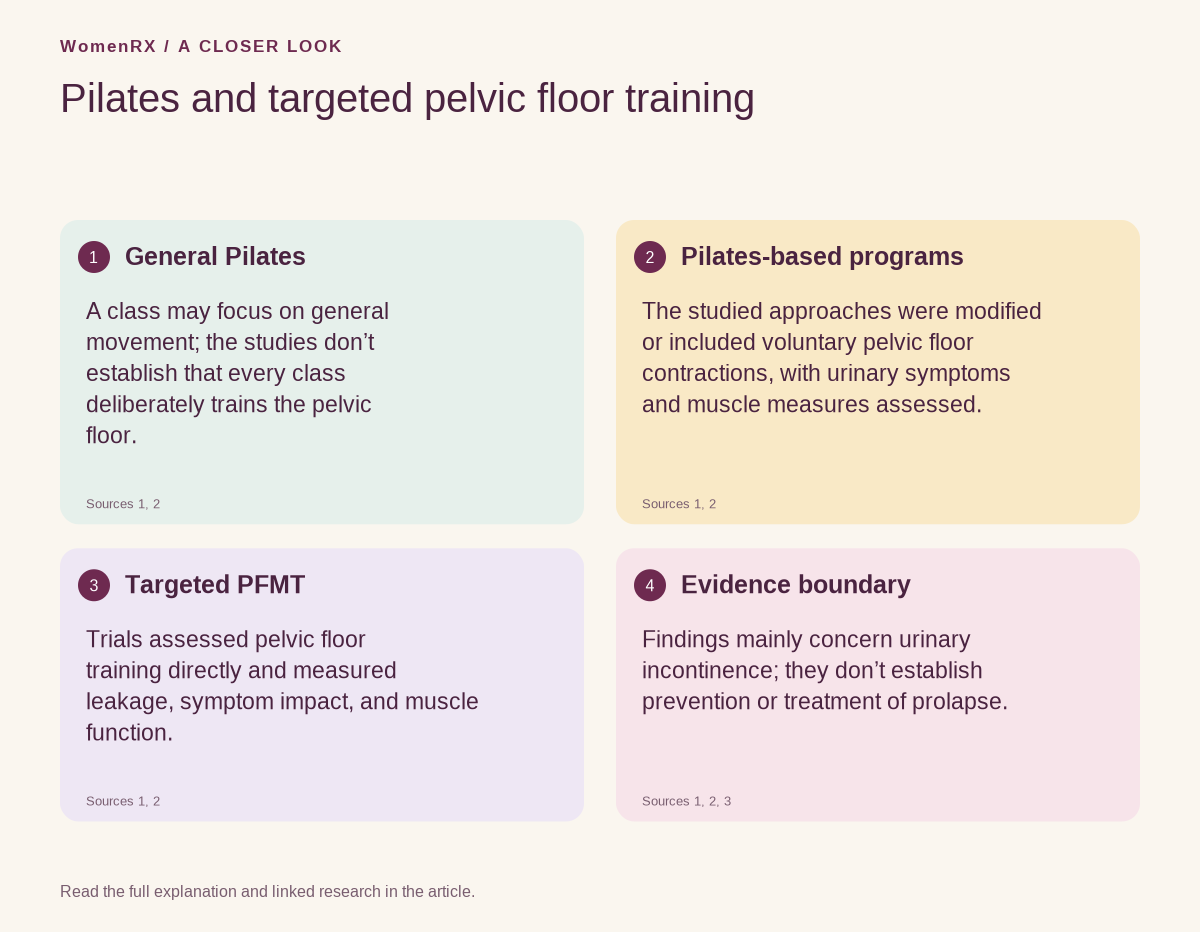
Pilates and targeted pelvic floor training
General Pilates: A class may focus on general movement; the studies don’t establish that every class deliberately trains the pelvic floor.12
Pilates-based programs: The studied approaches were modified or included voluntary pelvic floor contractions, with urinary symptoms and muscle measures assessed.12
Targeted PFMT: Trials assessed pelvic floor training directly and measured leakage, symptom impact, and muscle function.12
Evidence boundary: Findings mainly concern urinary incontinence; they don’t establish prevention or treatment of prolapse.123
Read the figure as text
The distinction is not simply one exercise versus another: studies measured specific programs and different outcomes.- General Pilates: A class may focus on general movement; the studies don’t establish that every class deliberately trains the pelvic floor.12
- Pilates-based programs: The studied approaches were modified or included voluntary pelvic floor contractions, with urinary symptoms and muscle measures assessed.12
- Targeted PFMT: Trials assessed pelvic floor training directly and measured leakage, symptom impact, and muscle function.12
- Evidence boundary: Findings mainly concern urinary incontinence; they don’t establish prevention or treatment of prolapse.123
More questions, answered
Does a regular Pilates class count as pelvic floor training?
Not automatically. The Pilates programs studied for urinary leakage included modified exercises or deliberate pelvic floor contractions. A class focused on general movement may not include that targeted work. 1 2
Does Pilates help prevent or treat pelvic organ prolapse?
The trials assessed urinary incontinence, muscle measures, and related quality of life. They don’t establish that Pilates prevents or treats pelvic organ prolapse. 1 2 3
Sources you can check
- Comparative analysis of pelvic floor muscle training and Pilates in managing urinary incontinence among postmenopausal women: a randomized controlled trial.Gonzaga S, de Oliveira RG, Dutra LL, Oliveira LS, de Oliveira LC. · International urogynecology journal · 2024Return to first citation
- Comparison of the effects of pelvic floor muscle training and modified pilates exercises in elderly women with stress urinary incontinence: A randomized clinical trial.Dimli BO, Mutlu EK, Altac DS, Taskiran H. · European journal of obstetrics, gynecology, and reproductive biology · 2024Return to first citation
- Effect of Internet combined with pelvic floor muscle training on postpartum urinary incontinence.Wang J, An D. · International urogynecology journal · 2023Return to first citation
- Physical therapy for urinary incontinence in older women: A systematic review.Hao J, Yao Z, Fan P, Ding Y, Remis A, Liu S. · Archives of gerontology and geriatrics · 2026Return to first citation
- Alternative Exercise Regimens for Stress Urinary Incontinence in Women: A Systematic Review and Meta-analysis.Hao J, Yao Z, Remis A, Sun Y, Pu Y, Huang B. · International urogynecology journal · 2026Return to first citation