Bladder Leakage After Birth: Patterns, Recovery, and Care
When and how you leak can point toward different kinds of bladder symptoms and different treatment options.
Leakage with coughing, sneezing, lifting, or exercise often fits stress incontinence; leakage after a sudden, hard-to-delay urge fits urgency incontinence. Some women have both. Symptoms can happen after vaginal or cesarean birth, and there isn’t one recovery timeline. If leakage persists, bothers you, or affects daily life, describe the pattern at a care visit: assessment can help guide treatment instead of assuming it will resolve on its own. 134
Start with what happens just before the leak
A few details can help distinguish common patterns. If urine escapes when you cough, sneeze, laugh, lift something, or exercise, that fits stress incontinence. “Stress” here means physical pressure, not emotional stress. If a sudden, intense need to pee comes first and urine leaks before you reach the toilet, that fits urgency incontinence. Some people experience both. 123
Notice whether leakage is tied to a specific activity or follows an urge, and whether you also feel you need to pee often or don’t fully empty your bladder. Small trickles that happen frequently alongside a feeling of incomplete emptying describe a different pattern worth mentioning in an assessment. These observations don’t diagnose the cause, but they make the conversation more specific. 13
Recovery varies, and birth mode isn’t the whole story
Pregnancy and childbirth can affect the pelvic floor and the muscles involved in urine control. 26 Leakage is not limited to vaginal birth: research has assessed postpartum symptoms among women after both vaginal and cesarean deliveries. In one cohort of 426 first-time mothers with singleton pregnancies, researchers recorded leakage at postpartum follow-ups in groups that included elective and intrapartum cesarean births as well as vaginal births. 4
That study offers a snapshot, not a personal forecast. In the whole cohort, the proportion reporting leakage was 20.2% at 42 days after birth and 14.3% at six months. Those figures don’t show when any one person’s symptoms will improve, and they shouldn’t be treated as rates for every postpartum population. A separate review of 32 studies found wide variation between studies, underscoring that estimates depend on the populations and methods involved. 45
Delivery mode may be associated with differences in risk, but it doesn’t tell you whether you personally will leak or what care you need. A systematic review identified cesarean delivery as a protective factor, while the cohort also found higher rates after vaginal than elective cesarean birth. Neither finding means cesarean birth prevents leakage, or that symptoms after vaginal birth are inevitable. 45
What an assessment can add
You can bring a short record of when you drink, when you pee, and when leakage happens. Note the activity or urge just beforehand and whether you feel able to empty your bladder. A bladder diary is one tool a provider may use alongside questions about your symptoms and, when appropriate, a pelvic examination. 12
It’s reasonable to bring this up if leakage is continuing, interfering with exercise or daily routines, or simply concerning you. You don’t have to wait for it to become severe. A clinical assessment can help sort out whether the pattern is mainly stress, urgency, mixed, or something else, and what options fit. Urinary incontinence is common, but it can often improve with appropriate treatment. 13
Match the next step to the pattern
For stress leakage, pelvic floor muscle training is a common approach. The NHS describes pelvic floor exercises as strengthening muscles that help control urine flow. If you’re unsure how to contract and relax those muscles, ask whether instruction or supervised pelvic floor therapy is appropriate for you rather than guessing at an exercise routine. A postpartum qualitative review also found that women described barriers to accessing interventions, so it’s useful to ask directly what support is available. 26
For urgency symptoms, bladder training is another possible option: it involves gradually increasing the time between bathroom trips according to a schedule. A provider may also discuss medicines that relax the bladder or reduce urgency signals. These are general incontinence options, not a postpartum-specific treatment plan; the right choice depends on your symptoms and assessment. 1
If you have both stress and urgency leakage, say so. One approach may not address both patterns, and treatment options differ by type. If you’re passing frequent small amounts or feel unable to empty your bladder, mention that too, rather than describing the symptom only as “leakage.” 13
A simple way to describe it
You might say: “I leak a little when I cough,” or “I get a sudden urge and sometimes leak on the way to the bathroom.” Add when it began, whether it’s changing, and how it affects activities you care about. That gives a more useful starting point than waiting quietly to see whether the symptom disappears.
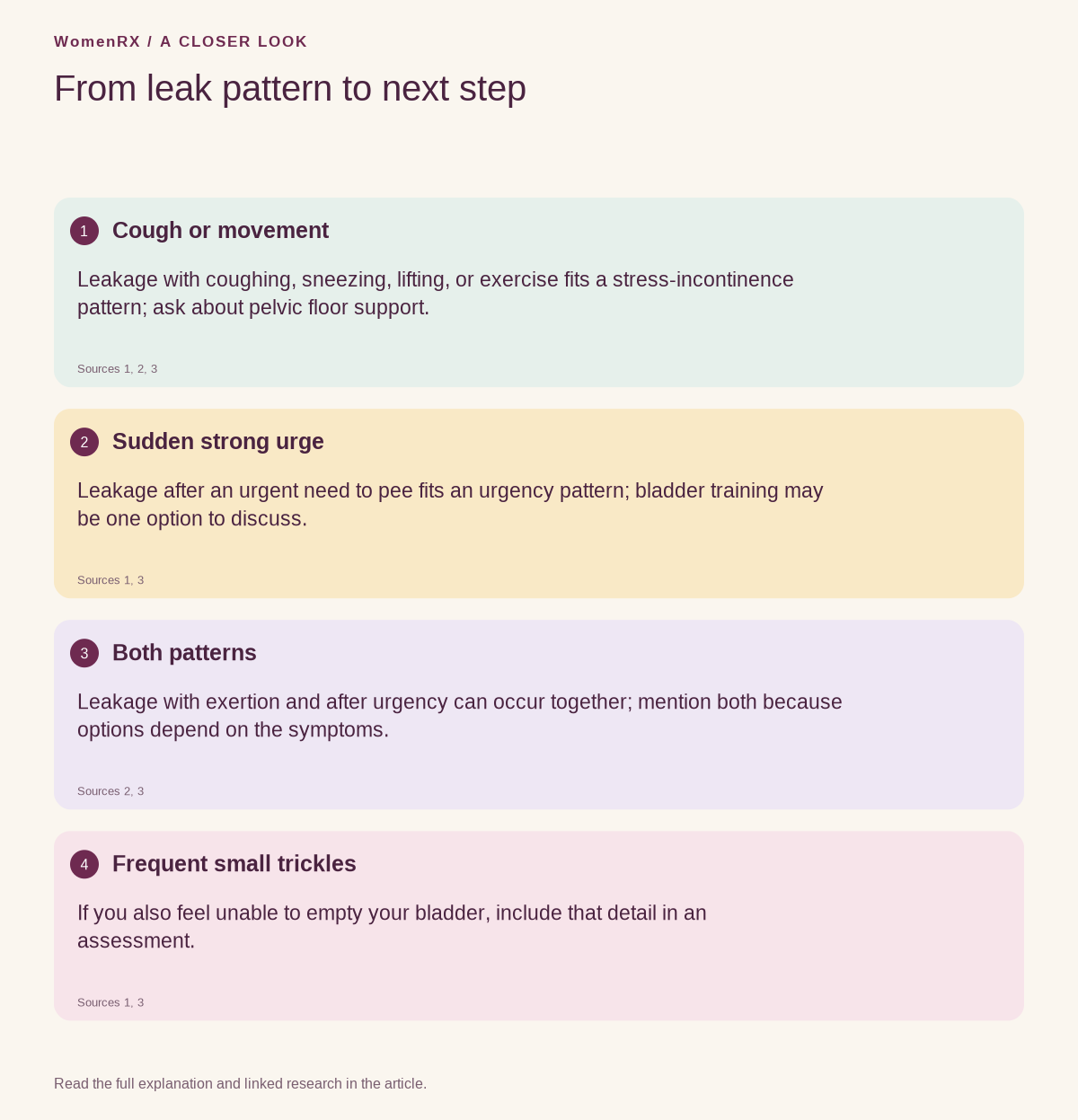
From leak pattern to next step
Cough or movement: Leakage with coughing, sneezing, lifting, or exercise fits a stress-incontinence pattern; ask about pelvic floor support.123
Sudden strong urge: Leakage after an urgent need to pee fits an urgency pattern; bladder training may be one option to discuss.13
Both patterns: Leakage with exertion and after urgency can occur together; mention both because options depend on the symptoms.23
Frequent small trickles: If you also feel unable to empty your bladder, include that detail in an assessment.13
Read the figure as text
Use the event just before leakage as a starting point for describing symptoms and discussing suitable assessment or options.- Cough or movement: Leakage with coughing, sneezing, lifting, or exercise fits a stress-incontinence pattern; ask about pelvic floor support.123
- Sudden strong urge: Leakage after an urgent need to pee fits an urgency pattern; bladder training may be one option to discuss.13
- Both patterns: Leakage with exertion and after urgency can occur together; mention both because options depend on the symptoms.23
- Frequent small trickles: If you also feel unable to empty your bladder, include that detail in an assessment.13
More questions, answered
Can bladder leakage happen after a cesarean birth?
Yes, postpartum leakage has been studied in women after cesarean as well as vaginal birth. In one cohort, researchers assessed symptoms in elective and intrapartum cesarean groups; the study found lower rates in the elective cesarean group than in the vaginal-birth group, but it does not mean cesarean prevents leakage. 4
Does leakage mean I should only do Kegels?
Not necessarily. Pelvic floor exercises are one option, especially for stress leakage, but sudden urgency, mixed symptoms, or difficulty emptying may call for a different assessment or additional options such as bladder training. Describe what happens before the leak so the next step can fit the pattern. 123
Sources you can check
- Urinary Incontinence | Stress Incontinence | UI | MedlinePlusAccessed 2026-09-25Return to first citation
- Urinary incontinence - NHSAccessed 2026-09-25Return to first citation
- Urinary incontinence - Symptoms - NHSAccessed 2026-09-25Return to first citation
- [Incidence and influencing factors of urinary incontinence during pregnancy and after childbirth].Zhong XW, Ouyang YL, Zhao XF. · Zhonghua fu chan ke za zhi · 2026Return to first citation
- Prevalence and factors of urinary incontinence among postpartum: systematic review and meta-analysis.Dai S, Chen H, Luo T. · BMC pregnancy and childbirth · 2023Return to first citation
- Women's perceptions of urinary incontinence during the postpartum period: systematic review of qualitative evidence.Gallego-Gómez C, Torres-Costoso A, Martínez-Vizcaíno V, Quezada-Bascuñán CA, Martínez-Bustelo S, Basco-López JÁ, Ferri-Morales A, Martínez-Martínez H. · BMC pregnancy and childbirth · 2026Return to first citation