Pelvic Floor Recovery After Birth: What Symptoms Mean
Leakage, a vaginal bulge, or trouble controlling bowel movements can each point toward a different kind of assessment and treatment.
If you’re leaking urine, notice a lump or bulge at the vagina, or have trouble controlling bowel movements after birth, you don’t have to wait for a set recovery milestone to ask for an assessment. These symptoms can have different causes, so pelvic floor exercises aren’t the whole answer. Rehabilitation can help with some symptoms, particularly persistent urinary leakage, but the plan should fit what’s happening for you. 238
Start with the symptom, not an exercise plan
Birth can affect the muscles involved in bladder control, but not every postpartum symptom means those muscles simply need strengthening. A leak when you cough differs from a sudden urge you can’t hold back. A vaginal bulge raises a different question again. These distinctions help explain why an assessment can be more useful than choosing exercises based on the word “pelvic floor” alone. 234
There’s no requirement to wait until three months postpartum to mention leakage. Guidance on urinary incontinence recommends seeking an assessment for any type of leakage. A postpartum guideline specifically recommends pelvic floor muscle rehabilitation for persistent urinary incontinence at three months, but that treatment recommendation isn’t a rule to delay care until then. 38
What the symptoms may be telling you
Urine leaks with coughing, laughing, lifting, or exercise. This pattern is called stress incontinence. It relates to pressure on the bladder and can involve weakness or damage in the muscles that help prevent leakage. “Stress” here means physical pressure, not emotional stress. 34
You suddenly need to pee and leak before reaching the bathroom. That pattern is urgency incontinence. It can involve overactivity of the bladder muscle, rather than the same mechanism as a cough-related leak. Both patterns can occur together, so tell your care team about each one if they do. 34
You feel a lump or notice a bulge in or around the vagina. Pelvic organ prolapse is one possible explanation: the bladder, uterus, or bowel can bulge into the vagina. Prolapse may also come with bladder symptoms, including a feeling that you haven’t emptied fully. A clinician can ask about the symptoms and examine you to work out whether prolapse is present and what, if anything, needs treatment. 2
You’re having trouble controlling stool, or discomfort is disrupting daily life or intimacy. Bring this up, especially if you had a tear involving the anal sphincter. That injury can be followed by bowel, urinary, pain, and sexual symptoms. Its recovery can vary considerably from one woman to another. 67
You can make a brief note of what happens and when, such as whether a leak follows a cough or a sudden urge. That gives an assessor a clearer starting point; it isn’t a test you need to complete before asking for help. A bladder diary is one tool a clinician may suggest when assessing urinary symptoms. 3
What a pelvic health assessment can change
An assessment is more than a check of muscle strength. For urinary leakage, a clinician may ask about the pattern of symptoms and do a pelvic examination. If supervised pelvic floor muscle training is being considered for incontinence, NICE recommends a digital assessment to confirm that you can contract the muscles. That check can help avoid building a program around a movement you’re not yet able to identify. 13
A vaginal bulge may call for an examination focused on prolapse. If your concern follows an anal sphincter injury, explain whether you can defer a bowel movement, whether stool leaks, and whether you have pain. Assessment and follow-up after this injury may involve different clinicians and, when symptoms warrant it, more specialized evaluation. 256
Your birth history belongs in that conversation, but it doesn’t replace an assessment. Postpartum recommendations address care regardless of delivery mode, while a known anal sphincter injury calls for particular attention to bowel symptoms and healing. How long it’s been since birth matters too: symptoms in the early weeks and leakage that persists months later are not the same decision point. 578
Where rehabilitation fits
Pelvic floor muscle training has a useful role, especially for urinary incontinence. In a systematic review of trials involving pregnant and postpartum women, training improved measured pelvic floor muscle strength. Improvements in urinary symptoms and other outcomes were less consistent, so a stronger muscle measurement doesn’t promise that every symptom will resolve. 9
For leakage that persists at three months postpartum, a postpartum clinical guideline recommends rehabilitation using pelvic floor muscle contractions, regardless of the type of urinary incontinence. It also recommends rehabilitation for anal incontinence, though with a lower grade of evidence. That supports getting a plan matched to the symptom, rather than assuming that one set of squeezes treats bladder leakage, bowel leakage, a bulge, and pain alike. 8
The limits matter. In one observational study of women who had an obstetric anal sphincter injury, several urinary symptoms improved between an initial physiotherapy visit within six weeks of birth and follow-up at three to six months. Fecal incontinence did not improve significantly in that study. Because everyone was observed over time rather than compared with a group assigned to different care, the study can’t tell us how much of the change physiotherapy caused. 6
A postpartum guideline does not recommend pelvic floor rehabilitation for women without symptoms solely to prevent later incontinence. It also does not recommend it to treat or prevent postpartum prolapse or painful sex. General prolapse care can include pelvic floor training, but that doesn’t establish it as the answer to a new postpartum bulge. If pain or a bulge is your main concern, finding out what’s behind it comes first. 28
The useful next move is to name the symptom plainly when you contact your postpartum care team: “I leak when I cough,” “I can’t hold back stool,” or “I feel a bulge.” Those details point toward different evaluations. You deserve an answer tailored to your symptoms, not a fixed deadline for recovery or an exercise sheet offered in place of understanding them. 235
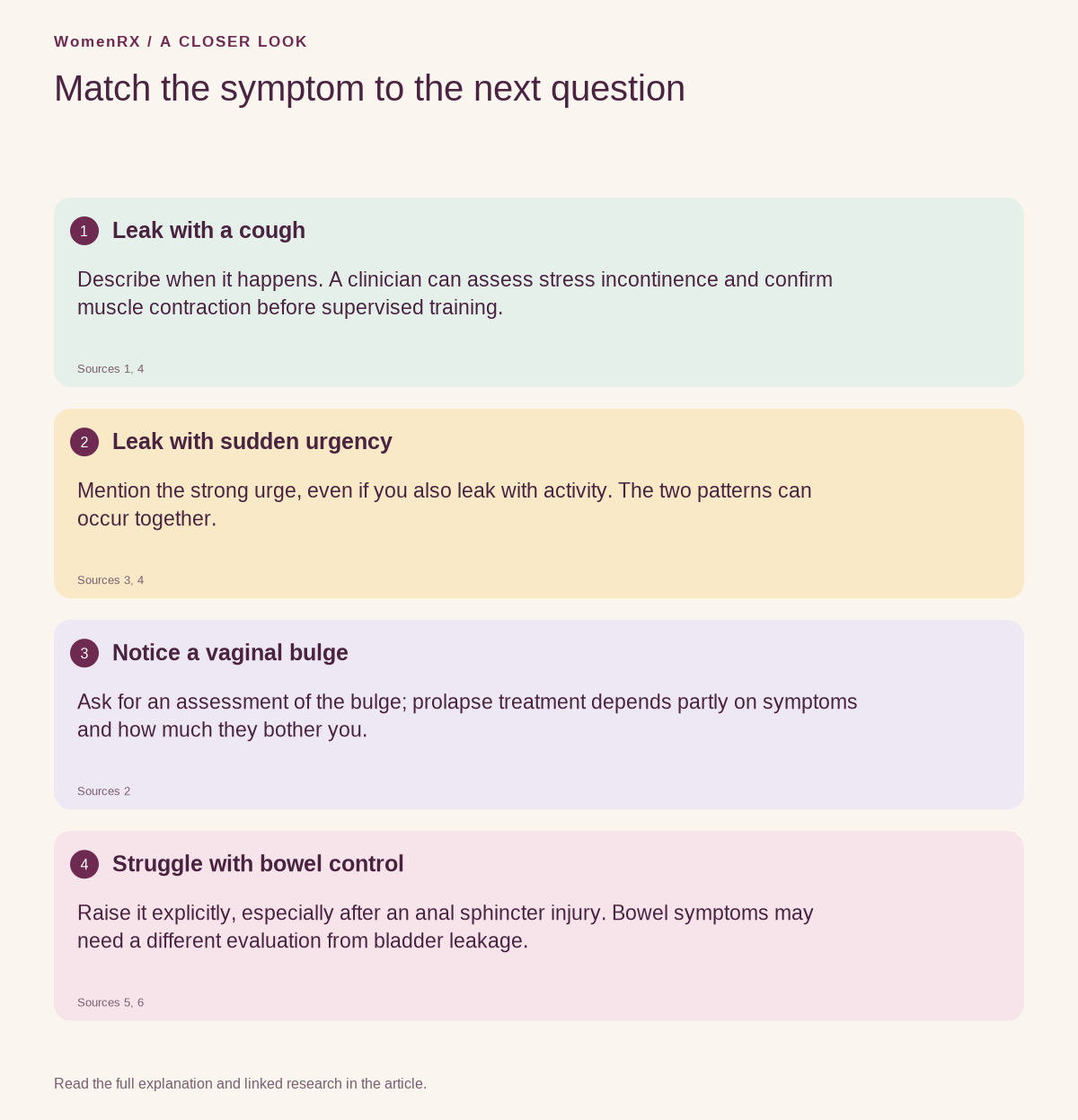
Match the symptom to the next question
Leak with a cough: Describe when it happens. A clinician can assess stress incontinence and confirm muscle contraction before supervised training.14
Leak with sudden urgency: Mention the strong urge, even if you also leak with activity. The two patterns can occur together.34
Notice a vaginal bulge: Ask for an assessment of the bulge; prolapse treatment depends partly on symptoms and how much they bother you.2
Struggle with bowel control: Raise it explicitly, especially after an anal sphincter injury. Bowel symptoms may need a different evaluation from bladder leakage.56
Read the figure as text
Use the symptom as a starting point for assessment, rather than assuming every concern calls for the same exercises.- Leak with a cough: Describe when it happens. A clinician can assess stress incontinence and confirm muscle contraction before supervised training.14
- Leak with sudden urgency: Mention the strong urge, even if you also leak with activity. The two patterns can occur together.34
- Notice a vaginal bulge: Ask for an assessment of the bulge; prolapse treatment depends partly on symptoms and how much they bother you.2
- Struggle with bowel control: Raise it explicitly, especially after an anal sphincter injury. Bowel symptoms may need a different evaluation from bladder leakage.56
More questions, answered
Can pelvic floor symptoms happen after a cesarean birth?
Delivery mode alone shouldn’t decide whether you raise a symptom. Postpartum guidance addresses care regardless of mode of delivery and recommends rehabilitation for persistent urinary incontinence based on the symptom, not on whether the birth was vaginal or cesarean. 8
Does a vaginal bulge always need treatment?
Not necessarily. Prolapse may cause no symptoms, and treatment depends partly on whether it bothers you. A new lump or bulge is still worth having assessed so you know what it is and can discuss the options that fit your situation. 2
Sources you can check
- Recommendations | Urinary incontinence and pelvic organ prolapse in women: management | Guidance | NICEAccessed 2026-09-25Return to first citation
- Pelvic organ prolapse - NHSAccessed 2026-09-25Return to first citation
- Urinary incontinence - NHSAccessed 2026-09-25Return to first citation
- Urinary incontinence - Symptoms - NHSAccessed 2026-09-25Return to first citation
- Care pathways and anorectal evaluation for obstetric anal sphincter injury-related incontinence: A UK survey of obstetricians.Elsaid N, Thomas GP, Dutta S, Fernando RJ, Carrington EV, Vaizey CJ. · Colorectal disease : the official journal of the Association of Coloproctology of Great Britain and Ireland · 2025Return to first citation
- Which symptoms of pelvic floor dysfunction does physiotherapy improve after an OASI?Blades G, Simms C, Vickers H, Kershaw V, Jha S. · European journal of obstetrics, gynecology, and reproductive biology · 2021Return to first citation
- Women's experiences of obstetric anal sphincter injury and physical therapy interventions - A qualitative study.Johannesson E, Sjöberg ÅL, Segerbrand N, Fagevik Olsén M, Gutke A. · Brazilian journal of physical therapy · 2022Return to first citation
- Postpartum practice: guidelines for clinical practice from the French College of Gynaecologists and Obstetricians (CNGOF).Sénat MV, Sentilhes L, Battut A, Benhamou D, Bydlowski S, Chantry A, Deffieux X, Diers F, Doret M, Ducroux-Schouwey C, Fuchs F, Gascoin G, Lebot C, Marcellin L, Plu-Bureau G, Racca... · European journal of obstetrics, gynecology, and reproductive biology · 2016Return to first citation
- Effects of Pelvic Floor Muscle Training in Pregnant and Postpartum Women: A Systematic Review.Jin S, Lee H. · International urogynecology journal · 2026Return to first citation