Pelvic Floor Exercises: When Strengthening Fits and When to Get Help
Leakage with a cough, leakage after a sudden urge, and pelvic pressure can point to different next steps.
Supervised pelvic floor muscle training is a first-line option for stress or mixed urinary leakage and may be considered for some women with symptomatic, early-stage prolapse. Urgency leakage can involve the bladder muscle rather than simple pelvic floor weakness. If you feel pelvic pressure or notice a vaginal bulge, seek an assessment before choosing exercises. 1 2 3 4
Start with the kind of symptom
A leak when you cough, sneeze, laugh, or exercise is called stress urinary incontinence. It’s often linked to weakness or damage in the muscles that help prevent urine from escaping. A sudden, intense urge to pee followed by leakage is urge incontinence; this usually involves overactivity of the bladder muscle. Some women have both. So, leakage doesn’t always point to the same problem, and it doesn’t automatically mean that more squeezing is the answer. 3
A vaginal lump or bulge, or urinary changes such as needing to pee more often, leaking, or feeling that your bladder hasn’t emptied fully, can also be signs of pelvic organ prolapse. Pelvic pressure may occur with prolapse, but the feeling alone can’t tell you its cause or whether strengthening will help. Prolapse may cause no symptoms, and treatment depends on whether it’s bothering you and on its severity. A clinician can assess what’s going on rather than asking you to infer it from symptoms alone. 2 4
When strengthening has a clearer role
For stress or mixed urinary incontinence, NICE recommends a trial of supervised pelvic floor muscle training as a first treatment. For women with symptomatic stage 1 or 2 prolapse, its guidance says to consider supervised training as a first option. These are specific situations, not a rule that every woman needs Kegels. For supervised training to treat urinary incontinence, NICE calls for an assessment to confirm that you can contract the pelvic floor muscles. 1
Pregnancy and postpartum recovery deserve their own context. Pelvic floor exercises during pregnancy may help prevent urinary incontinence. A systematic review of online training studies found improved postpartum incontinence outcomes, but the results varied across studies. Online training also did not significantly improve symptom severity in the review’s older-adult group, even though adherence improved. That’s a reason not to assume one exercise format works equally well at every life stage. 3 5
Check the movement before choosing a routine
Symptoms can point to useful questions, but they don’t tell you by themselves whether a strengthening routine fits. NICE recommends confirming that a woman can contract her pelvic floor muscles before supervised training for urinary incontinence. If you’re unsure whether you can contract the muscles correctly, or whether repeated squeezes fit your symptoms, ask for an assessment rather than guessing at a routine. 1
Strengthening isn’t the whole conversation if your main concern is pressure or a bulge. An assessment can establish whether prolapse is present and how much it’s affecting you. If it is, pelvic floor muscle training is one possible option; a vaginal pessary or other treatments may also be considered. 1 2 4
A practical next step
If you leak with effort, ask whether supervised pelvic floor muscle training fits your symptoms. If leakage follows urgency, mention the sudden urge specifically: bladder training is one treatment option for urinary incontinence, and the cause may not be simple muscle weakness. If you notice a vaginal lump or bulge, pelvic pressure, or urinary symptoms that could be related to prolapse, arrange an assessment. 2 3 4
A clear description of when leakage happens, whether you feel a sudden urge, and whether you’ve noticed a lump, pressure, or urinary-emptying changes can help make the conversation more useful.
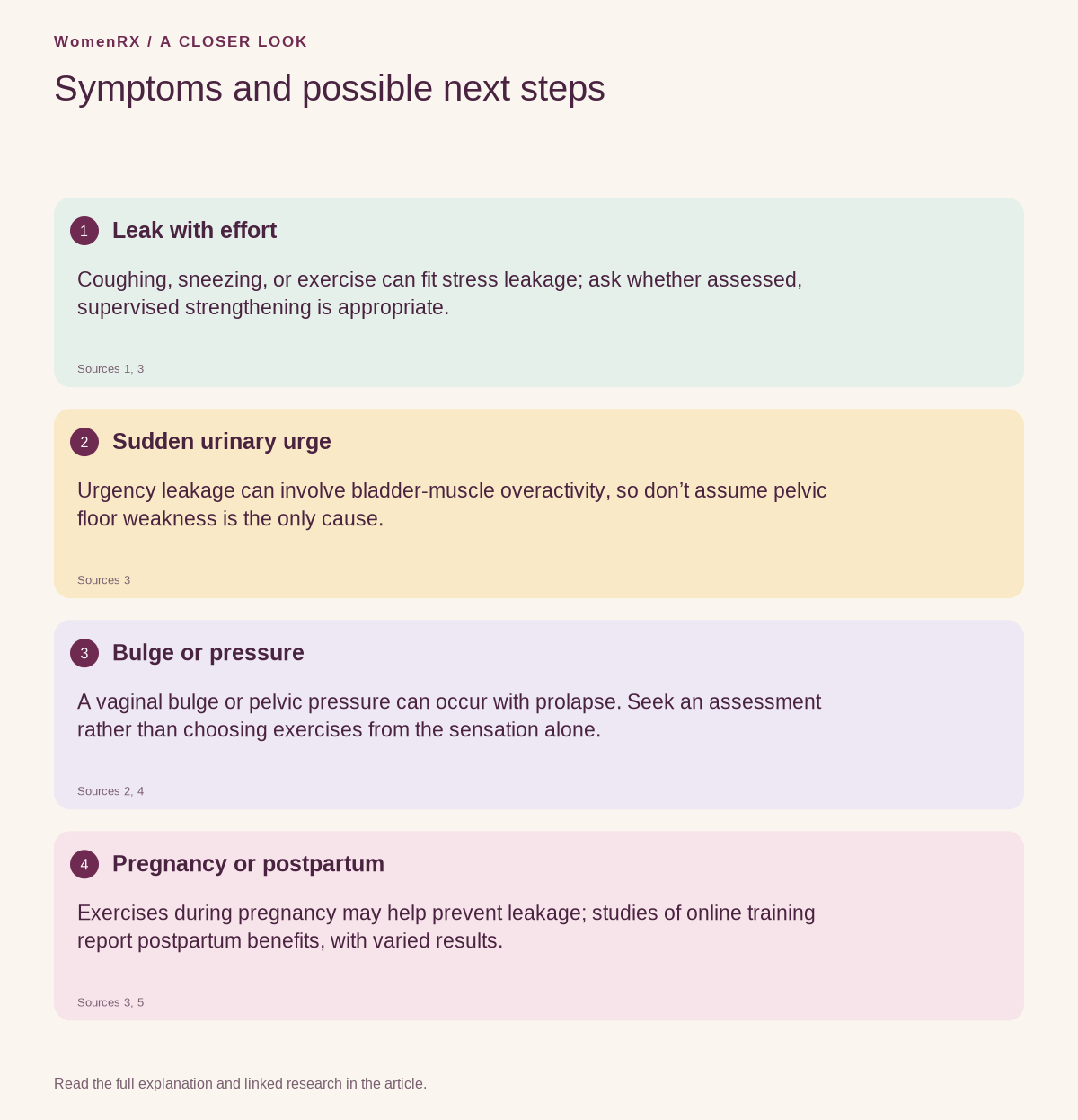
Symptoms and possible next steps
Leak with effort: Coughing, sneezing, or exercise can fit stress leakage; ask whether assessed, supervised strengthening is appropriate.13
Sudden urinary urge: Urgency leakage can involve bladder-muscle overactivity, so don’t assume pelvic floor weakness is the only cause.3
Bulge or pressure: A vaginal bulge or pelvic pressure can occur with prolapse. Seek an assessment rather than choosing exercises from the sensation alone.24
Pregnancy or postpartum: Exercises during pregnancy may help prevent leakage; studies of online training report postpartum benefits, with varied results.35
Read the figure as text
Start with what you notice, then use the distinction to decide what to describe when seeking advice. Symptoms alone don’t select an exercise.- Leak with effort: Coughing, sneezing, or exercise can fit stress leakage; ask whether assessed, supervised strengthening is appropriate.13
- Sudden urinary urge: Urgency leakage can involve bladder-muscle overactivity, so don’t assume pelvic floor weakness is the only cause.3
- Bulge or pressure: A vaginal bulge or pelvic pressure can occur with prolapse. Seek an assessment rather than choosing exercises from the sensation alone.24
- Pregnancy or postpartum: Exercises during pregnancy may help prevent leakage; studies of online training report postpartum benefits, with varied results.35
More questions, answered
Does leakage always mean my pelvic floor is weak?
No. Stress leakage is often linked to weakness or damage in muscles that help control urination, while urge leakage usually involves overactivity of the bladder muscle. Some women have both, so leakage alone doesn’t identify the cause. 3
Should I start Kegels during pregnancy or after birth?
Pelvic floor exercises during pregnancy may help prevent urinary incontinence, and a review of online training studies found improved postpartum incontinence outcomes. That doesn’t establish one routine for everyone; if you’re unsure how to contract the muscles or what fits your symptoms, ask about an individualized assessment. 3 5
Sources you can check
- Recommendations | Urinary incontinence and pelvic organ prolapse in women: management | Guidance | NICEAccessed 2026-09-25Return to first citation
- Pelvic organ prolapse - NHSAccessed 2026-09-25Return to first citation
- Urinary incontinence - NHSAccessed 2026-09-25Return to first citation
- Pelvic Organ Prolapse with an Emphasis on the Central Compartment: From Genetic Risk Factors and Biomarkers to Contemporary Sacropexy and Emerging Robotic Innovations.Pomorski M, Fuchs T, Kryza-Ottou A, Budny-Wińska J, Śliwa J, Pomorski A. · Journal of clinical medicine · 2026Return to first citation
- The Rehabilitative Effects of Online Pelvic Floor Muscle Exercises on Female Urinary Incontinence Across Various Life Stages: A Systematic Review and Meta-Analysis.Wang Y, Zhang H, Wang J, Feng W, Sun Z, Chen Y. · International journal of nursing practice · 2026Return to first citation