Why Sex May Hurt and What Care Can Help
Where the pain happens can offer clues, but it can’t identify the cause on its own.
Pain at the vaginal opening may involve dryness or soreness, while pain felt deeper may occur alongside pelvic conditions such as endometriosis, an ovarian cyst, or infection. Pelvic floor muscles are another possible contributor to painful penetration. These are questions to explore, not diagnoses you can make from the location of pain alone. 124
Pain during sex deserves attention, not endurance. It can happen at the vaginal opening or feel deeper in the pelvis, and more than one factor may contribute. Noticing where it hurts, when it starts, and what else is happening can help make a clinical conversation more focused. 12
First, notice where and when it hurts
Pain near the opening may feel like soreness or discomfort with penetration. Dryness can contribute, and it can have several possible causes, including menopause, not being aroused, or irritation from perfumed products. In postmenopause, lower estrogen and other sex steroids can change vulvovaginal tissue and contribute to dryness and pain. 15
Pelvic floor muscles are another question to raise if penetration hurts. They need to relax as well as contract. Overactivity can involve muscles not relaxing when needed, and an assessment can consider whether pelvic floor pain is contributing. This is one possible explanation, not something you can confirm from the sensation alone. 4
Pain felt deeper during penetration may occur alongside other pelvic pain. Pelvic pain may be related to infection, including sexually transmitted infections, or conditions affecting reproductive organs, such as endometriosis or an ovarian cyst. The bowel and bladder can also be involved in pelvic pain. 2
These patterns overlap. Pain at the opening doesn’t rule out another cause, and deep pain doesn’t point to one condition by itself. Location is a useful way to describe your experience, not a way to diagnose it. 12
The details that help shape an assessment
If you’re comfortable, describe the pain in your own words. Useful details include whether it starts with touch or penetration, feels deep, or occurs only in certain situations. You can also mention whether it’s new or recurring, and whether you’ve noticed dryness, itching, unusual discharge, bleeding, pelvic pain outside sex, or symptoms with urination. Pelvic pain can have several causes, so sharing the pattern and accompanying symptoms can help guide evaluation. 12
Life stage is context, not a diagnosis. If the pain began after birth, while breastfeeding, or around perimenopause, you can include that timing in your description. Those details alone don’t identify why sex hurts. Postmenopause is a specific context in which hormone-related vulvovaginal tissue changes can contribute to dryness and pain, but it isn’t the only possible explanation. 15
An exam is not all-or-nothing. You can ask what a proposed step is meant to find out, whether there are alternatives, and what will happen before it begins. You can ask to pause or stop at any point. If an internal exam feels like too much, say so; the next useful step may be a conversation about symptoms or what other evaluation could help.
Care depends on what’s contributing
For dryness, a water-based lubricant may reduce friction during sex. Perfumed soaps, washes, and douches can be irritating for some people, so avoiding them around the vulva may be worth trying. These steps may ease discomfort, but persistent pain, unusual discharge, or bleeding after sex calls for an assessment rather than assuming dryness is the whole story. 1
If pelvic floor muscle problems are part of the picture, pelvic floor physical therapy may be considered; pelvic floor problems can involve difficulty relaxing, not only weakness. If an infection or a gynecologic condition is identified, care will depend on that cause. For postmenopausal dryness, hormone-related options may be worth discussing when appropriate, but improvement in pain is not guaranteed: in one randomized trial of postmenopausal women with pelvic organ prolapse, dyspareunia did not differ between those assigned vaginal estrogen and placebo at the preoperative assessment. 1234
Sudden, severe pelvic pain can have causes that need urgent treatment, so don’t wait for a routine appointment if that happens. Otherwise, recurring pain is still worth bringing up, especially if it is affecting sex or daily life. 2
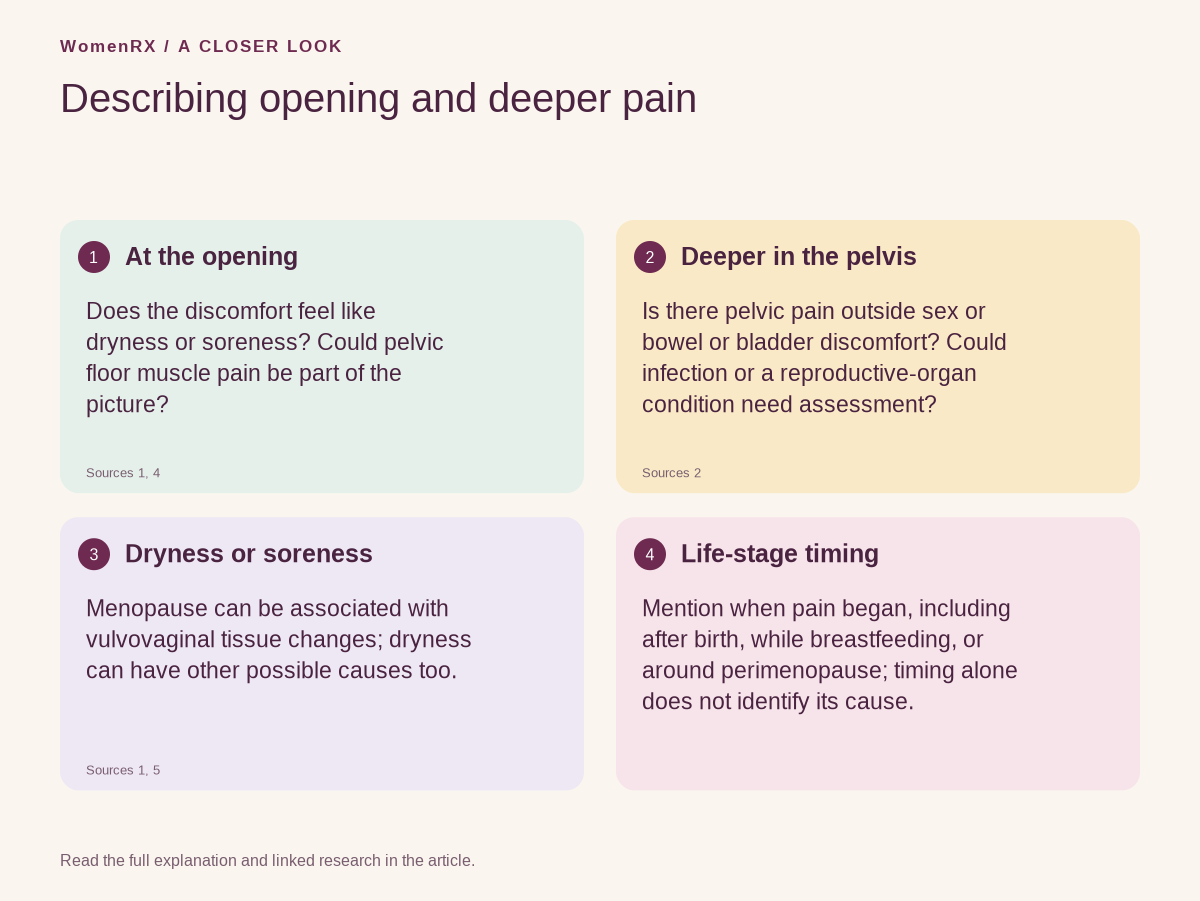
Describing opening and deeper pain
At the opening: Does the discomfort feel like dryness or soreness? Could pelvic floor muscle pain be part of the picture?14
Deeper in the pelvis: Is there pelvic pain outside sex or bowel or bladder discomfort? Could infection or a reproductive-organ condition need assessment?2
Dryness or soreness: Menopause can be associated with vulvovaginal tissue changes; dryness can have other possible causes too.15
Life-stage timing: Mention when pain began, including after birth, while breastfeeding, or around perimenopause; timing alone does not identify its cause.
Read the figure as text
The location of pain can help you explain what’s happening and frame questions for an assessment, but it cannot diagnose the cause.- At the opening: Does the discomfort feel like dryness or soreness? Could pelvic floor muscle pain be part of the picture?14
- Deeper in the pelvis: Is there pelvic pain outside sex or bowel or bladder discomfort? Could infection or a reproductive-organ condition need assessment?2
- Dryness or soreness: Menopause can be associated with vulvovaginal tissue changes; dryness can have other possible causes too.15
- Life-stage timing: Mention when pain began, including after birth, while breastfeeding, or around perimenopause; timing alone does not identify its cause.
More questions, answered
Does pain with penetration always mean a pelvic floor problem?
No. Dryness and other causes of pelvic pain are also possible. Pelvic floor muscle pain is one question to explore, but the sensation alone can’t establish the cause. 124
Can lubricant be enough?
It may help when friction or dryness is contributing. If pain continues, or you also have unusual discharge or bleeding after sex, get the cause assessed rather than relying on lubricant alone. 1
Sources you can check
- Vaginal dryness - NHSAccessed 2026-09-25Return to first citation
- Pelvic pain - NHSAccessed 2026-09-25Return to first citation
- Effects of preoperative intravaginal estrogen on pelvic floor disorder symptoms in postmenopausal women with pelvic organ prolapse.Rahn DD, Richter HE, Sung VW, Hynan LS, Pruszynski JE. · American journal of obstetrics and gynecology · 2023Return to first citation
- Women's sexual health improvement: sexual quality of life and pelvic floor muscle assessment in asymptomatic women.Baszak-Radomańska E, Wańczyk-Baszak J, Paszkowski T. · Frontiers in medicine · 2024Return to first citation
- Pelvic floor muscle rehabilitation for genitourinary syndrome of menopause: why, how and when?Mercier J, Dumoulin C, Carrier-Noreau G. · Climacteric : the journal of the International Menopause Society · 2023Return to first citation