When Pelvic Floor Physical Therapy May Help
Leakage, pelvic pressure, pain, and bowel difficulties can call for different kinds of care, and a pelvic health physical therapist may be one part of it.
A pelvic health physical therapy assessment is worth considering when leakage, pelvic pressure, pain with sex, or difficulty emptying your bowels is affecting daily life. Therapy isn’t automatically a strengthening program: depending on the problem, it may focus on muscle coordination, relaxation, or supervised training. New or concerning pelvic pain also needs medical evaluation because it can have causes that physical therapy won’t treat. 1367
The symptom matters more than the life stage
Pelvic floor muscles help support the bladder, bowel, and reproductive organs. Problems involving this area can show up as urinary leakage, trouble reaching the bathroom in time, constipation, pelvic pain, or pain with sex. Those symptoms don’t all have the same cause, so the useful question is not simply, “Is my pelvic floor weak?” It’s “What might be contributing to this symptom, and would pelvic floor therapy help?” 69
Pregnancy and childbirth can affect pelvic support, but you don’t have to be postpartum to raise a concern. Pelvic support problems can also be associated with aging, surgery, or radiation treatment. If symptoms appear around menopause, it’s reasonable to ask about pelvic floor function without assuming menopause itself explains them. 9
Where therapy may fit
Leakage with a cough, laugh, or activity. This pattern is a reason to ask about supervised pelvic floor muscle training. NICE guidance recommends it as a first-line option for women with stress or mixed urinary incontinence. The guidance also recommends checking that a woman can contract the muscles before supervised training begins. That distinction matters if you’ve tried exercises but aren’t sure you’re using the right muscles. 7
A vaginal bulge or bothersome pressure. Pelvic organ prolapse can occur when the bladder, bowel, or uterus bulges into the vagina. An examination can help establish whether prolapse is present and inform the options. For some women with symptomatic, less advanced prolapse, supervised pelvic floor muscle training is an option; a pessary is another nonsurgical option. If a prolapse isn’t causing symptoms or bother, treatment may not be needed. Therapy is a choice to discuss, not an automatic next step for every bulge. 78
Difficulty emptying the bowels or bowel leakage. Pelvic floor therapy can work on coordination and relaxation as well as strength. For certain evacuation disorders, treatment may include biofeedback, which helps a person recognize how muscles behave during an attempted bowel movement. Services differ: a survey of therapists found that pelvic floor PT and specialized anorectal biofeedback were delivered in different ways. If bowel emptying is your main concern, ask what experience a therapist has with that specific problem and whether medical or gastrointestinal evaluation is also needed. 35
Pelvic pain or pain with penetration. A pelvic health PT may be part of care, particularly when muscle tension or coordination is relevant. But pelvic pain can also come from infections or conditions involving the bladder, bowel, or reproductive organs. For example, worsening period pain or pain during sex, urination, or bowel movements may call for an evaluation of the cause, not just exercises. 126
These situations can overlap. You might have leakage and pressure, for example, or constipation and pain. An assessment can help sort out which concern to address, while medical evaluation can look for conditions that need a different treatment. 178
What to ask about a first visit
There isn’t one assessment or treatment routine that fits every symptom. Before booking, you can ask: “Do you work with my main concern?” and “What might an initial visit involve?” Share what happens in everyday terms, such as leaking when you lift your child, feeling pressure by the end of a workday, or straining despite feeling the need to have a bowel movement. Those details make your goal clearer than “I need to strengthen my pelvic floor.”
You can also ask whether an examination is proposed and how it would help guide care. NICE guidance calls for a digital assessment to confirm muscle contraction before supervised training for urinary incontinence; evaluation for suspected prolapse may include a pelvic examination by a medical clinician. Neither point means every PT visit must include an internal examination. If an internal approach worries you or has been painful before, say so and ask what other approaches are possible. 78 A review focused on women with a history of sexual violence notes that intravaginal techniques can raise particular challenges; you don’t need to disclose a history to ask for an explanation of any proposed technique. 4
Depending on the concern, therapy may involve supervised muscle training, practice coordinating or relaxing the muscles, or behavioral approaches. Biofeedback is used in some bowel-focused care, but it isn’t a routine requirement for urinary incontinence training. A useful question is, “What are we trying to change, and how will we tell whether this approach is helping?” 357
When medical care should come first or happen alongside PT
Arrange a medical evaluation for pelvic pain that keeps returning or doesn’t go away, or for a new bulge or pressure that could be prolapse. The aim is to identify what’s causing the symptom and discuss options, which may include PT but can also include other treatment. 18
Seek prompt medical advice if pelvic pain comes with difficulty urinating or passing stool, blood in your urine or stool, unusual vaginal bleeding or discharge, fever, or possible pregnancy. Get emergency care for severe or worsening pelvic pain, fainting, or heavy vaginal bleeding. These are not symptoms to wait out while arranging physical therapy. 1
You can pursue the right evaluation and ask about pelvic health PT at the same time. The most useful referral or first conversation names the problem you want help with, whether that’s staying dry during activity, feeling less pressure, emptying your bowels more comfortably, or understanding why sex hurts. 36
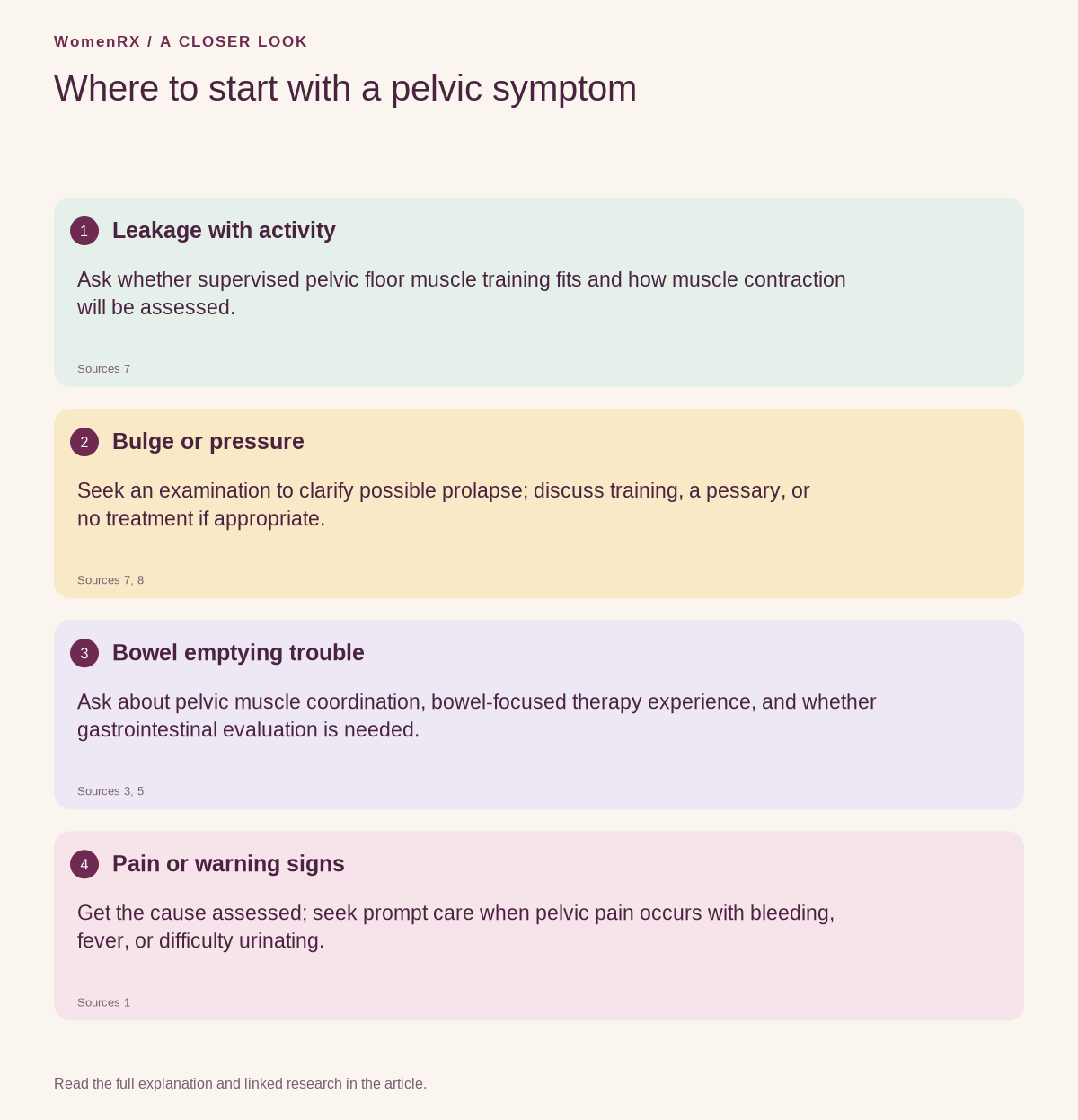
Where to start with a pelvic symptom
Leakage with activity: Ask whether supervised pelvic floor muscle training fits and how muscle contraction will be assessed.7
Bulge or pressure: Seek an examination to clarify possible prolapse; discuss training, a pessary, or no treatment if appropriate.78
Bowel emptying trouble: Ask about pelvic muscle coordination, bowel-focused therapy experience, and whether gastrointestinal evaluation is needed.35
Pain or warning signs: Get the cause assessed; seek prompt care when pelvic pain occurs with bleeding, fever, or difficulty urinating.1
Read the figure as text
Match the concern to a useful first conversation without assuming every symptom needs the same treatment.- Leakage with activity: Ask whether supervised pelvic floor muscle training fits and how muscle contraction will be assessed.7
- Bulge or pressure: Seek an examination to clarify possible prolapse; discuss training, a pessary, or no treatment if appropriate.78
- Bowel emptying trouble: Ask about pelvic muscle coordination, bowel-focused therapy experience, and whether gastrointestinal evaluation is needed.35
- Pain or warning signs: Get the cause assessed; seek prompt care when pelvic pain occurs with bleeding, fever, or difficulty urinating.1
More questions, answered
Should I start doing Kegels before seeing a pelvic health PT?
Not necessarily. Pelvic floor therapy can address relaxation and coordination as well as strengthening, and supervised training for urinary incontinence includes checking that you can contract the intended muscles. If pain or difficulty relaxing is your main concern, ask what approach fits before assuming more contractions are the answer. 37
Is pelvic floor PT only for people who’ve given birth?
No. Pregnancy and childbirth can affect pelvic support, but pelvic floor concerns also occur in other circumstances and later life. Whether PT fits depends on the symptom and its cause, not whether you’ve had a baby. 69
Sources you can check
- Pelvic pain - NHSAccessed 2026-09-25Return to first citation
- Period pain - NHSAccessed 2026-09-25Return to first citation
- Beyond Biofeedback: Expanding Perspectives on Pelvic Floor Physical Therapy for Evacuation Disorders.Yang MM, Bales C, Carvao LF, Iberle J, Liu J. · Digestive diseases and sciences · 2026Return to first citation
- [Pelvic floor physical therapy among sexual abuse women survivors with genito-pelvic pain and penetration disorders].Quentin J. · Gynecologie, obstetrique, fertilite & senologie · 2026Return to first citation
- Biofeedback Therapy and Pelvic Floor Physical Therapy in the Treatment of Constipation and Fecal Incontinence Are Very Different in Real-World Practice.Park CJ, Rao S, İnal B, Nadarajah R, Cragg T, Jones MP, Malcolm A. · Neurogastroenterology and motility · 2026Return to first citation
- Pelvic floor physical therapy: Enhancing patient outcomes.Francis M, Thielen M, Austin C, Strelow B. · JAAPA : official journal of the American Academy of Physician Assistants · 2025Return to first citation
- Recommendations | Urinary incontinence and pelvic organ prolapse in women: management | Guidance | NICEAccessed 2026-09-25Return to first citation
- Pelvic organ prolapse - NHSAccessed 2026-09-25Return to first citation
- Pelvic Support Problems | Pelvic Floor | MedlinePlusAccessed 2026-09-25Return to first citation