Kegels: How to Check the Squeeze and Release
A pelvic floor squeeze should lift inward, then fully let go, without help from your buttocks or held breath.
If you leak when you cough, sneeze, or exercise, pelvic floor muscle training may fit that pattern. Try a gentle squeeze and inward lift around the openings you use to pass urine and gas, then let the muscles relax. Keep breathing and avoid clenching your buttocks. If you can’t feel a release, have pain, or struggle to empty your bladder, an assessment can help clarify what’s happening. 2 7 9
Start with what triggers the leak
A small leak when you cough, sneeze, or exercise is called stress incontinence. It’s usually associated with weakening or damage to the muscles that help control urination, including the pelvic floor. Pelvic floor muscle training is a first-line option for women with stress or mixed urinary incontinence. 1 2 7
A sudden, intense urge to pee followed by leakage is different. Urge incontinence is commonly associated with an overactive bladder muscle. Some women have both patterns, called mixed incontinence. That distinction matters: doing more squeezes shouldn’t be treated as a universal answer to every kind of leakage. 1 2
The pelvic floor also supports pelvic organs. But that role alone doesn’t show that a self-directed Kegel routine will resolve every concern about support. For some women with symptomatic pelvic organ prolapse, supervised muscle training is an option; a pessary is another. 6 7
Pregnancy and childbirth can weaken muscles involved in controlling urine, and pelvic floor exercises may help prevent incontinence during pregnancy. Menopause and aging can also be associated with pelvic floor changes, but neither tells you by itself which exercise approach fits your symptoms. Whether you’ve recently given birth or are well past menopause, notice whether leakage follows pressure, such as a cough, or a sudden urge. That pattern helps guide the next conversation. 1 2 6 9
Feel for a lift, then let it go
Imagine gently stopping yourself from passing gas while drawing the muscles around the anus up and in. Add the feeling of lifting around the opening where urine comes out, as if you were zipping upward inside. The movement to look for is inward and upward, not a push outward. If you use a mirror, the skin between the vagina and anus should move inward during the squeeze. These are cues for a home attempt, not proof that you’ve contracted the intended muscles. 9
Keep breathing normally. Your buttocks shouldn’t clench, your knees shouldn’t press together, and you shouldn’t need to pull your tummy in to make the movement happen. Then slowly let go and notice the lifting effort end before trying another squeeze. A release is part of the exercise, not a pause in a continuous clench. 9
If you can’t tell whether you’re lifting or pushing down, or whether you’ve fully let go, ask for help checking the movement instead of simply doing more repetitions. Clinical guidance calls for confirming a pelvic floor contraction before supervised training for incontinence. 7 8
Pelvic pain deserves attention in its own right. It can have several causes, so pain during an attempted squeeze isn’t a reason to push harder or assume strengthening is what you need. Have pain that comes and goes or doesn’t go away assessed. 3
What an assessment can clarify
A clinician familiar with pelvic floor problems can start with your symptoms and check whether you can contract the intended muscles. An examination may include asking you to squeeze while the clinician feels the pelvic floor muscles. It can answer a question that noticing a sensation at home cannot: whether the movement you’re attempting is actually a pelvic floor contraction. 7 8
An examination also has limits. In a study of women with urinary incontinence or provoked vestibulodynia, physical therapists’ estimates of pelvic floor tone were associated with instrument measurements, but adjacent tone levels often overlapped. An assessment is useful for guiding care, not a perfect numerical verdict on your muscles. 5
Tell the clinician what happens before the leak: a cough or workout, a sudden urge, or both. Also mention frequent small leaks or a feeling that your bladder hasn’t emptied; these can point to a different pattern than stress leakage. Bring up urinary leakage even if it seems minor, since the type and cause can shape the options offered. 1 2
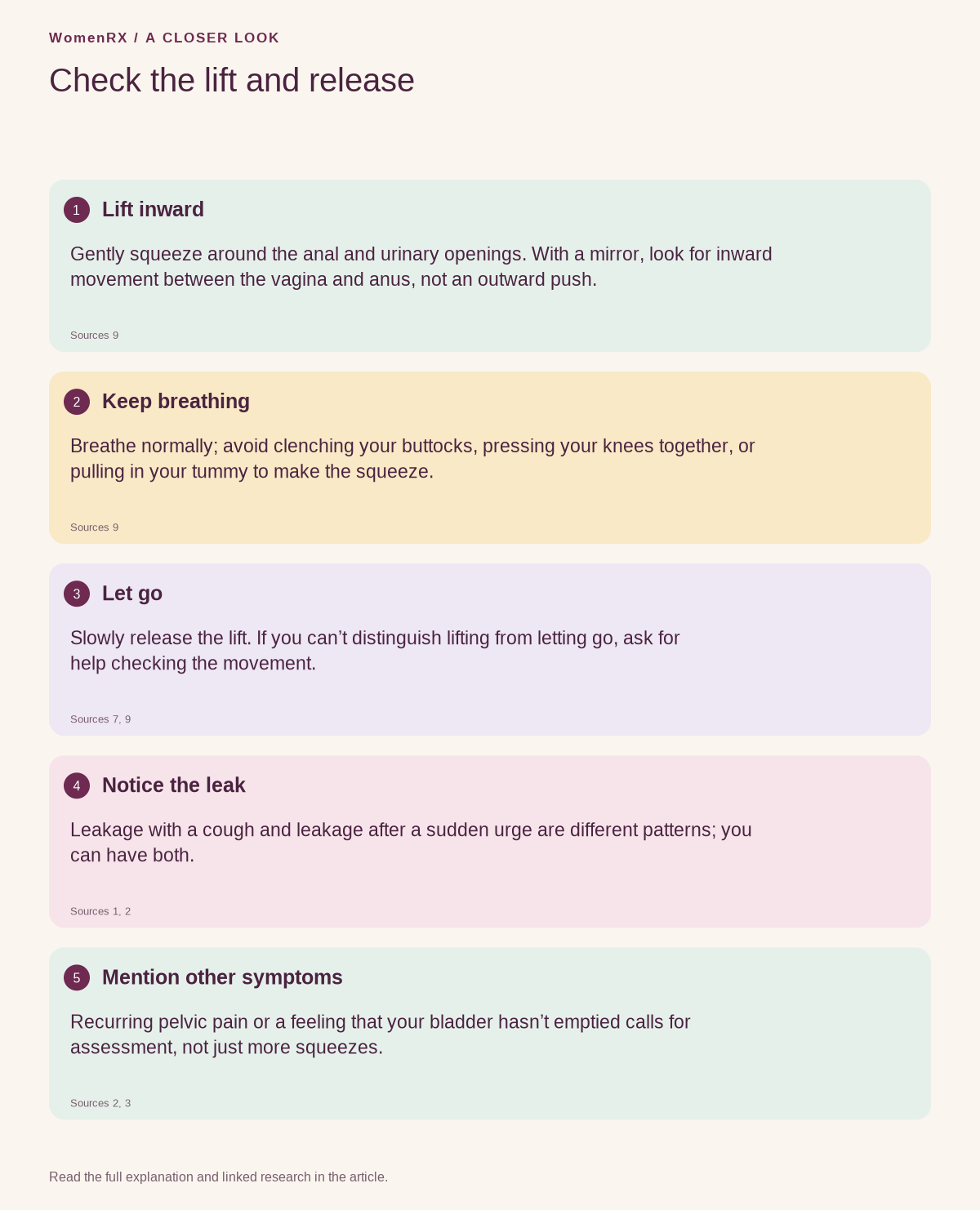
Check the lift and release
Lift inward: Gently squeeze around the anal and urinary openings. With a mirror, look for inward movement between the vagina and anus, not an outward push.9
Keep breathing: Breathe normally; avoid clenching your buttocks, pressing your knees together, or pulling in your tummy to make the squeeze.9
Let go: Slowly release the lift. If you can’t distinguish lifting from letting go, ask for help checking the movement.79
Notice the leak: Leakage with a cough and leakage after a sudden urge are different patterns; you can have both.12
Mention other symptoms: Recurring pelvic pain or a feeling that your bladder hasn’t emptied calls for assessment, not just more squeezes.23
Read the figure as text
Use these cues to describe what happens when you try a Kegel. A clinician can confirm the contraction if you’re unsure.- Lift inward: Gently squeeze around the anal and urinary openings. With a mirror, look for inward movement between the vagina and anus, not an outward push.9
- Keep breathing: Breathe normally; avoid clenching your buttocks, pressing your knees together, or pulling in your tummy to make the squeeze.9
- Let go: Slowly release the lift. If you can’t distinguish lifting from letting go, ask for help checking the movement.79
- Notice the leak: Leakage with a cough and leakage after a sudden urge are different patterns; you can have both.12
- Mention other symptoms: Recurring pelvic pain or a feeling that your bladder hasn’t emptied calls for assessment, not just more squeezes.23
More questions, answered
Does leakage during exercise mean my pelvic floor is weak?
Not necessarily. Leakage with exercise fits the stress-incontinence pattern, which is commonly linked to weakening or damage in muscles that help control urination. The symptom pattern is a useful clue, not a measurement of your muscle strength. 1 2
Will I need an ultrasound to check my contraction?
Not necessarily. Clinical guidance recommends confirming a pelvic floor contraction by examination before supervised training for incontinence. Ultrasound has been used to study pelvic floor movement, but that doesn’t mean you need a scan to check a Kegel. 4 7
Sources you can check
- Urinary incontinence - NHSAccessed 2026-09-25Return to first citation
- Urinary incontinence - Symptoms - NHSAccessed 2026-09-25Return to first citation
- Pelvic pain - NHSAccessed 2026-09-25Return to first citation
- Reliability of Pelvic Floor Muscle Assessment with Transabdominal Ultrasound in Young Nulliparous Women.Zając B, Sulowska-Daszyk I, Mika A, Stolarczyk A, Rosłoniec E, Królikowska A, Rzepko M, Oleksy Ł. · Journal of clinical medicine · 2021Return to first citation
- Can We Rely on Palpation to Assess Pelvic Floor Muscle Tone? A Validity Study Comparing Palpation With Ultrasound and Dynamometry.Starzec-Proserpio M, Abuani S, Dumoulin C, Morin M. · Archives of physical medicine and rehabilitation · 2026Return to first citation
- Pelvic Support Problems | Pelvic Floor | MedlinePlusAccessed 2026-09-25Return to first citation
- Recommendations | Urinary incontinence and pelvic organ prolapse in women: management | Guidance | NICEAccessed 2026-09-25Return to first citation
- Urinary incontinence - Diagnosis - NHSAccessed 2026-09-25Return to first citation
- Pelvic Floor Exercises for Women - North Tees and Hartlepool NHS Foundation TrustAccessed 2026-09-25Return to first citation