Vaginismus and Penetration Pain: What Can Contribute?
Involuntary tightening can be part of the picture, but pain with penetration has more than one possible cause.
Vaginismus is an automatic tightening response that can make tampons, pelvic exams, or vaginal sex painful or difficult. It may be linked with fear, a painful experience, or an infection, and more than one factor can be involved. Penetration pain can also have other causes, so an assessment can help distinguish muscle guarding from infection or pelvic-organ conditions and guide care. 1 2
What the word vaginismus describes
Vaginismus is an involuntary tightening of muscles around the vagina when something is inserted or even brought near the vaginal opening. It can cause burning or stinging pain, and it may affect tampon use, vaginal sex, or a cervical screening exam. The response isn’t intentional or something you can simply switch off. It can also begin after a period of previously comfortable penetration, and it doesn’t necessarily affect arousal or enjoyment of other kinds of sexual contact. 2
Pain, anticipation, and tightening may influence one another for some people: a painful attempt can make the next attempt feel worrying, and fear of penetration is among the factors associated with vaginismus. That’s one possible pattern, not a universal explanation. Some people have a physical contributor, some have emotional or situational contributors, and these can overlap. 2
Penetration pain isn’t one diagnosis
Pain during sex or insertion can have causes other than vaginismus. Infection and conditions affecting pelvic organs are among the possible sources of pelvic pain. In perimenopause and after menopause, a recent review describes genitourinary changes as one common contributor to intercourse-related pain, while also noting that pelvic-floor, inflammatory, psychosocial, and other factors may coexist. A pattern of deeper pain may call for a broader pelvic evaluation than pain at the opening. 1 3
Where and when it hurts can offer useful clues, but it doesn’t identify the cause on its own. For example, pain mainly with insertion differs from pain felt deeper during sex; pain that also happens outside penetration is another detail worth mentioning. If symptoms started after pregnancy or childbirth, share that timing too. It’s context for an assessment, not proof of one particular cause.
What an assessment can help sort out
A clinician may ask when the pain happens, what kinds of insertion trigger it, and whether you’ve noticed other symptoms. For suspected vaginismus, an examination may be offered to look for another issue, such as infection. You can ask what an exam involves and say what feels manageable; the NHS guidance also notes that you can request a female doctor or bring someone you trust. 2
The aim is not to assume that pain is “all in your head” or that tight muscles explain everything. In women around and after menopause, a 2026 narrative review recommends distinguishing superficial from deep pain and considering pelvic-floor tenderness alongside other possible contributors. It describes pelvic-floor physiotherapy as an option when tenderness, guarding, or penetration-limiting muscle tightness is present, while noting that menopause-specific evidence for this approach remains limited. 3
Care can address more than one part of the problem
For vaginismus, treatment approaches described in clinical guidance include psychosexual therapy, relaxation techniques, pelvic-floor exercises, and vaginal trainers that allow gradual familiarization with insertion. These are options to discuss, not a requirement to push through pain or a one-size-fits-all sequence. 2
Some small trials offer early support for combined approaches. In a randomized trial of 34 women receiving vaginismus treatment, a group given four sessions of sexual counseling and pelvic-floor relaxation alongside routine care had improved sexual-function scores compared with the control group; the researchers called for larger studies. 4 A separate randomized trial of 32 women with primary vaginismus found improvement in both groups receiving dilator therapy, with greater improvement in the group that also received biofeedback. The results are promising, but these small studies don’t establish that one approach will work for everyone or for every cause of penetration pain. 5
A useful next step is to describe the specific situation: whether pain occurs with tampons, exams, sex, or all insertion; whether it feels at the opening or deeper; and whether it began after a painful experience, infection, pregnancy, or childbirth. Those details can help focus an assessment on the right possibilities without presuming a single cause.
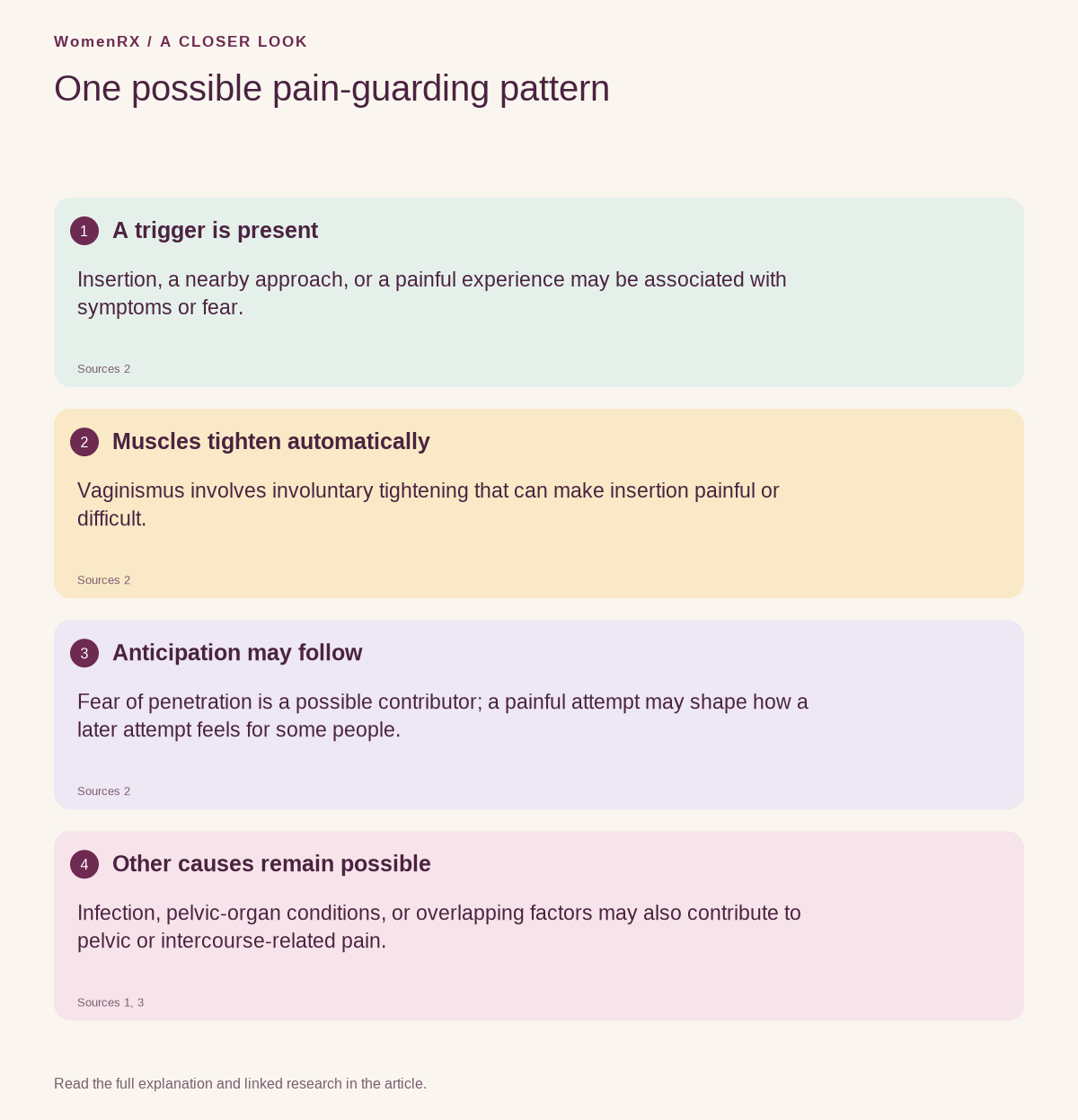
One possible pain-guarding pattern
A trigger is present: Insertion, a nearby approach, or a painful experience may be associated with symptoms or fear.2
Muscles tighten automatically: Vaginismus involves involuntary tightening that can make insertion painful or difficult.2
Anticipation may follow: Fear of penetration is a possible contributor; a painful attempt may shape how a later attempt feels for some people.2
Other causes remain possible: Infection, pelvic-organ conditions, or overlapping factors may also contribute to pelvic or intercourse-related pain.13
Read the figure as text
Pain and anticipation can be connected for some people, but this pattern is not the explanation for every case of vaginismus or penetration pain.- A trigger is present: Insertion, a nearby approach, or a painful experience may be associated with symptoms or fear.2
- Muscles tighten automatically: Vaginismus involves involuntary tightening that can make insertion painful or difficult.2
- Anticipation may follow: Fear of penetration is a possible contributor; a painful attempt may shape how a later attempt feels for some people.2
- Other causes remain possible: Infection, pelvic-organ conditions, or overlapping factors may also contribute to pelvic or intercourse-related pain.13
More questions, answered
Does pain with penetration mean I have vaginismus?
No. Vaginismus involves involuntary tightening with attempted insertion, but pelvic pain can also come from infection or conditions affecting pelvic organs. An assessment can help distinguish these possibilities. 1 2
Can vaginismus start after sex used to be comfortable?
Yes. Vaginismus can begin even after someone has previously had painless penetrative sex. A change in symptoms is worth describing, but it doesn’t by itself reveal the cause. 2
Sources you can check
- Pelvic pain - NHSAccessed 2026-09-25Return to first citation
- Vaginismus - NHSAccessed 2026-09-25Return to first citation
- Assessment and management of dyspareunia in peri- and postmenopausal women: A phenotype-based gynecologic approach.Broul M, Vančo M, Banýrová J, Hujová A. · International journal of gynaecology and obstetrics: the official organ of the International Federation of Gynaecology and Obstetrics · 2026Return to first citation
- The effects of sexual counseling and pelvic floor relaxation on sexual functions in women receiving vaginismus treatment: a randomized controlled study.Işık C, Aslan E. · International urogynecology journal · 2023Return to first citation
- Effectiveness of Biofeedback with Dilator Therapy for Sexual Function in Women with Primary Vaginismus: Randomized Controlled Trial Study.Jokar F, Fani M, Isfahani NT, Sabahi R. · International urogynecology journal · 2025Return to first citation