Pain During Sex: What the Pattern Can Tell You
Where pain starts, when it happens, and what comes with it can help point toward the right kind of evaluation.
Pain at the vaginal opening, pain deeper in the pelvis, and pain that lingers afterward can have different possible causes, and more than one pattern can occur at once. Notice where and when it hurts, along with changes in periods, dryness, or urinary and bowel symptoms. If pain keeps returning, worsens, or affects sex, arrange an evaluation rather than trying to push through it. 145
Start with where and when it hurts
Pain during sex is a symptom, not a diagnosis. Describing its location and timing can help a clinician choose what to assess. These patterns are clues, not a way to diagnose yourself, and some women have more than one type of pain. Research in women with endometriosis, for example, found that pain at the entrance and deeper pelvic pain could occur together. 45
Before an appointment, you might make a few notes: Is the pain at the opening, deeper inside, or both? Does it begin with penetration, happen with deeper movement, or continue afterward? Does it also happen with periods, urination, or bowel movements? Is there dryness, irritation, or bleeding? You can describe symptoms without having to use a medical term for them.
If pain is at the opening
Pain at or around the vaginal entrance can be associated with dryness or irritation, vulvar pain conditions, or pelvic-floor muscle tension. The possibilities vary, so the location alone doesn't identify the cause. Infections are also among the possible causes of painful sex generally, but they aren't specific to entrance-area pain. 4
Dryness may be relevant during menopause, when lower estrogen can contribute to vaginal dryness and irritation. Local vaginal estrogen is one treatment used for those menopause-related symptoms; it is not a general treatment for every kind of painful sex. Lubricants and moisturizers may also help with menopause-related dryness. 23
After childbirth, some women who are breastfeeding have dryness and pain with sex. A survey of women in Australia linked these symptoms with the lower-estrogen state of lactation. That makes postpartum dryness one possibility to discuss, not an assumption about what is causing your pain. 6
Pelvic-floor muscles may also contribute. Increased muscle tone has been suggested as one component of sexual pain, but it cannot be confirmed from symptoms alone. A clinician can assess whether pelvic-floor involvement is worth exploring and whether pelvic-floor physical therapy fits your situation. 4
If pain feels deep in the pelvis
Pain with deeper penetration, or pain that continues after sex, can have pelvic causes. Endometriosis is one possibility, particularly when painful sex occurs alongside period pain or other pelvic symptoms, but this pattern doesn't establish that diagnosis. A study of women with diagnosed endometriosis found both deep and entrance-area pain were reported, sometimes together. 15
Tell your clinician if the pain changes around your period or also occurs when you urinate or have a bowel movement. Those details can help shape an evaluation; they don't prove that endometriosis or another particular condition is present. 1
If the pain lingers afterward
Pain that continues after sex is worth describing just as clearly as pain during penetration. Note where it remains and whether it is linked with deep penetration, entrance-area pain, periods, or urinary and bowel symptoms. Deep pelvic pain during or after sex is one pattern described in research on endometriosis, but lingering pain can have other causes too. 5
Avoid continuing an activity that is painful. If you want to try sexual activity, you can pause, change what you're doing, or stop; pain isn't something you need to endure to complete sex. Lubricants are a possible aid when dryness is part of the problem, but they won't address every cause. 34
Choosing a next step
Make an appointment if pain keeps recurring, is getting worse, or is interfering with sex. It is also worth seeking evaluation when pain during sex comes with painful urination or bowel movements, or bleeding between periods. If pelvic or period pain is severe or worse than usual and painkillers haven't helped, seek urgent medical advice. 1
A gynecologist or primary care clinician can start by hearing the pattern and considering an examination or further tests based on your symptoms. Depending on what they find, the next step may involve assessing vaginal or vulvar symptoms, pelvic-floor function, hormonal changes, or a possible pelvic condition. Treatment depends on the cause and findings; there isn't one solution that fits every pattern. 4
If an explanation doesn't fit what you're experiencing, or pain continues, say so. A useful evaluation should take the location, timing, associated symptoms, and your concerns seriously. A survey of women seeking specialist care found that some had not received a formal diagnostic process, underscoring why it is reasonable to ask what possibilities are being considered and what the next step would clarify. 4
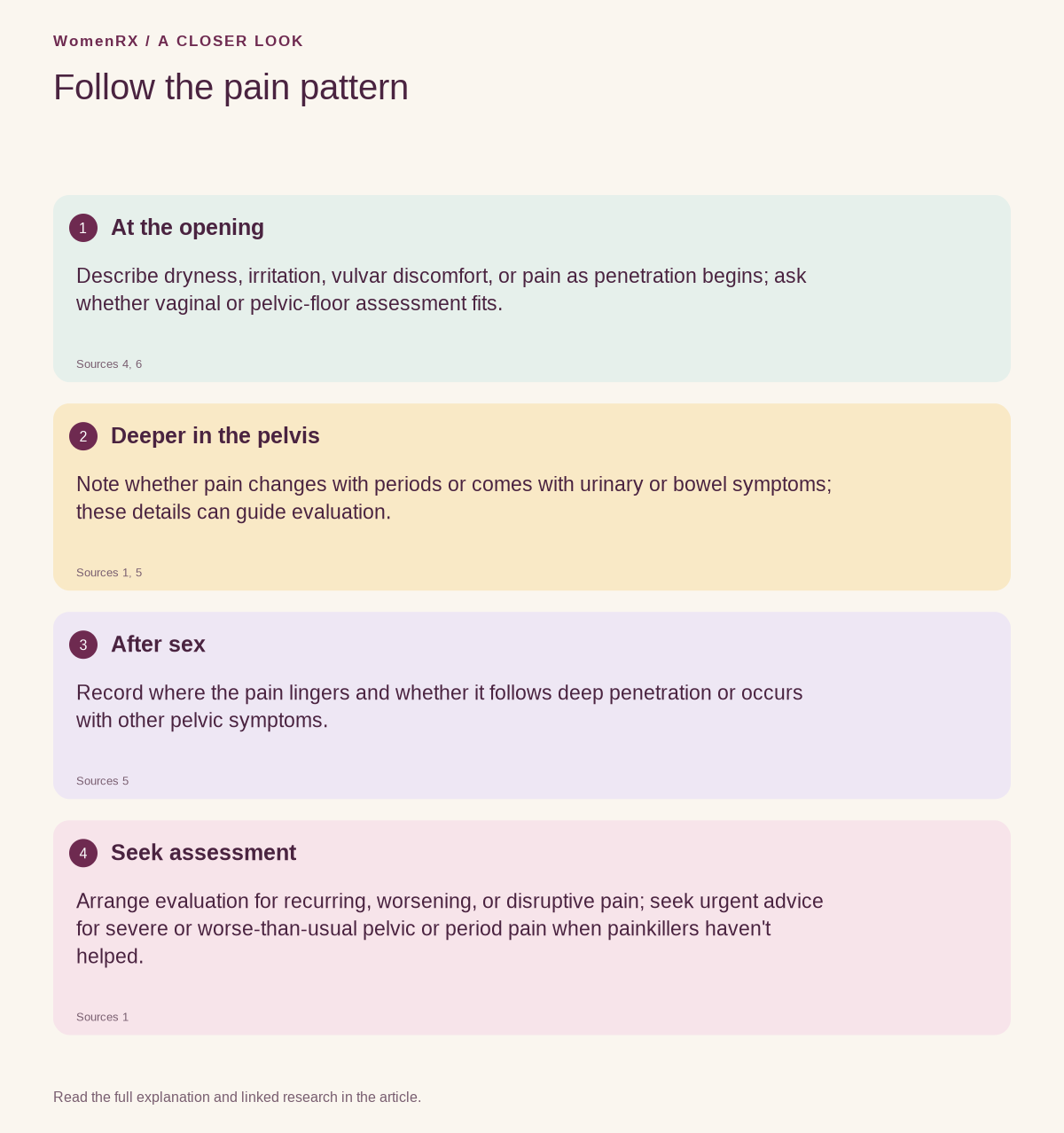
Follow the pain pattern
At the opening: Describe dryness, irritation, vulvar discomfort, or pain as penetration begins; ask whether vaginal or pelvic-floor assessment fits.46
Deeper in the pelvis: Note whether pain changes with periods or comes with urinary or bowel symptoms; these details can guide evaluation.15
After sex: Record where the pain lingers and whether it follows deep penetration or occurs with other pelvic symptoms.5
Seek assessment: Arrange evaluation for recurring, worsening, or disruptive pain; seek urgent advice for severe or worse-than-usual pelvic or period pain when painkillers haven't helped.1
Read the figure as text
Use location, timing, and accompanying symptoms to describe what is happening and choose a sensible starting point for evaluation. This is a conversation guide, not a diagnostic tool.- At the opening: Describe dryness, irritation, vulvar discomfort, or pain as penetration begins; ask whether vaginal or pelvic-floor assessment fits.46
- Deeper in the pelvis: Note whether pain changes with periods or comes with urinary or bowel symptoms; these details can guide evaluation.15
- After sex: Record where the pain lingers and whether it follows deep penetration or occurs with other pelvic symptoms.5
- Seek assessment: Arrange evaluation for recurring, worsening, or disruptive pain; seek urgent advice for severe or worse-than-usual pelvic or period pain when painkillers haven't helped.1
More questions, answered
Can pain at the entrance and deep pain happen together?
Yes. In a study of women with diagnosed endometriosis, some reported both superficial, entrance-area pain and deep pain. Having both patterns doesn't by itself confirm endometriosis, but it is useful to describe each one during an evaluation. 5
Could breastfeeding be related to painful sex?
It could be one consideration. A survey of breastfeeding women in Australia reported vaginal dryness and pain with sex among genitourinary symptoms associated with the postpartum, lower-estrogen state of lactation. Symptoms still deserve individual assessment rather than an automatic postpartum explanation. 6
Sources you can check
- Period pain - NHSAccessed 2026-09-25Return to first citation
- About vaginal oestrogen - NHSAccessed 2026-09-25Return to first citation
- Common questions about vaginal oestrogen - NHSAccessed 2026-09-25Return to first citation
- Exploring the Diagnostic and Therapeutic Pathways of Women with Dyspareunia: A Mixed-Methods Study.Wojtas J, Sotomska Z, Murawski M, Grzybowska ME. · Journal of clinical medicine · 2026Return to first citation
- Painful sexual intercourse, quality of life and sexual function in patients with endometriosis: not just deep dyspareunia.Del Forno S, Raspollini A, Doglioli M, Andreotti A, Spagnolo E, Lenzi J, Borghese G, Raimondo D, Arena A, Rodriguez E, Hernandez A, Govoni F, Seracchioli R. · Archives of gynecology and obstetrics · 2024Return to first citation
- Postpartum health-seeking behaviours, awareness and experiences of Genitourinary Syndrome of Lactation.Santos E, Bradfield Strydom M, Perelmuter S, Schloss J. · Midwifery · 2026Return to first citation