Painful Sex in Perimenopause: Causes and Next Steps
Dryness can contribute to painful sex during perimenopause, but where and when it hurts can point to other causes worth checking.
Yes, painful sex can start during perimenopause as falling estrogen contributes to vaginal dryness or irritation. But menopause isn’t the only possible cause. Pain at the opening, pain with deeper penetration, and pain alongside urinary or vulvar symptoms may call for different evaluations. If pain keeps returning or interferes with sex you want, seek an assessment rather than assuming you have to live with it. 1 3 5
Painful sex isn’t something you have to write off as part of perimenopause. Falling estrogen can cause vaginal dryness and irritation, which may make penetration uncomfortable. But sex-related pain can also involve the vulvar skin, the sensitive tissue around the vaginal opening, pelvic floor muscles, or a deeper pelvic condition. More than one contributor can be present at the same time. 1 3
Start with where it hurts
At the opening or on the vulva: Notice whether the pain feels like burning, stinging, or tenderness when the area is touched or penetration begins. Dryness or irritation may contribute, but vulvar skin conditions, inflammation, and pain centered around the vaginal opening are other possibilities. Pain with light touch, or pain that happens outside sex, is useful to mention. These clues help guide an exam; they don’t establish a diagnosis by themselves. 3 5
Deeper inside: Pain mainly with deeper penetration calls for a broader look than dryness alone. Pelvic floor tenderness may play a part, and a clinician may also consider other pelvic causes. If you still have periods, mention whether the deep pain comes with painful periods or painful bowel movements. Those symptoms can occur with endometriosis, though they don’t prove that’s the cause of your pain. 3 4 5
Alongside other symptoms: Urinary symptoms, vulvar itching or skin changes, and pain at times other than sex can shift what needs checking. Infection and inflammatory or skin conditions are among the possibilities a clinician may consider. For example, “It burns at the opening as soon as penetration starts” gives a different starting point from “I feel a deep ache only with deeper penetration.” 3 5
What an assessment can clarify
A clinician may ask whether pain is at the entrance or deeper, whether touch brings it on, and whether it happens outside sex. Depending on your symptoms, an exam may look at the vulva and vaginal opening, assess the vagina and pelvic floor, or include a deeper pelvic assessment. Tests or imaging aren’t routine for everyone, but may help when infection or a deeper pelvic condition is suspected. You can ask what an exam would involve and say if you need a pause. 3 5
If pain keeps returning, worsens, or makes you avoid sex you want, it’s worth getting it assessed. That matters even if dryness seems likely: identifying other contributors can change which treatment makes sense. 3 5
Match the option to the cause
If dryness or irritation is contributing, vaginal lubricants or moisturizers may help. For bothersome genitourinary syndrome of menopause symptoms that aren’t relieved by over-the-counter options, low-dose vaginal estrogen is one treatment to discuss. It targets vaginal symptoms, not every cause of pain with sex. A clinician can help determine whether it fits your symptoms and health history. 2 3 6
If pelvic floor muscles are tender or tighten with attempted penetration, pelvic floor physical therapy may be considered. Vulvar or skin conditions, infection, and deeper pelvic pain call for attention to their own causes. Evidence specific to pelvic floor treatment in peri- and postmenopausal women is limited, so an individual assessment matters more than assuming one approach will work for everyone. 3 5
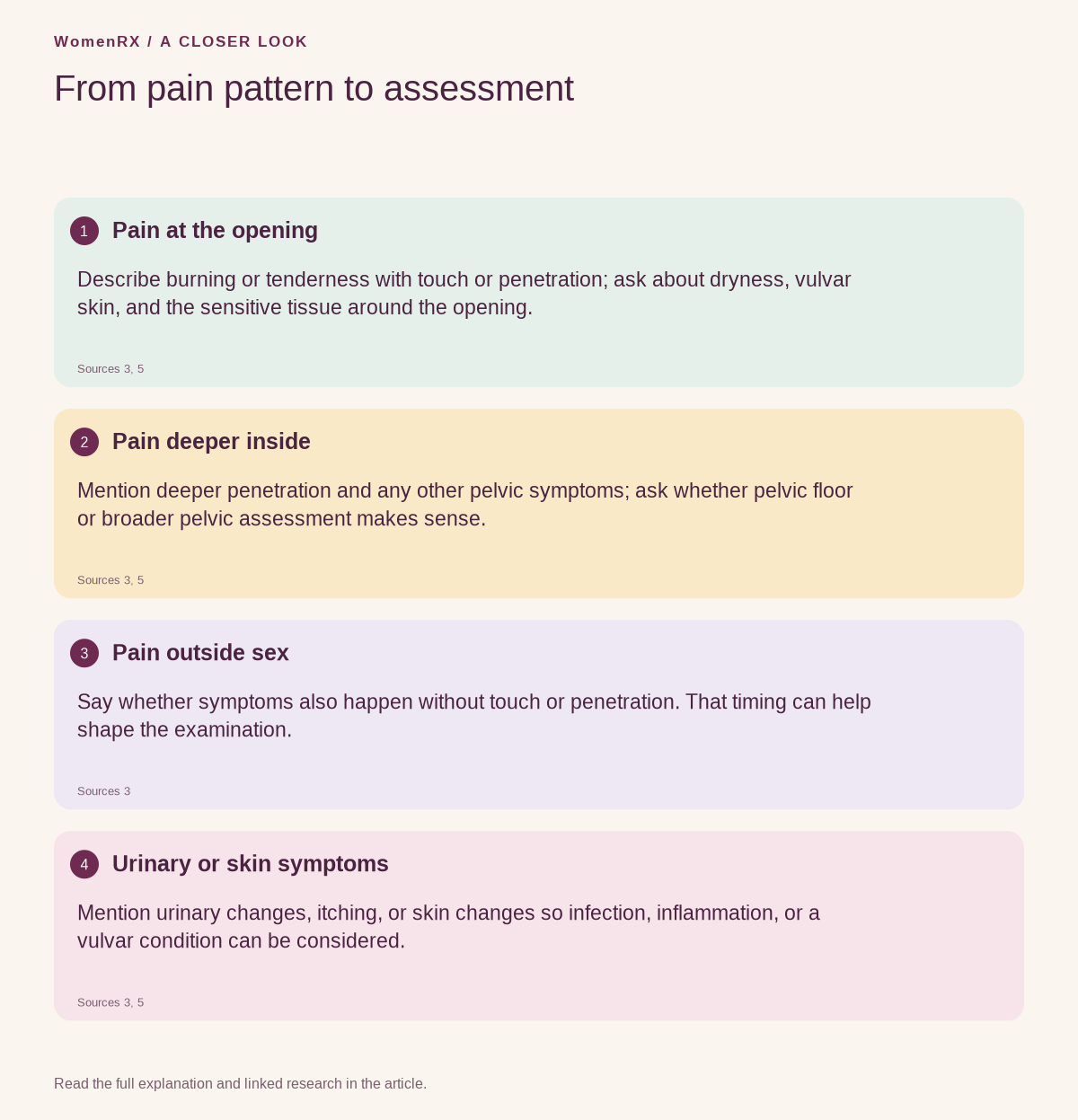
From pain pattern to assessment
Pain at the opening: Describe burning or tenderness with touch or penetration; ask about dryness, vulvar skin, and the sensitive tissue around the opening.35
Pain deeper inside: Mention deeper penetration and any other pelvic symptoms; ask whether pelvic floor or broader pelvic assessment makes sense.35
Pain outside sex: Say whether symptoms also happen without touch or penetration. That timing can help shape the examination.3
Urinary or skin symptoms: Mention urinary changes, itching, or skin changes so infection, inflammation, or a vulvar condition can be considered.35
Read the figure as text
Start with what you notice, then use that detail to discuss what might need checking. No single pattern identifies the cause.- Pain at the opening: Describe burning or tenderness with touch or penetration; ask about dryness, vulvar skin, and the sensitive tissue around the opening.35
- Pain deeper inside: Mention deeper penetration and any other pelvic symptoms; ask whether pelvic floor or broader pelvic assessment makes sense.35
- Pain outside sex: Say whether symptoms also happen without touch or penetration. That timing can help shape the examination.3
- Urinary or skin symptoms: Mention urinary changes, itching, or skin changes so infection, inflammation, or a vulvar condition can be considered.35
Sources you can check
- About vaginal oestrogen - NHSAccessed 2026-09-25Return to first citation
- Common questions about vaginal oestrogen - NHSAccessed 2026-09-25Return to first citation
- Assessment and management of dyspareunia in peri- and postmenopausal women: A phenotype-based gynecologic approach.Broul M, Vančo M, Banýrová J, Hujová A. · International journal of gynaecology and obstetrics: the official organ of the International Federation of Gynaecology and Obstetrics · 2026Return to first citation
- Pain with orgasm in endometriosis: potential etiologic factors and clinical correlates.Ding A, Noga H, Bouchard KN, Bedaiwy MA, Lee C, Allaire C, Orr NL, Yong PJ. · The journal of sexual medicine · 2024Return to first citation
- Female Pelvic Conditions: Dyspareunia and Vulvodynia.Brown B. · FP essentials · 2024Return to first citation
- The 2022 hormone therapy position statement of The North American Menopause Society.“The 2022 Hormone Therapy Position Statement of The North American Menopause Society” Advisory Panel. · Menopause (New York, N.Y.) · 2022Return to first citation