Painful Sex in Your 40s: Could It Be Perimenopause?
Perimenopause can make sex uncomfortable, but where it hurts and what else has changed can point toward other causes that need care.
Yes, perimenopause could be involved, especially if painful sex comes with new dryness or irritation, changing periods, or hot flashes. But being in your 40s doesn’t establish the cause. Pain at the vaginal opening, deeper pelvic pain, unusual discharge, or bleeding after sex can point toward different explanations. The pattern helps you decide what to try and what to have checked. 45267
Look at the pattern, not just your age
Perimenopause is a reasonable possibility when your periods have become more or less frequent, or the bleeding has changed, particularly if hot flashes or night sweats have started too. Dryness, burning, irritation, and painful sex can also occur during perimenopause. Those clues belong together, but none proves that hormones are the reason sex hurts. Hormonal contraception can make period changes harder to interpret. 45
Consider what the discomfort actually feels like. For example, is it friction or burning near the vaginal opening? A sharp pain in one spot on the vulva? Or pain felt deeper in the pelvis during or after sex? Those descriptions aren’t diagnoses. They’re useful because dryness, vulvar conditions, pelvic floor problems, and other pelvic conditions can overlap with menopausal symptoms while calling for different care. 236
Dryness and friction are one possible explanation
Menopause-related genitourinary changes can involve dryness, irritation, discomfort when urinating, and pain with sex. Dryness can also occur when you’re not aroused during sex, after some cancer treatments, or with conditions such as diabetes or Sjögren’s syndrome. A dry feeling therefore matters more than an assumption about its cause. 21
If friction seems to be the problem and there are no other concerning symptoms, a water-based lubricant during sex or a vaginal moisturizer for ongoing dryness may help. Taking more time for arousal is another option. You don’t have to keep having sex that hurts to find out whether a product works. If dryness lasts for weeks despite what you’ve tried, affects daily life, or comes with unusual discharge or bleeding, arrange an assessment. 1
For genitourinary symptoms found to be associated with menopause, vaginal estrogen is a treatment option that can be used alone or alongside moisturizers or lubricants. That discussion is most useful after the cause of pain has been considered, rather than as a way to diagnose it yourself. 42
Pain at the opening or deeper in the pelvis needs a closer look
Burning or tenderness on the vulva or at the vaginal opening isn’t always dryness. Inflammatory, infectious, and other vulvar conditions can share symptoms with menopause-related changes. A clinician may need to look at the skin and the exact area involved, especially if you notice a persistent visible change, scarring, or pain that isn’t improving. 2
Pain felt deeper during or after sex raises a different set of questions. Endometriosis, for instance, can cause deep pain during or after intercourse, sometimes alongside bowel symptoms that follow a menstrual pattern. Pelvic floor dysfunction can also include painful sex and urinary or bowel symptoms. Neither possibility can be confirmed by pain location alone. 63
Notice symptoms that change the next move
Unusual discharge deserves assessment rather than being attributed to perimenopause. The same goes for bleeding after sex or between periods: dryness is one possible cause of bleeding after sex, but cervical changes, polyps, and sexually transmitted infections are among other possibilities. A clinician may consider an examination, pregnancy test, or STI testing according to your symptoms. 17
If you’ve missed a period and have unusual vaginal bleeding and abdominal or pelvic pain, seek urgent medical assessment. That combination can signal an ectopic pregnancy. If you’ve gone 12 months without a period, any new vaginal bleeding also needs checking. 75
The useful distinction is not ‘hormonal or not?’ as a single yes-or-no question. It’s whether the clues fit dryness and friction, point to a vulvar or pelvic source, or include discharge or bleeding that needs assessment. Perimenopause may be part of the picture, and another cause may still need attention. 1267
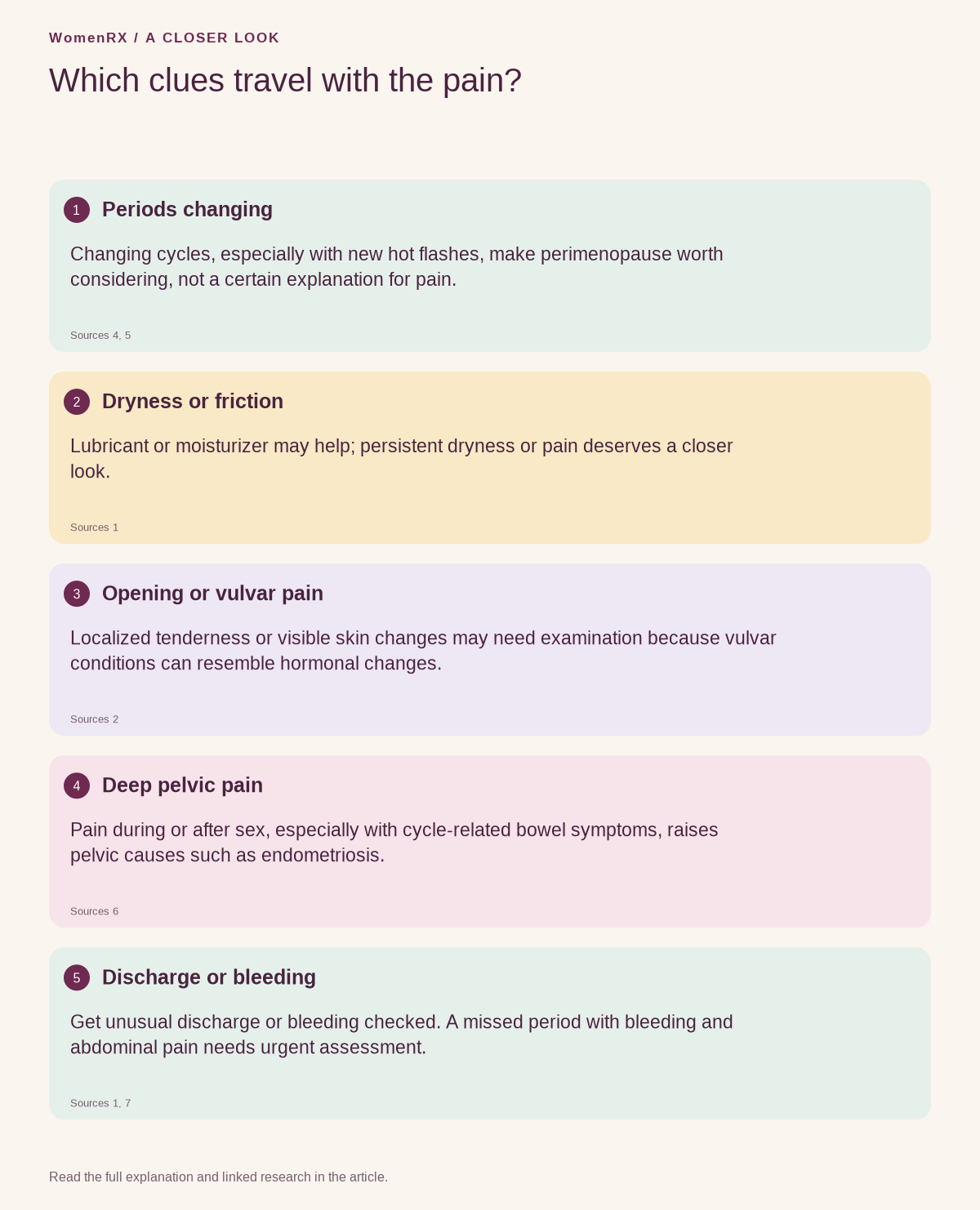
Which clues travel with the pain?
Periods changing: Changing cycles, especially with new hot flashes, make perimenopause worth considering, not a certain explanation for pain.45
Dryness or friction: Lubricant or moisturizer may help; persistent dryness or pain deserves a closer look.1
Opening or vulvar pain: Localized tenderness or visible skin changes may need examination because vulvar conditions can resemble hormonal changes.2
Deep pelvic pain: Pain during or after sex, especially with cycle-related bowel symptoms, raises pelvic causes such as endometriosis.6
Discharge or bleeding: Get unusual discharge or bleeding checked. A missed period with bleeding and abdominal pain needs urgent assessment.17
Read the figure as text
Start with what has changed, then follow the clue that best describes your symptoms. More than one can apply.- Periods changing: Changing cycles, especially with new hot flashes, make perimenopause worth considering, not a certain explanation for pain.45
- Dryness or friction: Lubricant or moisturizer may help; persistent dryness or pain deserves a closer look.1
- Opening or vulvar pain: Localized tenderness or visible skin changes may need examination because vulvar conditions can resemble hormonal changes.2
- Deep pelvic pain: Pain during or after sex, especially with cycle-related bowel symptoms, raises pelvic causes such as endometriosis.6
- Discharge or bleeding: Get unusual discharge or bleeding checked. A missed period with bleeding and abdominal pain needs urgent assessment.17
Sources you can check
- Vaginal dryness - NHSAccessed 2026-09-25Return to first citation
- A Practical Management Approach to Vulvar Dermatoses and Genitourinary Syndrome of Menopause.Negris O, Ghafari-Saravi A, Mauskar MM. · Obstetrics and gynecology · 2026Return to first citation
- Analysis of the Structural Characteristics and Psychometric Properties of the Pelvic Floor Bother Questionnaire (PFBQ): A Systematic Review.Molina-Torres G, Amiano-López L, Córdoba-Peláez MM, Ibáñez-Vera AJ, Diaz-Mohedo E. · Journal of clinical medicine · 2022Return to first citation
- Recommendations | Menopause: identification and management | Guidance | NICEAccessed 2026-09-25Return to first citation
- Symptoms of menopause and perimenopause - NHSAccessed 2026-09-25Return to first citation
- Recommendations | Endometriosis: diagnosis and management | Guidance | NICEAccessed 2026-09-25Return to first citation
- Vaginal bleeding between periods or after sex - NHSAccessed 2026-09-25Return to first citation