Ospemifene or Vaginal Prasterone for Painful Sex?
Both may ease menopause-related pain with sex, but one is taken by mouth and the other is used vaginally, and research hasn’t established that one works better.
For postmenopausal pain linked to genitourinary syndrome of menopause (GSM), ospemifene is an oral medicine and prasterone is used vaginally. In a systematic review, each may improve painful sex in the short term, but the evidence was low certainty and didn’t establish which is more effective. The route, your medical history, and other medicines are useful points to discuss when considering either option. 2 4
Two different routes for a similar symptom
Pain during sex after menopause can occur with vaginal dryness and other symptoms of genitourinary syndrome of menopause (GSM), a group of vulvovaginal, urinary, and sexual symptoms associated with lower hormone levels. Ospemifene and prasterone are prescription options discussed for GSM, but they aren’t the same treatment: ospemifene is taken by mouth, while prasterone is used vaginally. 1 2 4
That difference can shape a conversation about what feels practical for you. One option involves an oral medicine; the other involves using a treatment in the vagina. The evidence summarized in a systematic review suggests that each may help with painful sex, but it does not show that either one is better than the other. 2 4
| Ospemifene | Vaginal prasterone | |
|---|---|---|
| Route | Oral | Vaginal |
| Symptom evidence | May improve dyspareunia | May improve dyspareunia |
| What the comparison can tell you | Evidence doesn’t establish it as the better choice | Evidence doesn’t establish it as the better choice |
The review included randomized trials of postmenopausal women with GSM symptoms. Across the treatments it assessed, studies varied in their participants, treatments, comparisons, and outcome measures, so the reviewers couldn’t combine results in a meta-analysis. The evidence for both medicines’ effects on painful sex was rated low certainty; most studies were 12 weeks or shorter, and long-term evidence was limited. These findings support considering either option, not predicting which will work best for an individual. 2 4
First check whether GSM fits the pain
Pain during sex isn’t a diagnosis. GSM is one possible contributor, but pain can also involve the vulvar opening, pelvic-floor muscles, skin conditions, inflammation, or deeper pelvic causes. The pattern matters: pain at the entrance or with penetration may point to different issues than pain felt deeper in the pelvis. 3
So a prescription aimed at GSM may not address every cause of painful sex. It’s reasonable to describe where the pain occurs, what brings it on, and whether you also have dryness, burning, itching, urinary symptoms, or pain outside sex. Those details help distinguish a GSM-related symptom pattern from other possibilities. 3
For milder GSM symptoms, nonhormonal approaches are often considered first; over-the-counter lubricants and vaginal moisturizers are among those options. They’re different from prescription treatment and may be considered as part of the options conversation. 1 4 If these measures aren’t enough, the question becomes which prescription approach fits the likely cause of your symptoms and your circumstances.
Safety belongs in the comparison
The research review found that studies did not report frequent serious harms, but short follow-up and limited ability to detect uncommon serious harms leave important questions open. It doesn’t provide a head-to-head safety comparison or enough product-specific detail to determine which option has a better safety profile for you. 2
Make your medical history and current medicines part of the decision, rather than assuming that the local route makes a treatment the right choice for everyone. If you’ve had breast cancer, or are taking medicines related to breast cancer treatment, the discussion needs particular care: guidance and reviews describe treatment decisions in this group as individualized, with oncology input where appropriate. Evidence in cancer survivors is limited, so findings in the general postmenopausal population may not settle what’s suitable for you. 1 2 4
A useful conversation might include: “Does my pain seem related to GSM, or could something else be contributing?” “How does the oral versus vaginal route fit my situation?” and “What safety questions apply given my health history and current medicines?” Those questions help keep the choice focused on the cause of the pain and the tradeoffs that matter to you.
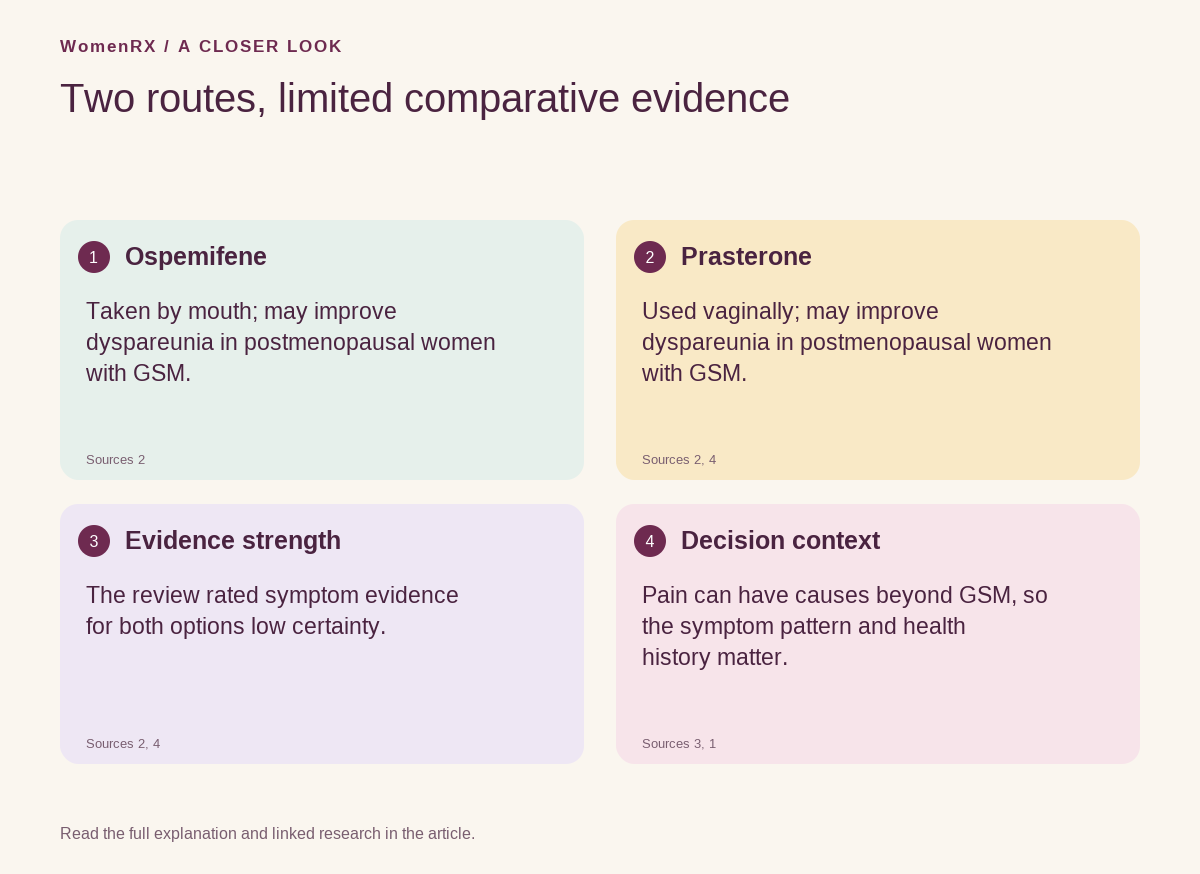
Two routes, limited comparative evidence
Ospemifene: Taken by mouth; may improve dyspareunia in postmenopausal women with GSM.2
Prasterone: Used vaginally; may improve dyspareunia in postmenopausal women with GSM.24
Evidence strength: The review rated symptom evidence for both options low certainty.24
Decision context: Pain can have causes beyond GSM, so the symptom pattern and health history matter.31
Read the figure as text
Compare how the options are used and what research can, and can’t, say about painful sex.- Ospemifene: Taken by mouth; may improve dyspareunia in postmenopausal women with GSM.2
- Prasterone: Used vaginally; may improve dyspareunia in postmenopausal women with GSM.24
- Evidence strength: The review rated symptom evidence for both options low certainty.24
- Decision context: Pain can have causes beyond GSM, so the symptom pattern and health history matter.31
More questions, answered
Does evidence show that one relieves painful sex better?
No. A systematic review found that both oral ospemifene and vaginal DHEA may improve dyspareunia, but it rated the evidence low certainty and did not establish which works better. Vaginal DHEA is also called prasterone. 2 4
Does pain during sex always mean GSM?
No. GSM is one possible cause, but dyspareunia can also involve vulvar, pelvic-floor, skin, inflammatory, or deeper pelvic factors. The location and pattern of pain help distinguish possibilities. 3
Sources you can check
- Case-Based Perspectives on the Management of Genitourinary Syndrome of Menopause.Cyriac J, Sood R. · Clinics and practice · 2026Return to first citation
- Hormonal Treatments and Vaginal Moisturizers for Genitourinary Syndrome of Menopause : A Systematic Review.Danan ER, Sowerby C, Ullman KE, Ensrud K, Forte ML, Zerzan N, Anthony M, Kalinowski C, Abdi HI, Friedman JK, Landsteiner A, Greer N, Nardos R, Fok C, Dahm P, Butler M, Wilt TJ, Die... · Annals of internal medicine · 2024Return to first citation
- Assessment and management of dyspareunia in peri- and postmenopausal women: A phenotype-based gynecologic approach.Broul M, Vančo M, Banýrová J, Hujová A. · International journal of gynaecology and obstetrics: the official organ of the International Federation of Gynaecology and Obstetrics · 2026Return to first citation
- Genitourinary Syndrome of Menopause.Marino JM. · Journal of midwifery & women's health · 2021Return to first citation