Painful Sex Around Menopause: Where It Hurts Matters
Pain at the vaginal opening, pain with deeper penetration, and pain alongside urinary or vaginal changes can call for different kinds of help.
Menopause-related dryness and tissue changes can make sex painful, especially with penetration, but they aren’t the only possible cause. Notice whether pain is at the opening or deeper, and whether you also have discharge, bleeding, or urinary symptoms. Lubricants and moisturizers may ease dryness; persistent pain deserves an assessment so treatment fits the cause. 257
Start with where the pain happens
If sex has started to hurt, you don’t have to decide whether it’s “just menopause” before asking for help. Where the pain occurs offers a useful starting point, not a diagnosis. Pain as penetration begins, pain that seems deeper in the pelvis, and discomfort that also happens outside sex may need different attention. An examination can look for vaginal tissue changes and skin conditions, and may also assess whether pelvic-floor muscles are contributing to pain. 5
After menopause, lower estrogen can contribute to vaginal dryness and irritation. These changes are part of genitourinary syndrome of menopause, or GSM, which can also include painful sex and urinary symptoms. GSM is a plausible explanation, but having reached menopause doesn’t rule out another cause. 35
Pain at the opening
If contact or penetration hurts at the vaginal opening, notice whether dryness or friction seems to be part of it. A lubricant may make sexual activity more comfortable; a vaginal moisturizer is intended for dryness between sexual encounters. They do different jobs, and either can be used alongside menopause treatment if needed. Formulations vary, so a product that irritates you isn’t one you need to keep using. 7
Pain at the opening isn’t always solved by adding moisture. An examination can help distinguish tissue changes from a vulvar skin condition or pelvic-floor muscle tension. If an internal examination feels difficult, tell the clinician where contact hurts. An initial look at the outside tissues may be useful, and the pace of an examination can be adjusted to your comfort. 5
Pain that feels deeper
If pain occurs mainly with deeper penetration, don’t assume a vaginal moisturizer will address it. Tell a clinician where you feel the pain and whether it happens only during sex or at other times. An examination can check whether pelvic-floor muscle pain is contributing, but pain location alone cannot establish that. If deeper pain comes with changed discharge or bleeding, an infection such as chlamydia or gonorrhoea is one possibility to assess rather than assuming GSM. 25
Pain with other changes
A change in discharge’s smell, color, or texture, genital sores, bleeding after sex, or pain when you pee are reasons to arrange an assessment. These signs don’t identify one cause on their own. A clinician may need to consider a vaginal or sexually transmitted infection, depending on the symptoms. 2
Urgency and frequency can be menopause-related urinary symptoms. Burning when you pee can occur with GSM or a urinary tract infection. If urinary symptoms are part of the picture, mention them rather than treating them as separate from the sexual pain. A clinician can decide whether a urine test is useful. 15
Match relief to the likely cause
For dryness or friction during sex, a lubricant is the most direct nonhormonal option to try. For dryness that bothers you at other times too, a moisturizer is designed for ongoing symptom relief. Neither establishes why persistent pain is happening. 7
When GSM-related vaginal dryness or irritation is contributing, local vaginal estrogen is a treatment option. It targets vaginal symptoms, not hot flashes or sleep problems, and it can take time to work fully. A clinician can discuss whether it fits your symptoms and health history. 35
Other clinical options for GSM-related painful sex include intravaginal DHEA and oral ospemifene. They are alternatives to discuss, not interchangeable fixes for every kind of pelvic pain. If you’ve had breast cancer, say so before choosing a treatment: evidence for sexual-pain interventions in breast cancer survivors has limitations, and treatment decisions warrant particular care. 58
Pelvic-floor muscle tension calls for a different conversation from dryness. The useful next step is an assessment of that possible contributor, rather than repeatedly trying products meant to reduce friction. 5
You can start with the simplest distinction: Does it hurt at the opening, deeper inside, or both? Add any discharge, bleeding, urinary symptoms, or discomfort outside sex. That description gives an assessment a better starting point and helps you choose relief aimed at what’s actually hurting. 25
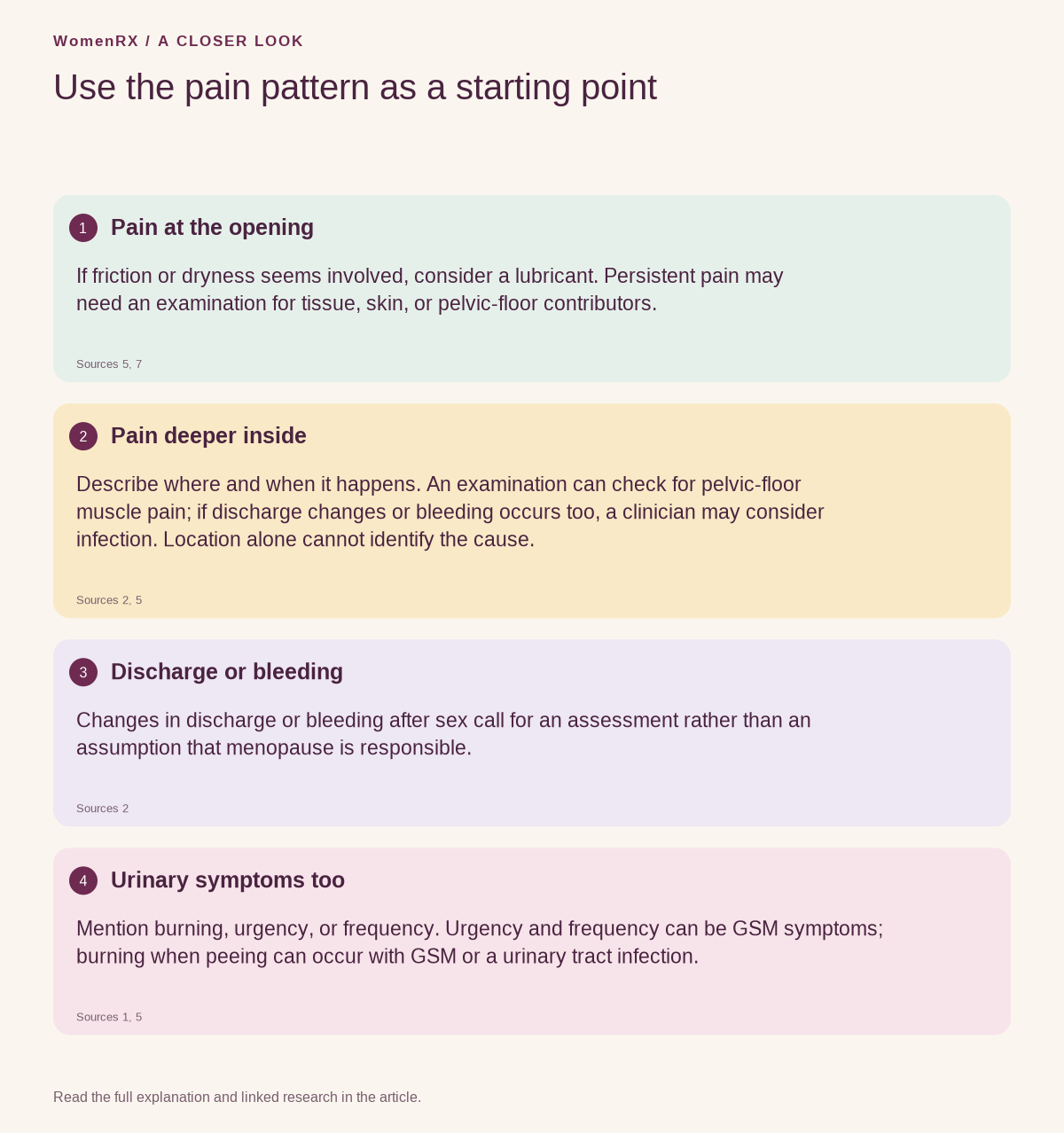
Use the pain pattern as a starting point
Pain at the opening: If friction or dryness seems involved, consider a lubricant. Persistent pain may need an examination for tissue, skin, or pelvic-floor contributors.57
Pain deeper inside: Describe where and when it happens. An examination can check for pelvic-floor muscle pain; if discharge changes or bleeding occurs too, a clinician may consider infection. Location alone cannot identify the cause.25
Discharge or bleeding: Changes in discharge or bleeding after sex call for an assessment rather than an assumption that menopause is responsible.2
Urinary symptoms too: Mention burning, urgency, or frequency. Urgency and frequency can be GSM symptoms; burning when peeing can occur with GSM or a urinary tract infection.15
Read the figure as text
These distinctions can help you describe what hurts and when to seek assessment; they cannot diagnose the cause.- Pain at the opening: If friction or dryness seems involved, consider a lubricant. Persistent pain may need an examination for tissue, skin, or pelvic-floor contributors.57
- Pain deeper inside: Describe where and when it happens. An examination can check for pelvic-floor muscle pain; if discharge changes or bleeding occurs too, a clinician may consider infection. Location alone cannot identify the cause.25
- Discharge or bleeding: Changes in discharge or bleeding after sex call for an assessment rather than an assumption that menopause is responsible.2
- Urinary symptoms too: Mention burning, urgency, or frequency. Urgency and frequency can be GSM symptoms; burning when peeing can occur with GSM or a urinary tract infection.15
More questions, answered
Can I use a lubricant if I’m already using vaginal estrogen?
Yes. Lubricants can be used for sexual activity even when topical or systemic menopause hormone therapy is also being used. A moisturizer serves a different purpose: relief of dryness between sexual encounters. 7
Will probiotics treat menopause-related painful sex?
There isn’t strong, consistent evidence for that use. A systematic review found limited and varied evidence for improvement in vaginal symptoms with Lactobacillus-based probiotics; changes in the vaginal microbiome also don’t reliably predict symptom relief. 46
Sources you can check
- Urinary tract infections (UTIs) - NHSAccessed 2026-09-25Return to first citation
- Vaginal discharge - NHSAccessed 2026-09-25Return to first citation
- About vaginal oestrogen - NHSAccessed 2026-09-25Return to first citation
- Gut, vaginal, and urinary microbiome alterations in women with genitourinary syndrome of menopause: A systematic review.Tsuboi I, Inoue S, Hirayama T, Mitsui Y, Watanabe M, Hirakawa H, Sadahira T. · Maturitas · 2026Return to first citation
- Urinary manifestations of genitourinary syndrome of menopause: a review of the pathophysiology, clinical presentation, and management.Saad JC, Brandon CA. · Gynecology and pelvic medicine · 2026Return to first citation
- Effect of Lactobacillus-based probiotics on genitourinary syndrome of menopause in post-menopausal women: A systematic review.Tsuboi I, Inoue S, Maruyama Y, Mitsui Y, Hirakawa H, Araki M, Sadahira T. · Maturitas · 2026Return to first citation
- Vaginal lubricants and moisturizers: a review into use, efficacy, and safety.Potter N, Panay N. · Climacteric : the journal of the International Menopause Society · 2021Return to first citation
- Management of sexual dysfunction in breast cancer survivors: a systematic review.Seav SM, Dominick SA, Stepanyuk B, Gorman JR, Chingos DT, Ehren JL, Krychman ML, Su HI. · Women's midlife health · 2015Return to first citation