Pain During Sex After Menopause: Causes and Options
Menopause-related dryness is common, but where and how you feel pain can point toward a different next step.
After menopause, lower estrogen can contribute to dryness, irritation, and pain with sex. Lubricants can ease friction during sexual activity, moisturizers help with ongoing dryness, and local vaginal estrogen treats menopause-related vaginal symptoms. But burning with touch, deeper pelvic pain, unusual discharge, or bleeding may call for assessment of another cause rather than more dryness treatment. 1 2 4 6 7
Start with the pattern, not an assumption
Menopause can change vaginal tissue and fluid levels. Dryness, soreness, irritation, and pain during sex can be part of genitourinary syndrome of menopause (GSM), a term for vaginal and urinary changes linked to lower estrogen. GSM may also involve urinary discomfort or urgency. 1 5
Pain at the vaginal opening or with touch may feel different from friction caused by dryness. For example, burning or stinging when the vulva is touched or something is inserted can occur with vulvar pain even when the skin looks unchanged. Skin conditions and infections can also cause soreness that overlaps with GSM. An examination can look for skin changes and check whether an infection might be involved; pain at the opening doesn’t establish one diagnosis by itself. 5 6
Pain felt deeper in the pelvis also deserves a wider look, especially if it occurs with urination or bowel symptoms. Pelvic pain during sex can have bladder, bowel, infectious, or reproductive-organ causes. Pelvic-floor muscles may be part of the assessment, and pelvic-floor physiotherapy is one possible treatment when the cause calls for it. A lubricant or vaginal estrogen won’t identify why deeper pain is happening. 6 7
Some irritants, such as perfumed washes, can add to soreness. If you notice unusual discharge, that’s another reason not to assume the problem is simply dryness. 1
You don’t have to want penetrative sex for these symptoms to matter. If penetration isn’t part of your goals, treatment can still focus on comfort, irritation, urinary symptoms, or whatever you’d like to improve.
How the options differ
Lubricants are used during sexual activity to ease friction. Vaginal moisturizers are used to help with dryness between sexual activity. They may be used alongside other menopause treatments. Products vary in ingredients and properties; if one seems to irritate you, ask a pharmacist or clinician about another option. 3 4
Local vaginal estrogen may be an option when symptoms fit menopause-related vaginal dryness and irritation. It delivers estrogen in the vagina and is intended for local symptoms; it isn’t a treatment for hot flashes or sleep problems. It comes in different forms, and it can take up to three months to have its full effect. 2 3
The NHS describes little of the medicine as reaching the rest of the body and says progestogen isn’t needed with vaginal estrogen. That general guidance doesn’t replace an individualized discussion, especially if your medical history makes hormone treatment a concern. 1 2
Treatment for another cause depends on what an assessment finds. Vulvar skin conditions and infections can resemble GSM, while pelvic pain may need an assessment beyond the vaginal tissue. When the diagnosis is unclear, symptoms persist despite treatment, or there are lesions or scarring, further evaluation may be needed. 5 7
A useful way to describe the problem at an appointment is where it hurts: at first touch, at the opening, or deeper in the pelvis. Mention whether you’ve noticed skin changes, discharge, or bladder or bowel symptoms. Those details help direct an examination toward the cause rather than assuming every kind of pain needs the same treatment. 5 6 7
When to get checked
Arrange an evaluation if symptoms persist, affect daily life, or don’t improve with the measures you’ve tried. Unusual discharge also deserves assessment. Bleeding after sex or any bleeding after menopause should be checked rather than assumed to be dryness. 1 8
If pelvic pain is severe or getting worse, particularly with faintness or heavy vaginal bleeding, seek urgent medical care. 7
If you try vaginal estrogen, check in if you haven’t improved after about three months; a different approach may be needed. The aim is not to push through pain or resume penetration, but to identify the cause and choose care that fits your goals. 3
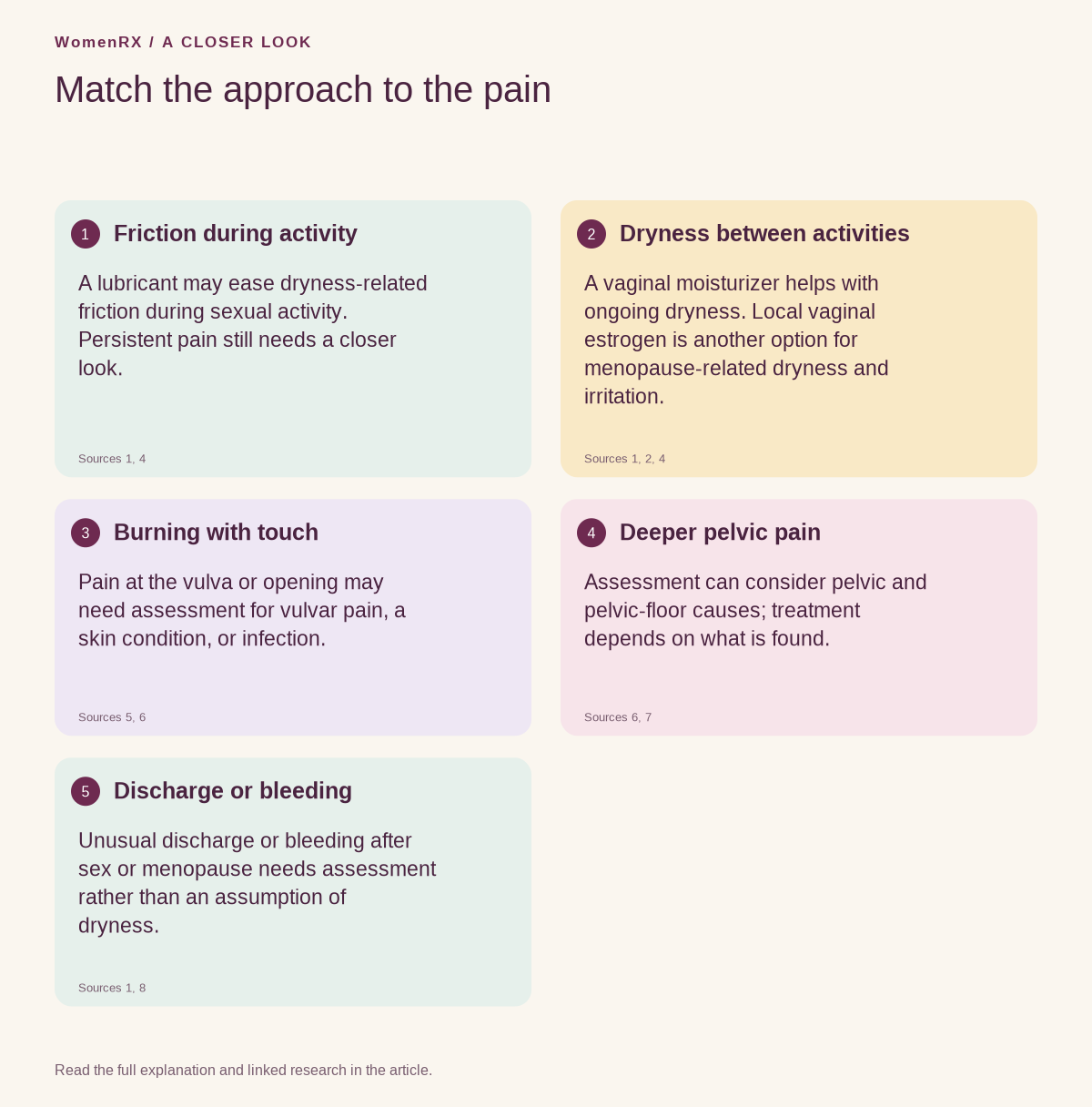
Match the approach to the pain
Friction during activity: A lubricant may ease dryness-related friction during sexual activity. Persistent pain still needs a closer look.14
Dryness between activities: A vaginal moisturizer helps with ongoing dryness. Local vaginal estrogen is another option for menopause-related dryness and irritation.124
Burning with touch: Pain at the vulva or opening may need assessment for vulvar pain, a skin condition, or infection.56
Deeper pelvic pain: Assessment can consider pelvic and pelvic-floor causes; treatment depends on what is found.67
Discharge or bleeding: Unusual discharge or bleeding after sex or menopause needs assessment rather than an assumption of dryness.18
Read the figure as text
Where discomfort happens and what comes with it can help distinguish dryness care from reasons to look for another cause.- Friction during activity: A lubricant may ease dryness-related friction during sexual activity. Persistent pain still needs a closer look.14
- Dryness between activities: A vaginal moisturizer helps with ongoing dryness. Local vaginal estrogen is another option for menopause-related dryness and irritation.124
- Burning with touch: Pain at the vulva or opening may need assessment for vulvar pain, a skin condition, or infection.56
- Deeper pelvic pain: Assessment can consider pelvic and pelvic-floor causes; treatment depends on what is found.67
- Discharge or bleeding: Unusual discharge or bleeding after sex or menopause needs assessment rather than an assumption of dryness.18
More questions, answered
Will vaginal estrogen help hot flashes too?
No. Local vaginal estrogen is used for vaginal symptoms such as dryness and irritation; it does not treat other menopause symptoms such as hot flashes or sleep problems. 2
Sources you can check
- Vaginal dryness - NHSAccessed 2026-09-25Return to first citation
- About vaginal oestrogen - NHSAccessed 2026-09-25Return to first citation
- Common questions about vaginal oestrogen - NHSAccessed 2026-09-25Return to first citation
- Vaginal lubricants and moisturizers: a review into use, efficacy, and safety.Potter N, Panay N. · Climacteric : the journal of the International Menopause Society · 2021Return to first citation
- A Practical Management Approach to Vulvar Dermatoses and Genitourinary Syndrome of Menopause.Negris O, Ghafari-Saravi A, Mauskar MM. · Obstetrics and gynecology · 2026Return to first citation
- Vulvodynia (vulval pain) - NHSAccessed 2026-09-25Return to first citation
- Pelvic pain - NHSAccessed 2026-09-25Return to first citation
- Vaginal bleeding between periods or after sex - NHSAccessed 2026-09-25Return to first citation