What Can Help When Vaginal Estrogen Isn’t Right for You
Moisturizers, lubricants, prescription options, and urinary evaluation each have a different role, so start with the symptom you want to change.
For ongoing dryness, a vaginal moisturizer may help when used regularly; lubricant is for reducing friction during sex. If vaginal symptoms remain bothersome, vaginal prasterone or oral ospemifene are prescription options to discuss, though they are not the same as nonhormonal products or vaginal estrogen. Repeated urinary symptoms need a separate assessment: these options are not established substitutes for recurrent-UTI care. 2 3 4
Choose by the symptom, not just the label
Menopause-related genitourinary symptoms can involve vaginal dryness or irritation, pain with sex, and urinary concerns. Those symptoms can overlap, but one product may not address them all. A useful starting point is to name what is bothering you most: dryness between sexual activity, friction or pain during sex, or urinary urgency, burning, or repeated infections. 1 2
This distinction matters especially if vaginal estrogen has not helped. Pain with penetration, for example, may also involve pelvic-floor muscle tenderness or tightening, vulvar skin conditions, inflammation, or deeper pelvic causes. A recent clinical review recommends considering these possibilities rather than assuming every kind of pain comes from menopause-related vaginal changes. 1
For ongoing dryness: a moisturizer
A vaginal moisturizer is meant for regular use to ease ongoing dryness, not just for sexual activity. In a systematic review of randomized trials in postmenopausal women, moisturizers may have improved dryness compared with placebo or no treatment. The certainty of that finding was low, so a moisturizer is a reasonable supportive option to try, but it may not be enough for everyone. 3 4
Products can differ, and some ingredients may irritate sensitive tissue. One clinical review discusses choosing products formulated to be compatible with vaginal tissue, including attention to pH and osmolality. If a product stings or seems to make irritation worse, it may not suit you; a pharmacist or clinician can help you consider another option. 2
For friction during sex: a lubricant
Lubricant is used during sexual activity to reduce friction and discomfort. A moisturizer and a lubricant aren’t interchangeable: one is intended for regular support of dryness, the other for sex-related friction. Lubricant may help when friction is the main issue, but persistent pain, pain that feels deep, or difficulty with penetration may call for a closer look at other contributors. 1 4
When tenderness, guarding, or muscle tightness makes penetration difficult, pelvic-floor physical therapy may be worth discussing. The menopause-specific evidence for this approach is limited, so it’s best understood as an option when the symptoms suggest a pelvic-floor contribution, not a universal treatment for vaginal dryness. 1
When you’re considering a prescription option
If nonprescription products aren’t enough, vaginal prasterone, also called DHEA, and oral ospemifene are options to discuss for selected vaginal symptoms. A systematic review found they may improve some symptoms, including dryness or pain with sex, compared with placebo; the certainty of evidence was low. Studies also tended to be short, so the findings don’t establish that these choices work equally well or have the same tradeoffs as vaginal estrogen. 2 3
These aren’t simply nonhormonal versions of a moisturizer. Prasterone is used vaginally, while ospemifene is an oral selective estrogen receptor modulator. They work differently from each other and from vaginal estrogen, so the relevant question is which symptoms the proposed treatment is intended to address and whether its tradeoffs fit your medical history and preferences. 2 3
If you’ve had breast cancer, or take an aromatase inhibitor, treatment choices deserve particular care. Evidence from studies of people with a cancer history is limited, and a review recommends individualized decision-making, especially for people using aromatase inhibitors. 2 3
Keep urinary symptoms in a separate lane
Urgency or burning can occur alongside menopause-related vaginal symptoms, but repeated urinary infections are a distinct concern. The available trial review reports possible effects of some GSM treatments on selected vaginal symptoms; it does not establish moisturizers, prasterone, or ospemifene as recurrent-UTI prevention. If urinary symptoms keep returning or persist, ask about assessment for urinary causes rather than relying on a vaginal product alone. 2 3
A focused conversation can start with the outcome you want: “I want less dryness,” “I want sex to hurt less,” or “I keep having urinary symptoms.” Then ask what symptom a proposed option is expected to help, what other causes might fit your pattern, and how your medical history changes the choice. That keeps the plan matched to your concern instead of treating every genitourinary symptom as the same problem.
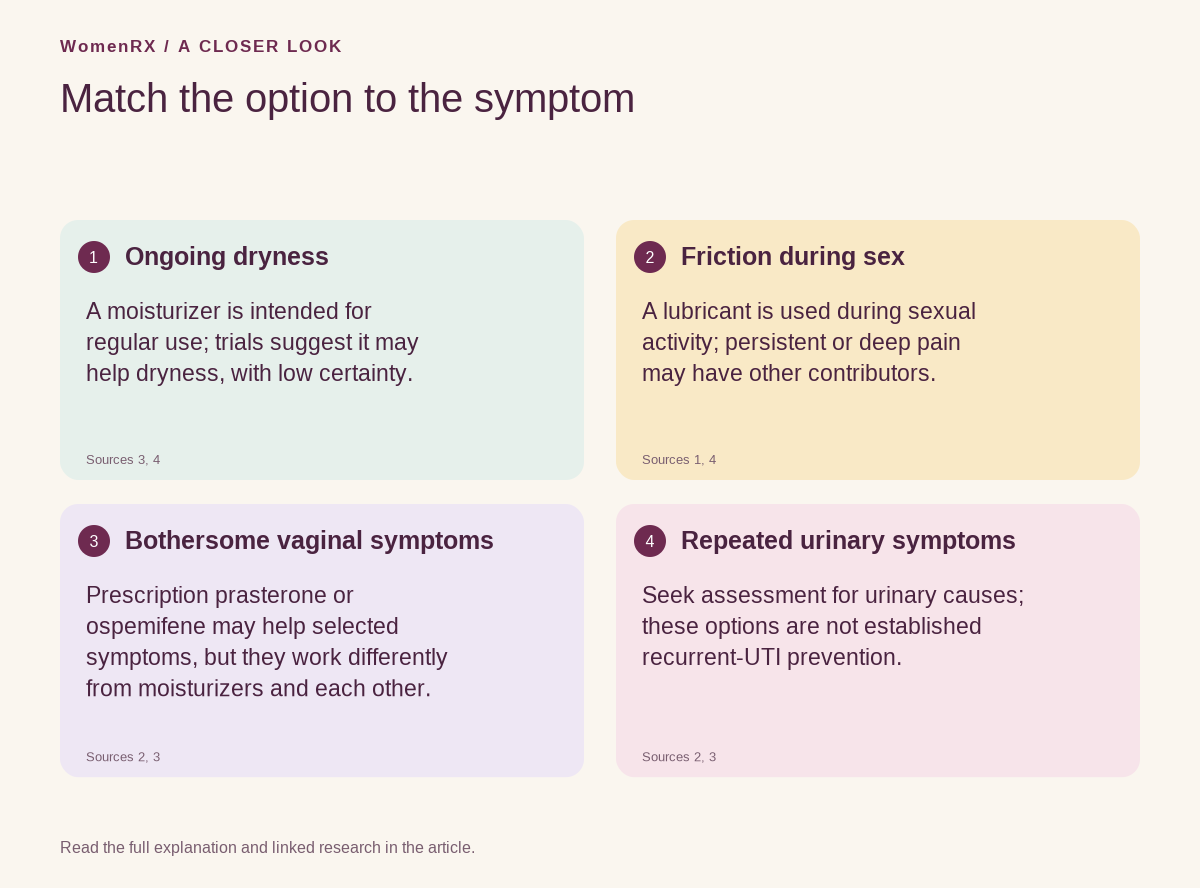
Match the option to the symptom
Ongoing dryness: A moisturizer is intended for regular use; trials suggest it may help dryness, with low certainty.34
Friction during sex: A lubricant is used during sexual activity; persistent or deep pain may have other contributors.14
Bothersome vaginal symptoms: Prescription prasterone or ospemifene may help selected symptoms, but they work differently from moisturizers and each other.23
Repeated urinary symptoms: Seek assessment for urinary causes; these options are not established recurrent-UTI prevention.23
Read the figure as text
These options have different purposes. Support for vaginal symptoms does not establish prevention of repeated urinary infections.- Ongoing dryness: A moisturizer is intended for regular use; trials suggest it may help dryness, with low certainty.34
- Friction during sex: A lubricant is used during sexual activity; persistent or deep pain may have other contributors.14
- Bothersome vaginal symptoms: Prescription prasterone or ospemifene may help selected symptoms, but they work differently from moisturizers and each other.23
- Repeated urinary symptoms: Seek assessment for urinary causes; these options are not established recurrent-UTI prevention.23
More questions, answered
Are vaginal moisturizers and lubricants used the same way?
No. A moisturizer is intended for regular use to ease ongoing dryness; lubricant is used during sexual activity to reduce friction. Either may help with its intended concern, but persistent pain can have other causes. 1 4
Can these options prevent repeated UTIs?
The trial review does not establish vaginal moisturizers, prasterone, or ospemifene as recurrent-UTI prevention. Repeated or persistent urinary symptoms deserve assessment for urinary causes as well as consideration of menopause-related symptoms. 2 3
Sources you can check
- Assessment and management of dyspareunia in peri- and postmenopausal women: A phenotype-based gynecologic approach.Broul M, Vančo M, Banýrová J, Hujová A. · International journal of gynaecology and obstetrics: the official organ of the International Federation of Gynaecology and Obstetrics · 2026Return to first citation
- Case-Based Perspectives on the Management of Genitourinary Syndrome of Menopause.Cyriac J, Sood R. · Clinics and practice · 2026Return to first citation
- Hormonal Treatments and Vaginal Moisturizers for Genitourinary Syndrome of Menopause : A Systematic Review.Danan ER, Sowerby C, Ullman KE, Ensrud K, Forte ML, Zerzan N, Anthony M, Kalinowski C, Abdi HI, Friedman JK, Landsteiner A, Greer N, Nardos R, Fok C, Dahm P, Butler M, Wilt TJ, Die... · Annals of internal medicine · 2024Return to first citation
- Therapeutic Choices for Genitourinary Syndrome of Menopause (GSM) in Breast Cancer Survivors: A Systematic Review and Update.Merlino L, D'Ovidio G, Matys V, Piccioni MG, Porpora MG, Senatori R, Viscardi MF, Vitale A, Della Rocca C, On Behalf Of Policlinico Umberto I Collaborators. · Pharmaceuticals (Basel, Switzerland) · 2023Return to first citation