Intimacy After Menopause: Find a Pace That Feels Right
You can rebuild closeness in small steps, and intimacy doesn’t have to mean intercourse.
There’s no required timetable or single goal for intimacy after menopause. Start with the kinds of closeness you actually want, and pause or change course if something feels uncomfortable. If dryness or irritation is getting in the way, vaginal moisturizers or lubricants may help; for persistent symptoms, a clinician can discuss additional options, including low-dose vaginal estrogen when appropriate. 3 4
Menopause can change what feels comfortable, but it doesn’t create an obligation to have sex, return to an earlier routine, or want the same things you once did. Intimacy might mean affectionate touch, kissing, shared time, sexual activity, or none of these for now. You get to define the goal, including deciding that you don’t want to resume sexual activity.
A useful starting point is smaller than “How do I get our sex life back?” Try asking: “What kind of closeness would feel good to me this week?” The answer can change from one day to the next.
Begin with comfort, not a performance goal
If vaginal dryness or irritation makes touch uncomfortable, it makes sense to address that before pushing yourself to continue. Menopause-related changes in estrogen can contribute to vaginal dryness and irritation. Vaginal lubricants and moisturizers are options that may help with these symptoms. 2 3
You might explore nonsexual closeness first, or choose a kind of touch that feels comfortable and easy to stop. If you want to try sexual activity, make it an experiment rather than a test: agree that either person can pause, change what’s happening, or stop. There’s no need to work toward intercourse unless that’s something you want.
If discomfort keeps getting in the way, or dryness and irritation aren’t improving, you don’t have to just tolerate it. The North American Menopause Society recommends low-dose vaginal estrogen or other therapies for bothersome genitourinary symptoms that haven’t improved with over-the-counter options, for women without an indication for systemic hormone therapy. A clinician can help you understand which options fit your situation. 4
Make the conversation specific and low-pressure
A conversation is often easier when it’s about one next step rather than an entire relationship or sex life. You could say:
- “I miss being close, but I don’t want to put pressure on either of us. Could we spend time cuddling and see how that feels?”
- “Some kinds of touch feel uncomfortable right now. I’d like to tell you what feels okay as we go.”
- “I’m not looking for sex tonight, but I would enjoy sitting close.”
These are examples, not scripts you have to use. If you’re not in a partnered relationship, the same check-in can be private: What do you want, what feels comfortable, and what would you rather leave aside? Desire and sexual health can be affected by more than menopause alone, including health conditions and medicines, so it’s reasonable to consider the broader picture if something has changed. 1
Let the next step stay flexible
Think of rebuilding intimacy as a series of choices, not a schedule. You might try one kind of closeness, notice how it feels, and decide later whether you want more, something different, or a break. A good outcome isn’t necessarily more activity; it’s having more room to choose without pain or pressure.
If vaginal symptoms are the main obstacle, say that plainly when you seek care. Low-dose vaginal estrogen is one option discussed in menopause guidance for bothersome symptoms that haven’t eased with over-the-counter treatments. It’s a local treatment option, distinct from taking systemic hormone therapy for other menopause symptoms; a clinician can talk through whether it fits your needs. 2 4
You don’t have to restore a former version of intimacy to have a satisfying life now. You can choose connection on your own terms, including taking your time or choosing not to pursue sexual activity.
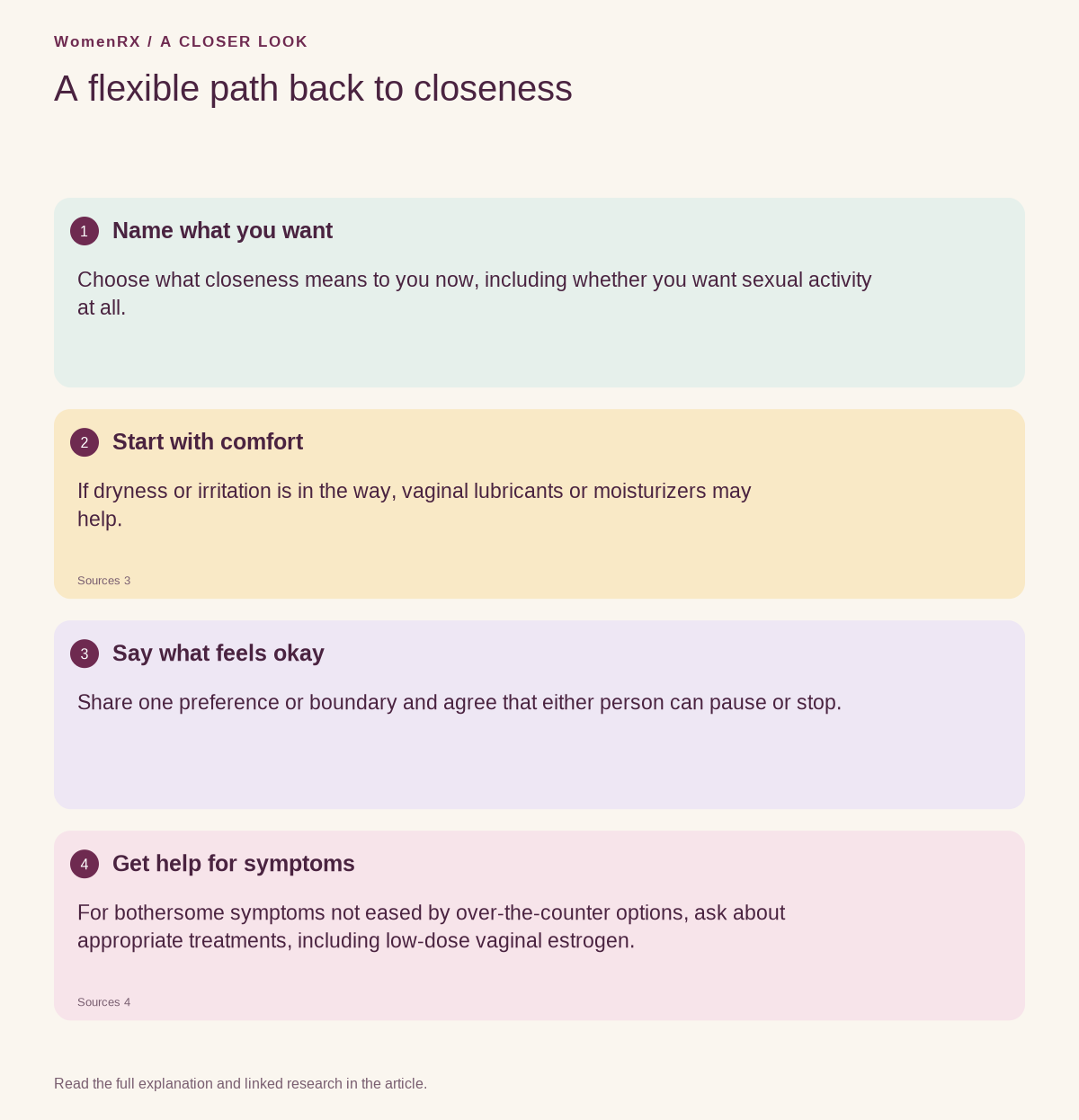
A flexible path back to closeness
Name what you want: Choose what closeness means to you now, including whether you want sexual activity at all.
Start with comfort: If dryness or irritation is in the way, vaginal lubricants or moisturizers may help.3
Say what feels okay: Share one preference or boundary and agree that either person can pause or stop.
Get help for symptoms: For bothersome symptoms not eased by over-the-counter options, ask about appropriate treatments, including low-dose vaginal estrogen.4
Read the figure as text
These are possible steps, not a timetable. You can pause, skip a step, or decide that sexual activity isn’t what you want.- Name what you want: Choose what closeness means to you now, including whether you want sexual activity at all.
- Start with comfort: If dryness or irritation is in the way, vaginal lubricants or moisturizers may help.3
- Say what feels okay: Share one preference or boundary and agree that either person can pause or stop.
- Get help for symptoms: For bothersome symptoms not eased by over-the-counter options, ask about appropriate treatments, including low-dose vaginal estrogen.4
More questions, answered
Does intimacy after menopause have to include intercourse?
No. Intimacy can mean any kind of connection you want, including affectionate touch, shared time, or no sexual activity. You don’t have to set intercourse as the goal.
What can I do if dryness or irritation is making intimacy uncomfortable?
Vaginal lubricants and moisturizers may help with menopause-related dryness and irritation. If symptoms remain bothersome, guidance supports discussing additional options, including low-dose vaginal estrogen when appropriate. 3 4
Sources you can check
- Sexual Health | MedlinePlusAccessed 2026-09-25Return to first citation
- About vaginal oestrogen - NHSAccessed 2026-09-25Return to first citation
- Common questions about vaginal oestrogen - NHSAccessed 2026-09-25Return to first citation
- The 2022 hormone therapy position statement of The North American Menopause Society.“The 2022 Hormone Therapy Position Statement of The North American Menopause Society” Advisory Panel. · Menopause (New York, N.Y.) · 2022Return to first citation