When Vaginal Penetration Hurts or Feels Impossible
Involuntary tightening can happen with tampons, exams, or sex, and care can begin with a conversation rather than penetration.
Vaginismus describes involuntary tightening when something is inserted into the vagina or even brought near it. It can make penetration painful or feel impossible, but it isn’t a choice or necessarily a problem with arousal. An assessment can explore the tightening and check for other causes of pain; possible care includes pelvic floor therapy, gradual exercises, or talking therapy, shaped around your goals. 26
What the tightening can feel like
You might feel burning or stinging when you try to insert a tampon, have a finger or toy near the vaginal opening, have penetrative sex, or undergo cervical screening. The muscles may tighten before anything goes in. That reaction is automatic, not a failure to relax on command. It can also begin after a period when penetration was comfortable. Vaginismus doesn’t necessarily prevent arousal or enjoyment of other kinds of sexual contact. 2
These situations can matter differently. You may want to use a tampon but have no interest in penetrative sex, or you may want an easier way to receive an exam. Tell the clinician which activities matter to you. Treatment doesn’t have to make intercourse the finish line.
An assessment should look beyond one label
A useful first conversation covers what you feel, where you feel it, when the difficulty began, and whether it happens with touch near the opening, insertion, or both. Mention symptoms outside penetration, too. Painful conditions, including an infection, can be involved in vaginismus; pelvic pain can have other causes as well. 21
For example, new discharge alongside pain is a reason to discuss a possible infection rather than assume muscle tightening explains everything. If you also have worsening period pain or pain when peeing or having a bowel movement, those details may point the assessment in another direction. They don’t diagnose a cause on their own. 13
A clinician may suggest looking at the outside of the vaginal area to check for another condition. A pelvic examination isn’t one single procedure: depending on the reason for it, it can involve a visual check, a speculum, or another type of examination. Ask what each part is meant to find out before deciding whether to proceed. You can say what feels possible today, ask to pause, or choose to begin with the conversation. 24
If pelvic pain is severe or getting worse, or comes with fever, unusual vaginal bleeding or discharge, difficulty peeing, or possible pregnancy, seek prompt medical attention rather than treating it as vaginismus alone. 1
What care can involve
Care may address both the muscle response and what happens around it. Pelvic floor physical therapy can work on awareness, control, and relaxation of the pelvic floor muscles. A study at one physical therapy clinic reported patient education, exercises, and internal manual techniques for women with lifelong vaginismus. 5 An internal technique is something to discuss, not a step you have to agree to. A review of pelvic floor therapy describes it as a treatment option for vaginismus, while noting that treatment approaches vary. 6
Some people choose gradual practice with vaginal trainers, also called dilators, if becoming comfortable with insertion is one of their goals. Relaxation exercises or psychosexual therapy may help with fear, distress, or feelings about penetration. That does not mean the pain is “all in your head.” A painful condition, a muscle response, and feelings shaped by previous pain can all deserve attention. A partner can be involved if you want, but doesn’t need to be. 2
The evidence supports offering options, not promising a particular result. In a small randomized trial of 32 women ages 18 to 45 with primary vaginismus, both groups improved on a sexual-function measure after dilator therapy; the group that also received biofeedback showed greater improvement on several measured aspects. The trial doesn’t tell us which approach will fit every person or whether improvement lasts long term. In an earlier review of records from 53 women treated at one physical therapy clinic for lifelong vaginismus, some pain, fear, and muscle tension remained after treatment. 75
A practical way to begin is to describe the specific moment things change: “A tampon reaches the opening and I feel a sting and tightening,” or “Touch near the opening is okay, but an exam becomes painful.” Then name your goal, whether it’s understanding the pain, managing menstrual care, making an exam more comfortable, exploring sexual activity, or something else. That gives the assessment and any treatment a purpose you chose.
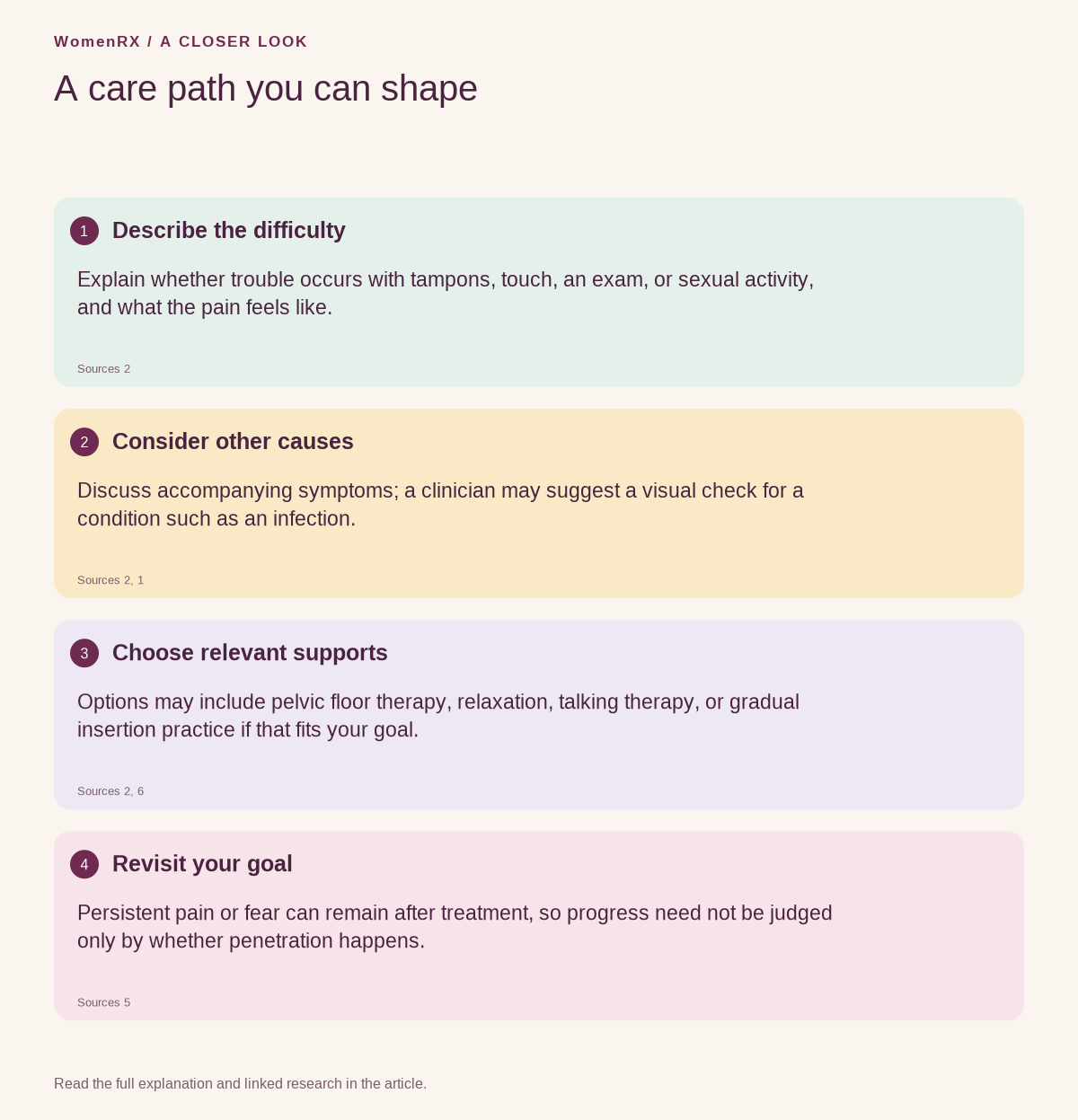
A care path you can shape
Describe the difficulty: Explain whether trouble occurs with tampons, touch, an exam, or sexual activity, and what the pain feels like.2
Consider other causes: Discuss accompanying symptoms; a clinician may suggest a visual check for a condition such as an infection.21
Choose relevant supports: Options may include pelvic floor therapy, relaxation, talking therapy, or gradual insertion practice if that fits your goal.26
Revisit your goal: Persistent pain or fear can remain after treatment, so progress need not be judged only by whether penetration happens.5
Read the figure as text
These are possible parts of care, not required steps or a test you must complete.- Describe the difficulty: Explain whether trouble occurs with tampons, touch, an exam, or sexual activity, and what the pain feels like.2
- Consider other causes: Discuss accompanying symptoms; a clinician may suggest a visual check for a condition such as an infection.21
- Choose relevant supports: Options may include pelvic floor therapy, relaxation, talking therapy, or gradual insertion practice if that fits your goal.26
- Revisit your goal: Persistent pain or fear can remain after treatment, so progress need not be judged only by whether penetration happens.5
More questions, answered
Can this happen if penetration used to be comfortable?
Yes. Vaginismus can develop even after previously painless penetrative sex. A new change is worth assessing rather than assuming the cause is the same as it would be for someone who has always had difficulty with insertion. 2
Do I need to want penetrative sex to get help?
No. Tightening can affect tampon use and cervical screening as well as sexual activity. You can seek help for the difficulty that matters to you without making penetrative sex your treatment goal. 2
Sources you can check
- Pelvic pain - NHSAccessed 2026-09-25Return to first citation
- Vaginismus - NHSAccessed 2026-09-25Return to first citation
- Period pain - NHSAccessed 2026-09-25Return to first citation
- No. 385-Indications for Pelvic Examination.Evans D, Goldstein S, Loewy A, Altman AD. · Journal of obstetrics and gynaecology Canada : JOGC = Journal d'obstetrique et gynecologie du Canada : JOGC · 2019Return to first citation
- Pelvic floor physical therapy for lifelong vaginismus: a retrospective chart review and interview study.Reissing ED, Armstrong HL, Allen C. · Journal of sex & marital therapy · 2013Return to first citation
- Pelvic floor physical therapy in the treatment of pelvic floor dysfunction in women.Wallace SL, Miller LD, Mishra K. · Current opinion in obstetrics & gynecology · 2019Return to first citation
- Effectiveness of Biofeedback with Dilator Therapy for Sexual Function in Women with Primary Vaginismus: Randomized Controlled Trial Study.Jokar F, Fani M, Isfahani NT, Sabahi R. · International urogynecology journal · 2025Return to first citation