Sex After Menopause: Telling Less Interest From Discomfort
Less interest, less pleasure, and vaginal discomfort can overlap. Telling them apart helps you identify which concern you want to address.
Desire can change after menopause, but hormones are rarely the only factor. Dryness or pain may make sex less appealing; sleep disruption, stress, relationship concerns, and pleasure can matter too. 1 4 6 If low interest bothers you despite comfortable sex, address it separately. Lubricants, moisturizers, and vaginal estrogen address vaginal symptoms; testosterone may be considered for some postmenopausal women with hypoactive sexual desire disorder (HSDD) after broader assessment. 1 2 6
First, name what feels different
“Low sex drive” can mean less interest in sex, but it can also be shorthand for sex becoming uncomfortable or less satisfying. Those experiences can overlap, but they aren’t interchangeable. Research reviews have treated desire, lubrication, and pain as separate parts of sexual health, which is a useful reminder not to assume that one symptom explains the others. 3
Pleasure is worth naming separately, too. You might want sex but find it less satisfying than it used to be. Dryness can occur when you are not aroused during sex, but it can have other causes. Pain or soreness is another concern to describe in its own right rather than treating it as a measure of desire. 1 3 4
Try putting your experience into plain words. For example: “I’m less interested even when sex feels comfortable,” “I want sex, but it feels less pleasurable,” or “I’m interested, but soreness makes sex uncomfortable.” These descriptions aren’t a diagnosis. They can help you and a clinician focus on the concern you want help with.
When vaginal changes are part of the picture
After menopause, lower estrogen can contribute to vaginal dryness and irritation. Less vaginal moisture can make intercourse uncomfortable or painful, which may change how appealing it feels. Dryness can also occur when you’re not aroused, or with some health conditions, so it doesn’t automatically explain every change in sexual desire. 1 2 6
If dryness is the main issue, a vaginal moisturizer or a water-based lubricant may help. A moisturizer is used to ease ongoing dryness; lubricant is used around sexual activity to reduce friction. If symptoms persist, a clinician can discuss vaginal estrogen, a local treatment for menopause-related vaginal dryness and irritation. 1 2 5
Be clear about what you hope treatment will change. Menopause guidance recommends vaginal estrogen for vaginal symptoms, not as a recommendation for low desire. If dryness improves but your interest in sex does not, that’s useful information, not a reason to dismiss the concern. 2 5
Bleeding after sex or any bleeding after menopause warrants medical attention. Persistent dryness, unusual discharge, or symptoms that interfere with daily life are also reasons to ask about care. 1
When interest itself feels different
If interest is what you miss, first consider whether sex is comfortable and pleasurable when it happens. If soreness or dryness makes it less appealing, addressing that symptom may be a useful goal in its own right. If sex feels comfortable but you still miss wanting it, low interest deserves attention separately from vaginal symptoms. 1 2 6
Menopause can be part of the picture without being the whole explanation. A menopause society’s clinical guide describes hormones as rarely the only factor in desire and arousal difficulties. It also notes that menopausal symptoms that disrupt sleep, along with relationship concerns, can matter. Research across women more broadly has examined low desire and related distress alongside daily stress, depression, relationship satisfaction, menopausal status, and sexual pleasure. These factors offer places to look, not a way to determine the cause of your own change from a list. 4 6
A testosterone blood level doesn’t settle the question either: the clinical guide reports that levels do not reliably predict desire or response to treatment. It distinguishes the gradual change in testosterone with age from the menopausal transition itself. That’s one reason a new change in desire calls for a broader conversation rather than an assumption that menopause caused a testosterone deficiency. 6
What you want to be different matters, too. You may want relief from discomfort, more interest even when sex is comfortable, or help with both. Naming those as separate goals keeps a vaginal treatment from standing in for a discussion about desire.
Match the next step to your goal
If dryness or irritation is making sex uncomfortable, options that ease those symptoms may fit your goal. If you’re comfortable but miss wanting sex, keep desire as the focus rather than expecting a vaginal treatment to answer that concern. If sex feels less pleasurable, describe that change separately; easing dryness may help comfort, but it may not address everything you miss about sex. If pain is the sticking point, discuss the discomfort in its own right, including whether dryness or irritation comes with it. 1 2 3
If several things have changed, bring up each one. For women without an indication for systemic hormone therapy, menopause guidance supports low-dose vaginal estrogen or other options for bothersome genitourinary symptoms when over-the-counter measures haven’t helped. That recommendation addresses vaginal symptoms. 5
For distressing low desire itself, the assessment is different. It can include comfort and pleasure, sleep, mood, relationship concerns, health changes, and whether a treatment changed around the same time. For some postmenopausal women with hypoactive sexual desire disorder, a trial of testosterone may be considered after other contributing factors are addressed. It isn’t a universal answer: a blood level does not predict who will benefit, and long-term safety remains uncertain. The clinical guide describing this option is Australian, so it should not be read as guidance on which products are available in the US. 4 6
If low interest persists and bothers you, you can ask for a visit focused on desire rather than folding it into a conversation about dryness alone. Explain what you miss, whether sex is comfortable, and what else changed around the same time. More comfortable sex is a worthwhile goal even when desire needs its own attention. 4 6
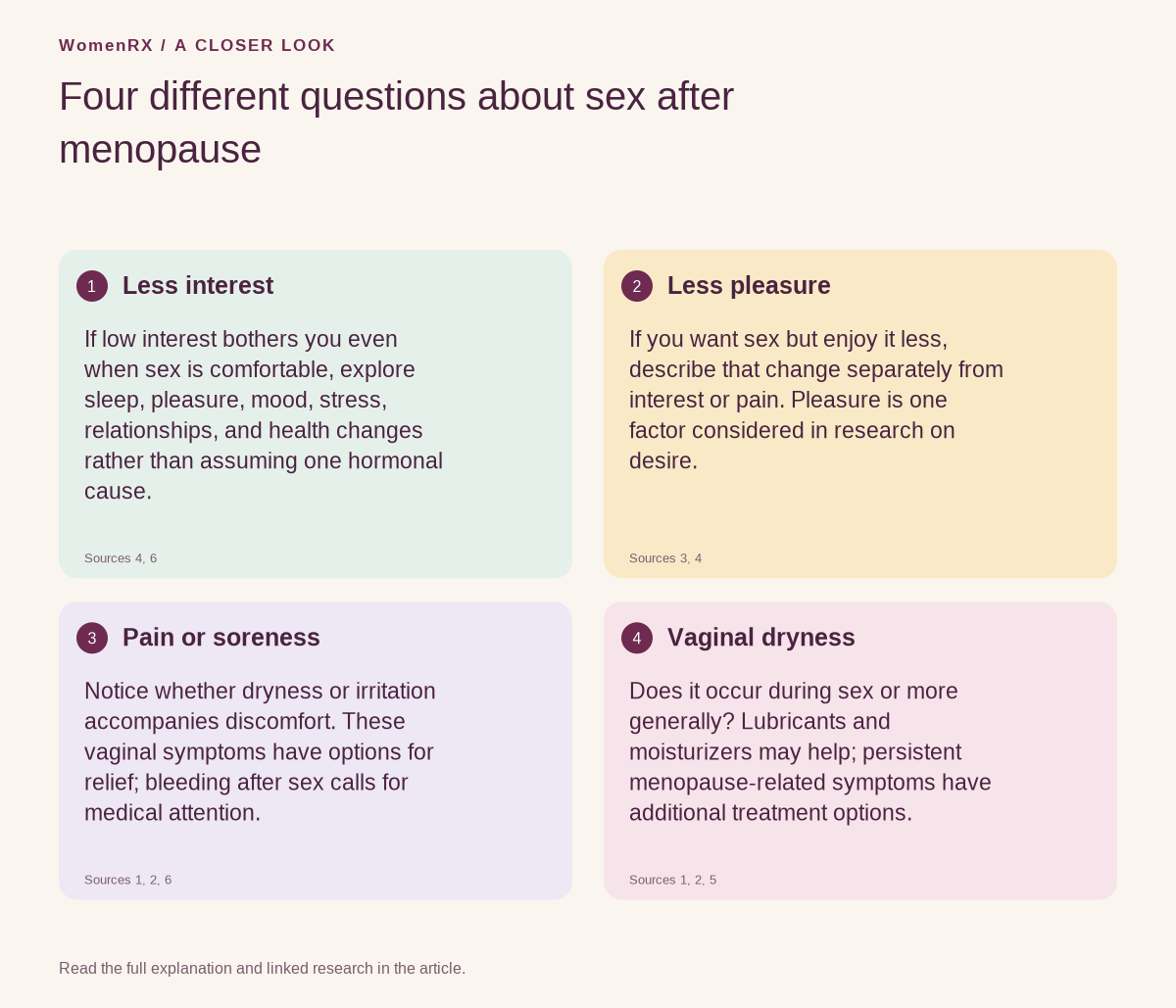
Four different questions about sex after menopause
Less interest: If low interest bothers you even when sex is comfortable, explore sleep, pleasure, mood, stress, relationships, and health changes rather than assuming one hormonal cause.46
Less pleasure: If you want sex but enjoy it less, describe that change separately from interest or pain. Pleasure is one factor considered in research on desire.34
Pain or soreness: Notice whether dryness or irritation accompanies discomfort. These vaginal symptoms have options for relief; bleeding after sex calls for medical attention.126
Vaginal dryness: Does it occur during sex or more generally? Lubricants and moisturizers may help; persistent menopause-related symptoms have additional treatment options.125
Read the figure as text
Start with the part of your experience that has changed. These distinctions are conversation starters, not diagnostic categories.- Less interest: If low interest bothers you even when sex is comfortable, explore sleep, pleasure, mood, stress, relationships, and health changes rather than assuming one hormonal cause.46
- Less pleasure: If you want sex but enjoy it less, describe that change separately from interest or pain. Pleasure is one factor considered in research on desire.34
- Pain or soreness: Notice whether dryness or irritation accompanies discomfort. These vaginal symptoms have options for relief; bleeding after sex calls for medical attention.126
- Vaginal dryness: Does it occur during sex or more generally? Lubricants and moisturizers may help; persistent menopause-related symptoms have additional treatment options.125
More questions, answered
Will vaginal estrogen bring back sexual desire?
Vaginal estrogen is used for menopause-related vaginal dryness and irritation. The menopause guidance cited here recommends it for vaginal symptoms, not as a treatment recommendation for low desire. If desire remains a concern, name it as a separate goal. 2 5
Does less desire after menopause mean something is wrong?
Not by itself. Low desire and distress about low desire are different concerns. If the change bothers you, support can focus on what has changed for you. Persistent dryness or discomfort deserves attention too, and bleeding after sex or after menopause should be assessed. 1 4 6
Sources you can check
- Vaginal dryness - NHSAccessed 2026-09-25Return to first citation
- About vaginal oestrogen - NHSAccessed 2026-09-25Return to first citation
- Conceptual Frameworks Linking Sexual Health to Physical, Mental, and Interpersonal Well-Being: A Comprehensive Systematic Review and Meta-Analysis.Pollard AE, Cero I, Rogge RD. · Behavioral sciences (Basel, Switzerland) · 2025Return to first citation
- Incidence and Predictors of Low Sexual Desire and Hypoactive Sexual Desire Disorder in Women: A Systematic Review and Meta-Analysis.Tetik S, Yalçınkaya Alkar Ö. · Journal of sex & marital therapy · 2023Return to first citation
- The 2022 hormone therapy position statement of The North American Menopause Society.“The 2022 Hormone Therapy Position Statement of The North American Menopause Society” Advisory Panel. · Menopause (New York, N.Y.) · 2022Return to first citation
- Australasian Menopause Society: Sexual difficulties in the menopause (2021)Accessed 2026-09-26Return to first citation